
BJP Faces Criticism for Anti-Muslim Rhetoric
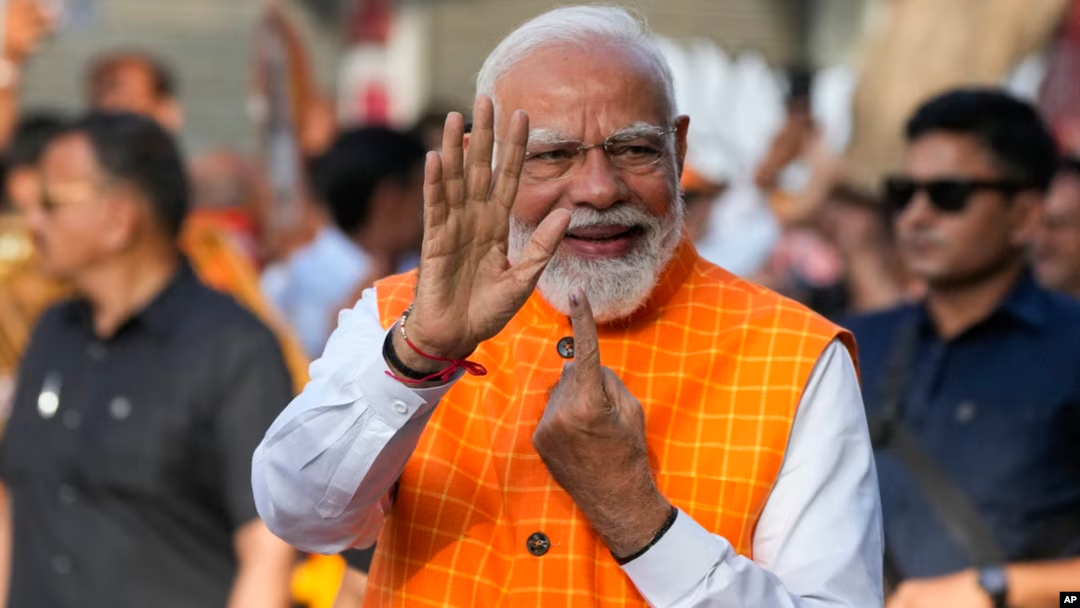
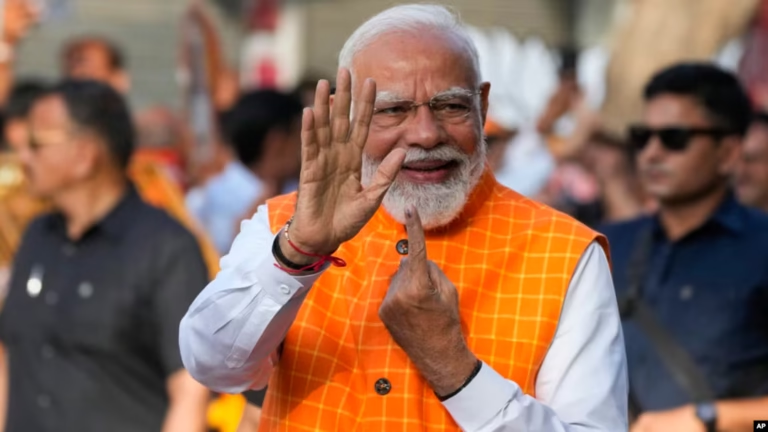
India’s ruling Bharatiya Janata Party is once again under fire for rhetoric that critics say treats Muslims not as equal citizens, but as a political instrument. The outrage is not about one stray speech or one overheated slogan. It is about a pattern that has become disturbingly familiar under Narendra Modi’s political era: sharpen communal anxieties, cast Muslims as suspects, and then harvest the polarization at the ballot box. Human Rights Watch said Modi’s 2024 campaign “frequently used hate speech against Muslims and other minorities,” while arguing that BJP leaders repeatedly made statements that incited discrimination and hostility. That is not ordinary democratic competition. It is a majoritarian mobilization dressed up as an electoral strategy.
The most troubling part is how routine this has all become. India’s political discourse now regularly absorbs language that would once have triggered national shock. A Reuters report in January, citing India Hate Lab, said anti-minority hate speech in India rose 13% in 2025, with 1,318 documented incidents, and that most occurred in states governed by the BJP or its allies. The Indian government has dismissed such reports as biased, and that should be noted. But the larger problem remains: when inflammatory language becomes constant background noise, society stops reacting to it with the seriousness it deserves.
Normalization is how prejudice graduates from the fringe into governance
Assam offers a vivid illustration of this style of politics. As campaigning intensified ahead of the April 9, 2026, state election, senior BJP leaders again leaned on identity-charged language around Muslims, migration, and belonging. Amit Shah said the BJP was “against infiltrators, not against indigenous Muslims in Assam,” a phrase that may sound calibrated, but still divides one religious community into politically acceptable and politically disposable categories. That is not the language of equal citizenship; it is the language of sorting, suspicion, and selective legitimacy. Once a ruling party starts deciding which Muslims are tolerable and which are a threat, it moves from representing the nation to policing who counts as fully part of it.
This is why the defense often offered by BJP supporters, that the party is merely talking about illegal immigration or security, rings hollow to many observers. In a country with India’s history, politicians know exactly what kind of emotional reaction words like “infiltrator,” “demographic shift,” and “bulldozer justice” are meant to trigger. These are not neutral administrative terms. They are political signals. They turn a minority into a threat narrative. They invite the majority to imagine themselves under siege.
And they allow leaders to convert economic frustration, governance failures, and regional anxieties into communal resentment. That is effective politics, perhaps, but it is corrosive nation-building
Yogi Adityanath embodies this politics in especially blunt form. His record is not a matter of speculation. Reuters reported in 2019 that India’s Election Commission temporarily banned him from campaigning after anti-Muslim comments during a national election. That episode mattered because it confirmed something many critics had long argued: communal provocation was not a bug in the BJP ecosystem; it was part of the operating model. Adityanath’s brand of politics does not merely reflect ideological hardline instincts. It demonstrates how openly sectarian messaging can be rewarded rather than punished in today’s electoral climate. When such figures remain central to the BJP’s wider appeal, criticism of the party’s rhetoric is not partisan overreaction; it is democratic self-defense.
The human cost of this politics is far greater than hurt sentiment or ugly speeches. Rights groups have documented a broader environment in which hate speech, mob violence, discriminatory policing, and punitive demolitions disproportionately affect Muslims and other minorities. Human Rights Watch’s 2025 and 2026 assessments of India said authorities continued to discriminate against minority communities, failed to act adequately against BJP supporters involved in attacks, and, in some cases, targeted victims themselves through unlawful demolitions and expulsions. Even where direct causation is hard to establish in every case, the political atmosphere matters.
When leaders repeatedly portray a minority as dangerous, disloyal, or alien, they lower the moral barrier against mistreatment
What is being damaged here is bigger than Muslim safety alone. India’s constitutional promise rests on pluralism: the idea that a deeply diverse society can still share one democratic home without ranking citizenship by faith. Hindutva, in its militant political form, strains that promise by redefining the nation in civilizational Hindu terms and treating minorities as guests who must prove loyalty rather than citizens entitled to dignity. Once that logic settles in, democracy itself becomes thinner. Elections still happen, parties still campaign, institutions still stand, but the moral core of the republic is hollowed out. A democracy cannot stay healthy when one community is repeatedly cast as the convenient villain in the majority’s political story.
The BJP may calculate that this rhetoric works because it consolidates support, sharpens identity, and distracts from harder questions of jobs, inequality, and governance. In the short term, that calculation may be right. Polarization is powerful because it is simple. It tells voters who to fear before it tells them what to build. But nations pay heavily when politicians keep choosing division over citizenship. India does not become stronger when Muslims are demonized at election time. It becomes smaller, meaner, and less sure of its own democratic ideals. The criticism facing the BJP is therefore not just deserved; it is necessary. Silence in the face of communal politics would not be neutrality.

