
Pakistan’s accountability theatre and the Fazlur Rehman case
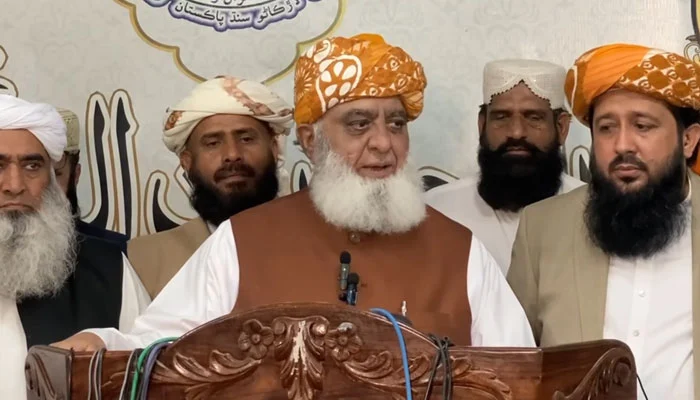
Maulana Fazlur Rehman has spent so long in the center of Pakistan’s power games that many people no longer see him as just a party leader. They see him as a symbol of a system that keeps recycling the same faces, the same bargains, and the same excuses. His supporters call him a seasoned parliamentarian and a religious leader with street strength. His critics call him a master of backroom deals who knows how to cash political weight into material comfort. The truth probably sits between those two extremes, but the real problem is that he rarely faces the kind of public scrutiny that could settle the argument with facts instead of noise.
The asset allegations around him matter because they are detailed, repetitive, and emotionally believable in a country where public office often becomes a private ladder. People talk about two houses and a plot in Dera Ismail Khan, a bungalow in Islamabad’s F 8, and flats and shops in multiple cities, including Peshawar, Karachi, and Quetta. They also talk about a house with fifteen acres in Pan Lala, another house with a madrasa and fifteen acres of agricultural land in Abdul Khel, and a similar combination in Shorkot. Then comes the foreign angle, a flat in Dubai, which always lands hard in the public mind because it suggests not only wealth but also an exit option.
Even if some of this is overstated, the shape of the story is familiar: land at home, real estate in the capital, commercial units in big markets, and something abroad
The part that turns ordinary suspicion into anger is the claim that the most valuable deals happen through proxies. The story says that land in Chak Shahzad, Islamabad, worth around thirteen billion was bought through a close confidant, named as former secretary Ghulam Ali, and his son Fayyaz Ali, described as Maulana’s son-in-law, then later sold for a large gain. Whether the number is exactly right or not, the method is what people recognize. In Pakistan, the public has learned to assume that the name on paper is not always the real owner, and that the person with political access rarely appears directly in the transaction. That is why the proxy story spreads faster than any speech could stop it.
The allegations around land allotments add another layer, because they are not just about private buying and selling; they are about public resources. One set of claims says that in 2006, four thousand kanals of agricultural land were allotted in Khuzdarani, Dera Ismail Khan, and that the contract was cancelled in 2007 after action was taken. Another claim says that in the same era, twelve hundred kanals were allotted to Captain Colonel Sher Khan Shaheed, Dera Ismail Khan, and that due to an accountability inquiry, the land ended up in the custody of the Agriculture Department. A third claim says that in 2011, six hundred kanals were allotted from the Forest Department in the name of a farm, with a price story that sounds shocking on purpose, one kanal allegedly bought for Rs 375 against an original price of Rs 45,000, and that after an inquiry from 2012 to 2014, the land was taken back.
These details may be disputed, but they point to a core fear: that influence can bend the state, and that the state only corrects itself when the spotlight becomes too hot
Now connect this to his political behavior, and you begin to see why the accusations never fully die. His opponents accuse him of being flexible in principle and firm only in negotiation. They point to his stance in the early 2000s around Musharraf-era arrangements and say he offered unconditional support when it suited him. They point to claims about government land in Dera Ismail Khan being given in his name in 2005 and treat it as proof that he benefited while preaching morality. They point to coalition politics, such as bargaining with the PPP-era government, and argue that ministries and permits became part of the trade, not a byproduct of policy alignment. Again, even when specific claims are not legally settled, the pattern is what fuels the narrative: a leader who can turn political pressure into political reward.
The hardest truth for his supporters to accept is that religious identity is no longer a shield. Many voters still respect madrasas, clerics, and the language of faith, but they are less willing to grant automatic trust. When allegations include houses and land tied to madrasa sites, it creates a special kind of discomfort. People start asking whether religious institutions are being used as community service, as private holdings, or as both at once.
They may have no proof, but they have a lived experience of how mixing piety and power often ends, with the faithful paying the cost while leaders keep the benefits
At the same time, his critics often weaken their own case by using accountability as a weapon rather than a principle. They demand inquiries when he is in opposition, then go quiet when they need him for numbers. That hypocrisy is one reason Pakistan’s accountability story feels like a loop with no end. The public is not blind. They see selective outrage. They also see that institutions like NAB can become tools of pressure, and that pressure rises and falls with politics, not with evidence. This does not clear anyone. It just explains why trust is broken.
If Maulana Fazlur Rehman wants to break this cycle, he cannot rely on sermons or rallies. He has to respond like a public office holder in a modern state. That means clear asset declarations that ordinary people can understand, with timelines, purchase prices, sources of funds, and ownership structures for himself and close family. If some properties are not his, he should say exactly whose they are, how they were acquired, and why his name keeps appearing in the story. If land allotments were cancelled, reclaimed, or investigated, he should show the paperwork and explain his link, or lack of link, to the process. A calm, documented reply would do more for his credibility than ten angry speeches.
Pakistan does not need perfect leaders. It needs leaders who accept that power requires proof, not just posture. If he continues to treat every question as a conspiracy, then he is choosing the politics of fog, and fog always benefits the person with the strongest network. If he chooses transparency, he risks short-term embarrassment, but he gains something rare in Pakistani politics: the chance to be judged on facts. Right now, he is being judged on suspicion, and suspicion grows in silence.

