

Pakistan’s Mediation Is Prudence, Not Weakness
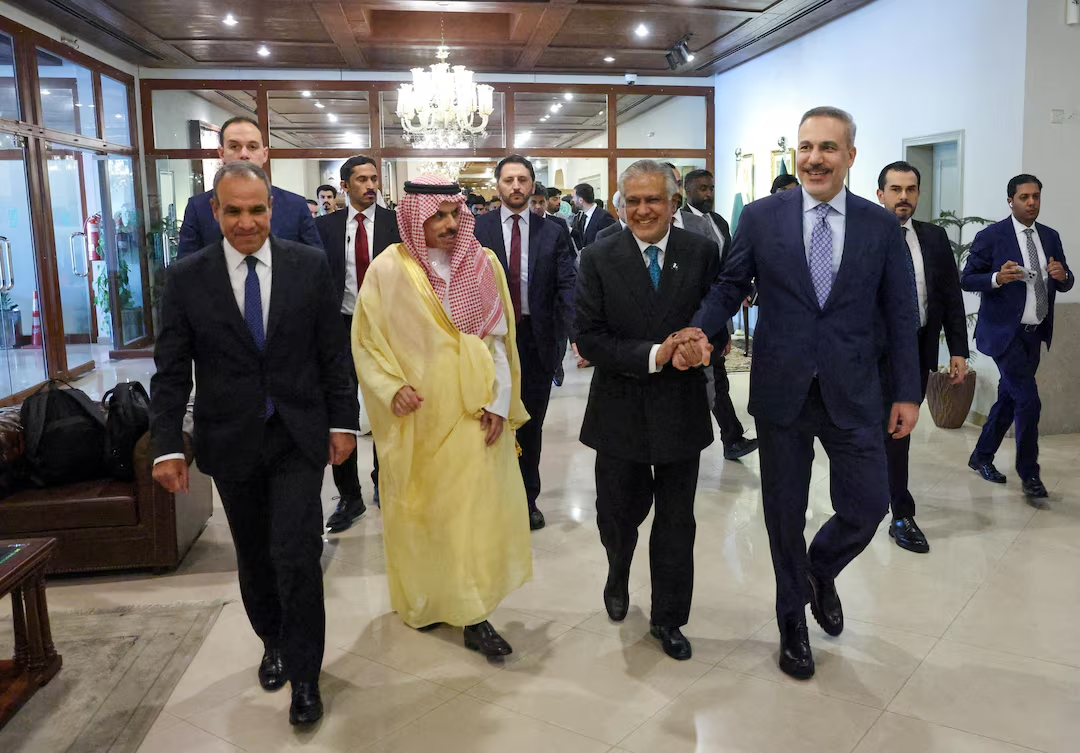
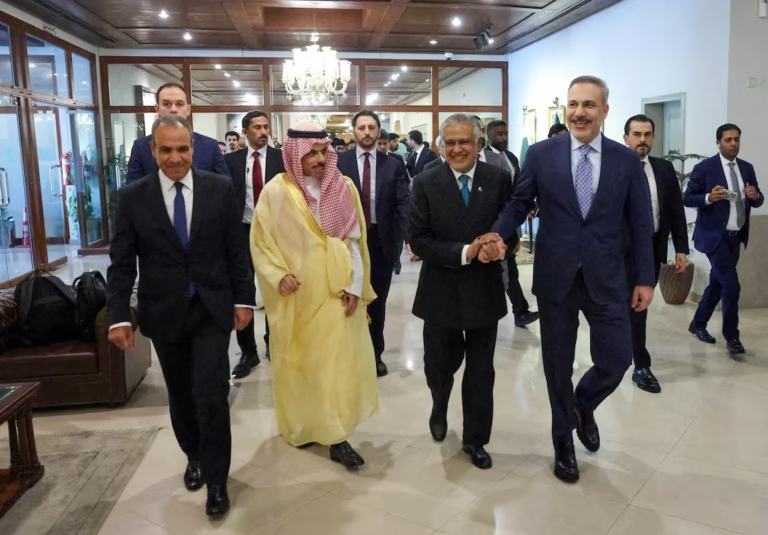
The criticism being directed at Pakistan for trying to mediate in the US-Israel-Iran conflict says more about the critics than it does about Pakistan. It reflects a deeply flawed belief that friendship must always mean alignment, and that partnership must always mean taking the same side in every crisis. That is not how serious states conduct foreign policy. Pakistan is not a camp follower. It is a sovereign country with its own strategic geography, its own security burdens and its own hard-earned understanding of what prolonged regional conflict can do to nations that happen to lie too close to the fire. When Pakistan argues for de-escalation, it is not evading responsibility. It is acting from a clear sense of responsibility to its own people and to a region that has already seen too much destruction.
Pakistan’s mediatory role is rooted in one simple reality: it has far more to lose from a widening war than many of those offering commentary from a distance. Pakistan sits at the junction of South Asia, Central Asia and the Middle East. Any large-scale regional conflict sends shock waves straight through its economy, security environment and domestic social fabric. Higher oil prices, disrupted trade routes, militant spillover, sectarian agitation, refugee pressures and strategic uncertainty are not abstract possibilities for Pakistan; they are familiar consequences.
Pakistan has paid for other people’s wars before, and paid heavily. It has no reason to romanticise escalation. It has every reason to prevent it
That is why mediation should be understood as a sign of diplomatic seriousness. It is easy to shout slogans in moments of war. It is harder to speak to all sides, preserve channels of communication and push for an off-ramp when emotions are high and rhetoric is reckless. Pakistan is attempting the harder task. It is using whatever credibility and access it has with multiple actors not to shield anyone from accountability, but to stop a crisis from turning into a regional inferno. That is not neutrality born of fear. It is diplomacy shaped by realism. States that still retain the ability to talk across fault lines perform a stabilising role, especially when the region is sliding toward absolutist positions that leave no room for a political endgame.
Some voices in the Gulf, particularly in circles that appear to view Pakistan through a purely transactional lens, seem to expect Islamabad to behave as though it were bound to support a bloc position automatically. That expectation is misguided. Pakistan values its relationship with the UAE and with other Arab partners. Those ties are deep, longstanding and important. They rest on trade, investment, historical goodwill and the immense contribution of the Pakistani diaspora. But friendship does not erase sovereignty. There is no formal military alliance that obliges Pakistan to join or endorse every confrontation in which another partner is involved.
Respectable partnerships are built on mutual regard for each other’s interests, not on demands for automatic strategic obedience
That point becomes even more important when viewed through the lens of reciprocity. During the Indian aggression against Pakistan in May 2025, the UAE did not take the kind of public position that many in Pakistan might have considered appropriate. It acted according to its own calculation of national interest. That was its right. No serious Pakistani should deny that. But if the UAE was entitled to make a cool, interest-based decision in a South Asian conflict, then Pakistan is equally entitled to make a cool, interest-based decision in a Middle Eastern one. It cannot be that one state’s restraint is called pragmatism while another state’s restraint is called disloyalty. International politics does not work on such selective morality.
More importantly, those criticising Pakistan have yet to answer the most basic strategic questions. What exactly is the end-state they seek? If the assumption is that Iran must be broken further through wider regional participation, then one must ask: to what end? Iran has already suffered grave military punishment. Senior political and military leadership has been hit. Strategic capabilities and infrastructure have been degraded. Key installations and state assets have been targeted. If that has not yet produced capitulation, what additional regional participation is supposed to achieve? Is the expectation that smaller regional actors can impose what overwhelming force has not yet secured?
Do critics imagine that opening more fronts automatically produces a cleaner outcome? History offers no such comfort
And then comes the central issue that war enthusiasts always postpone: war termination. How is this conflict supposed to end? What will the Middle East look like when the guns fall silent? Does anyone seriously believe that a country of around 90 million people can simply be bombed into political irrelevance without generating a long period of chaos, revenge and instability? Does anyone believe land invasion is feasible, sustainable or wise? If the answer to these questions is vague, then calls for broader military alignment are not strategy. They are impulse masquerading as resolve. A war without a coherent termination plan is not strength. It is strategic carelessness.
Pakistan’s caution here is informed by experience, not sentimentality. Pakistan has fought wars. It knows that battlefield success means little if the political settlement is incoherent. It knows that humiliation of the defeated often plants the seeds of future conflict. The lesson is old but enduring: peace cannot be built on permanent vengeance. The vanquished may be weakened, but if they are denied all dignity and all space for reintegration into a workable regional order, then today’s triumph becomes tomorrow’s crisis.
Anyone who cares about durable stability in the Gulf should be thinking not only about punishing Iran, but about shaping a post-war regional architecture that does not condemn everyone to another decade of fear and proxy confrontation
There is also a larger geopolitical truth that the region ignores at its peril. The United States can shift focus. Great powers often do. They enter, strike, recalibrate and move on to the next theatre when priorities change. But the states of this region do not have that luxury. Arabs, Persians, Turks and Pakistanis will remain in the same neighbourhood. They will still share the same sea lanes, security anxieties, energy routes and political shocks. If regional actors allow themselves to be dragged into a cycle of mutual exhaustion, they will be left to manage the wreckage long after external powers have turned their attention elsewhere. That is precisely why prudence matters now more than passion.
Pakistan, therefore, is not standing apart from the region. It is standing up for the region’s long-term interest. Its position is not emotional. It is strategic. It is asking the one question that truly matters: after all this destruction, what kind of peace is still possible? That is not a sign of weakness. It is the mark of a state that understands war and refuses to worship it. Pakistan is not choosing Iran. It is not choosing America. It is not choosing Israel over the Arab world or the Arab world over anyone else. It is choosing stability over ruin, settlement over fantasy and the hard discipline of diplomacy over the easy vanity of taking sides.

