
When Scholars Step Back and Streets Turn Violent
The past few weeks have brought into sharp focus a truth that Pakistan’s political class has long tried to avoid confronting: the era of manufactured street power is quietly ending. From the troubled hills of Azad Jammu and Kashmir to the corridors of Balochistan’s seminaries, and from the alliance chambers of Makkah to the frost bitten borders of Poland, a new, harder reality is asserting itself, one where posturing costs more than it delivers.
The AJK Crisis: When Protests Turn Predatory
AJK police have accused the proscribed Joint Awami Action Committee of operating under a specific agenda aimed at destabilising the region, while also alleging that sophisticated weapons were seized from arrested suspects. This is not the language of a routine protest movement, this is the vocabulary of organized subversion. According to AJK police, 26 personnel have been martyred this year during incidents of unrest, directly attributable to operatives of the proscribed JAAC targeting law enforcement.
What began ostensibly as a civic grievance movement, over electricity tariffs and administrative representation, has increasingly shown a face that the public in AJK recognizes but cannot always name openly. The government has stated that most of JAAC’s demands, including the Rs3/unit electricity tariff, had already been met, making the continuation of protests over assembly seat allocations difficult to justify on purely civic grounds. When legitimate demands are met and violence still escalates, the question stops being about electricity and starts being about something far more dangerous. Armed elements hiding behind civilian grievances are not protesters, they are terrorists exploiting genuine hardship for destabilizing ends. The state has not only the right but the obligation to respond firmly, and the clashes in Plandri and Rawalakot have made that obligation impossible to ignore any longer.
Fazlur Rehman’s Diminishing Street Capital
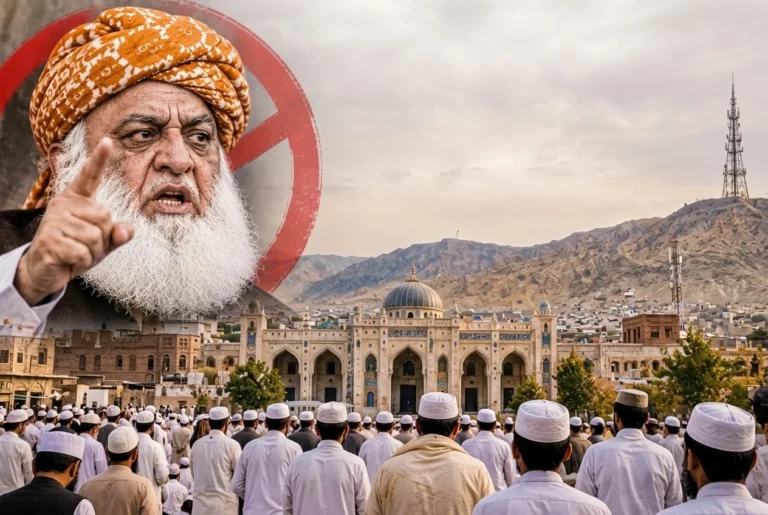
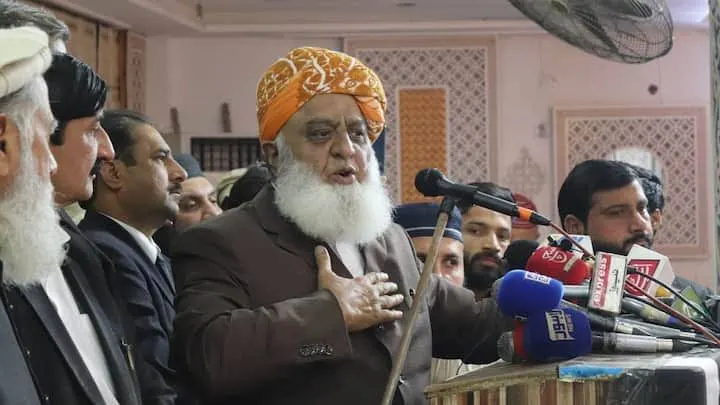
Across the country, another kind of reckoning is quietly underway. Maulana Fazlur Rehman has long built his political architecture on a single pillar: the seminary network. The assumption has always been that the madaris of Pakistan, particularly in Balochistan and KP, are his to mobilize, his to command. That assumption is now being tested in ways that must be making him deeply uncomfortable.
Over 100 religious scholars in Balochistan have reportedly refused to dispatch their students to political protests or anti establishment campaigns. This is not a small rupture, it is a structural one. The scholars are not defecting to a rival political force; they are simply withdrawing. And withdrawal, in politics, is often more damaging than outright opposition. It signals that the ulema of Balochistan no longer see their interests aligned with Maulana Fazlur Rehman’s ambitions. Senior religious scholars in Balochistan have instead been reaffirming their readiness to shoulder responsibility for restoring peace and stability in the province, warning that hostile elements exploit local grievances. This is a posture of institutional responsibility, not street agitation.
For a politician whose entire leverage rests on the threat of mobilization, being told by his own base that “we won’t march” is a seismic blow. It suggests that the religious scholarly class in Balochistan has read the room differently from Maulana Fazlur Rehman, they see that confrontation with the state offers them nothing but exposure, and that their communities are better served by stability than by theatre.
The Makkah Pact: Real Architecture, Real Ambiguity
Meanwhile, on the geopolitical stage, the Makkah Defence Pact, signed in August by Saudi Arabia, Turkey, and Pakistan, is producing its own complex dynamics. Turkish lawmakers ratified the defence cooperation agreement in early November as Riyadh sought increased regional support in its conflict with Iran backed Houthi rebels in Yemen. The pact, built on the principle that an attack on one member is an attack on all, represents something genuinely new in Muslim majority geopolitics: a formal trilateral defence framework with serious military weight behind it. The three members of the alliance combined have nearly 1.4 million active troops, approximately 3,400 military aircraft, 6,000 tanks, and more than 340 naval assets according to the 2026 Global Firepower Index.
But the gap between principle and action is already visible. Turkey’s Defence Minister Yasar Guler stated clearly that Turkey does not expect its troops to engage in direct combat with the Houthis under the pact. Turkish officials indicated that Turkey’s role would instead involve joint planning, military training, and intelligence sharing as Riyadh confronts renewed pressure from recent Houthi advances in Yemen. This is the honest arithmetic of alliance politics: collective defence commitments are easier to sign than to honour when the conflict involves a non state actor with deep Iranian backing and an asymmetric warfare doctrine. Turkey is contributing, but it is calibrating. That calibration is rational, but it also exposes the pact’s current limits as a deterrent instrument against the Houthi threat specifically.
For Pakistan, the pact matters enormously beyond Yemen. It signals a broadening of strategic partnerships outside the traditional US China binary, a triangular Muslim defence architecture that elevates Pakistan’s standing while also committing it to obligations that will grow heavier as the regional situation evolves.
NATO’s Fault Line: The View from Warsaw
Thousands of kilometres away, another alliance is showing its cracks. Russia’s repeated missile and drone incursions into Polish territory have put Warsaw on a collision course with its NATO partners over how the alliance should respond, with Poland accusing Moscow of intentional provocation while the bar for triggering NATO’s collective defence clause remains high.
When US President Donald Trump suggested that Russian drones that violated Polish airspace may have done so unintentionally, Poland’s top diplomat rejected the claim directly, saying “No, that wasn’t a mistake,” while analysts described Trump’s unwillingness to confront Moscow as a potential “fatal weakness” for NATO. This disagreement is more than a diplomatic spat, it is a structural fault line. An alliance whose most powerful member and its most threatened frontline member cannot agree on whether an incursion was deliberate is an alliance operating with a dangerously ambiguous deterrence posture.
The lesson for regional observers is plain: even the world’s most powerful military alliance can be paralyzed by political divergence at its top. This is precisely why frameworks like the Makkah Pact matter, not as replacements for broader global security architecture, but as regional insurance against the volatility of great power politics.
What All This Tells Us
Taken together, these developments paint a coherent picture. Street power without genuine public mandate is hollow, and the JAAC’s descent into violence, combined with the Balochistan ulema’s quiet withdrawal from Fazlur Rehman’s orbit, confirms that the Pakistani public has less patience than ever for movements that trade in grievance but deliver chaos. The state’s responsibility is to meet legitimate demands swiftly while maintaining the writ of law firmly against those who would exploit crisis for violent ends.
Globally, alliances are being stress tested. The Makkah Pact is young but real. NATO is old but increasingly strained. The world is reorganizing, and Pakistan, for once, finds itself at the intersection of that reorganization in a way that offers genuine strategic opportunity, if its internal house can be kept in order.

