



Karak’s Burning Ambulance
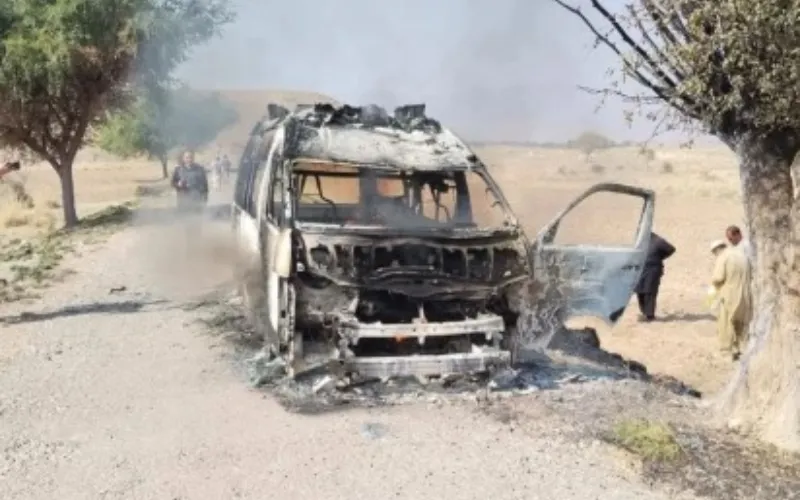
On February 23, 2026, a quadcopter assault targeted a Federal Constabulary installation in Qila Shaheedan, Karak. Rescue 1122 ambulances performed what ambulances typically do in the immediate aftermath of a bomb, when smoke and shock lingered in the air. They headed toward danger because others were bleeding and needed assistance. That is the fundamental social compact in a crisis: those trained to save lives react, while the rest of us hope they reach on time. What occurred next ruptured the contract in the most horrific manner.
Two ambulances arrived to transport the wounded. They were assaulted while on their way to the hospital. One ambulance was set on fire with injured people inside. The second car fled. This was not collateral harm. This was not an error committed in the midst of war. It was a planned attack on a clearly humanitarian operation, on persons whose only purpose was to transport the injured to treatment.
When a gang decides to destroy an ambulance, it sends a message that there are no boundaries, rules, or restraints
The atrocity is compounded by the fact that it occurred during Ramadan, a month dedicated to teaching self-control, kindness, and responsibility before God. In Islam, it is forbidden to injure the wounded. Even during conflict, there remain limits. The wounded are not targets; the defenseless are not prizes, and those attempting to rescue lives are not warriors. Anyone who claims religion while doing such an act is not just breaching a guideline; they are ripping apart the moral core that faith requires. You can’t recite piety while turning an ambulance into a furnace.
This is why the label matters. The Khawarij are marked not only by revolt, but also by their twisted moral logic: they pronounce others worthless while allowing themselves to do what God forbids. Burning wounded folks stuck in a medical van is a barbaric act, not a political statement. It depicts moral degradation to the point that cruelty is a technique rather than an accident. It demonstrates a lack of human conscience, the type of emptiness that views suffering as amusement and death as evidence of control.
The terrible choice to video the act and share it on social media demonstrates still another level of depravity. Recording pain is not new in contemporary militancy, but it will never become normal. It is humiliation-based propaganda intended to terrify communities and attract the unstable by giving them a feeling of power.
When a group prepares violence for the camera, it is indicating that it is more interested in the spectacle than the result. It wants dread to move quicker than ambulances
Some may attempt to make this more appealing by using cause and resistance slogans. Do not accept it. The goal here is power by slaughter, force, and intimidation, not a worthy cause. Whatever one believes, a genuine cause respects boundaries and differentiates between warriors and medics, a post and a patient. Targeting ambulances is an acknowledgment that the gang cannot acquire allegiance; it attempts to stay quiet. It cannot convince, therefore it frightens. It can’t build, therefore it burns.
There is also a painful fact that Khyber Pakhtunkhwa residents are all too familiar with: these assaults often target local Pashtuns, the same populations that the Khawarij profess to represent or protect. They reveal their deception by focusing on local residents. They harm innocent populations for selfish reasons, then hide behind religious discourse to avoid moral criticism. The reality on the ground is much simpler.
Their victims are sons, brothers, and dads from the same land they exploit. Their violence isn’t emancipation; it’s predation
An attack on an ambulance is more than just an assault on the wounded. It is an attack on all future emergency responses. It warns rescuers that their uniforms and sirens will not keep them safe. It warns families that seeking assistance may result in additional damage. Over time, this terror may immobilize whole districts. It has the potential to delay rescues, reduce staffing, and force medical personnel to quit. That is precisely why such organizations do it. They want the state to seem impotent, and society to feel isolated.
The answer must be forceful and principled. Condemnation is required, but not sufficient. Communities need safety for first responders, improved anti-drone measures, and clear legal implications for those who facilitate such assaults. Religious experts and community leaders should speak with one voice, emphasizing that injuring the injured is haram regardless of the cause, and that recording brutality is a sign of a diseased heart, not courage. And as members of the public, we must refuse to share their film, repeat their framing, and allow their brutality to hijack our moral vocabulary.
What occurred in Karak was a test. It wonders whether we shall see ambulances as hallowed places of kindness or as open targets for radicals. The solution should be apparent. The burning ambulance is more than simply a ruined vehicle; it is a mark on our collective consciousness. The best way to commemorate the injured and rescuers is to speak out against the Khawarij attitude, to defend those who save lives, and to declare that Ramadan and basic humanity cannot be insulted by persons who worship terror.

