
The Taliban’s Rule Is Not Sharia
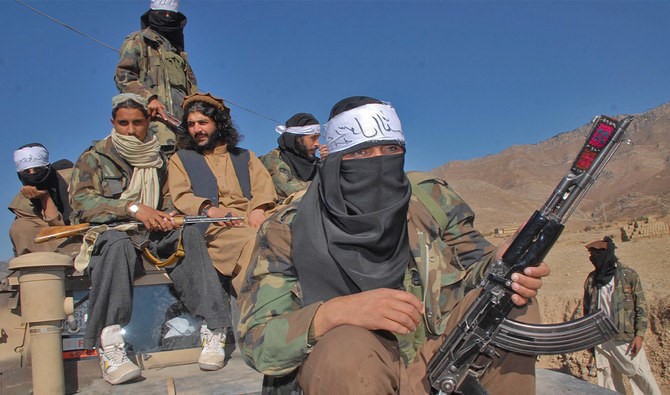
The Taliban presents its rule in Afghanistan as the pure application of Sharia, a government guided by religion, moral order, and justice. That claim falls apart when examined closely. What exists in Afghanistan today is not a principled Islamic system rooted in consultation, accountability, and public welfare. It is a coercive, authoritarian monarchy centered around Sheikh Hibatullah Akhundzada, a single unelected man whose word stands above institutions, above public debate, and in practice above the people themselves. The Taliban may use the language of Islam, but language alone does not make a system Islamic. A government that rules through fear, secrecy, and personal command cannot hide behind sacred terms forever.
A real Sharia-based order is not simply a state that punishes, censors, and controls. In the classical Islamic tradition, governance carries duties as well as powers. Justice is not a slogan. It requires due process, consultation, restraint, and a serious concern for the rights and dignity of the community. Even where Islamic jurists disagreed, they did not reduce government to the unchecked will of one ruler surrounded by loyal enforcers. Yet that is exactly what Afghanistan has become.
Power flows downward from the supreme leader in Kandahar, not upward from any meaningful public mandate, not through transparent institutions, and not through an open process of scholarly reasoning that Afghans can examine or challenge
The central fact of Taliban rule is personal dominance. Sheikh Hibatullah is not merely a symbolic figure or a distant cleric offering moral guidance. He is the core of the system. Major state decisions, especially on social policy, education, and the role of women, reflect his authority in a way that leaves little room for broader consultation. Ministers, judges, provincial officials, and commanders operate within a structure where loyalty matters more than public accountability. This is why calling the Taliban a form of monarchy is not rhetorical excess. It describes the concentration of authority in one man, treated as the final source of command, with no election, no credible institutional balance, and no avenue for ordinary citizens to shape the rules that govern their lives.
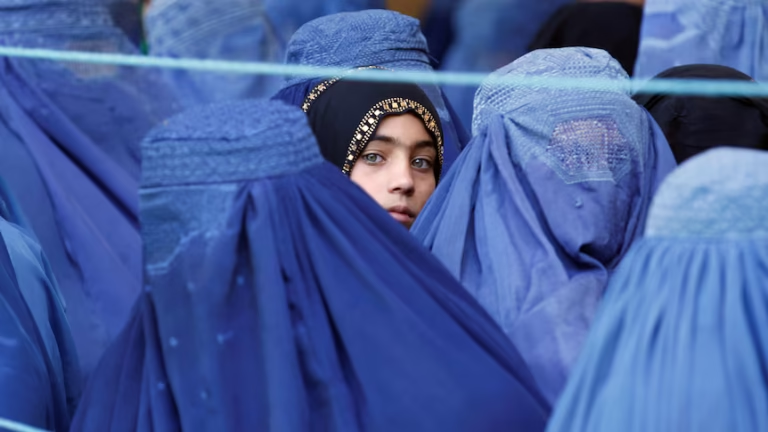
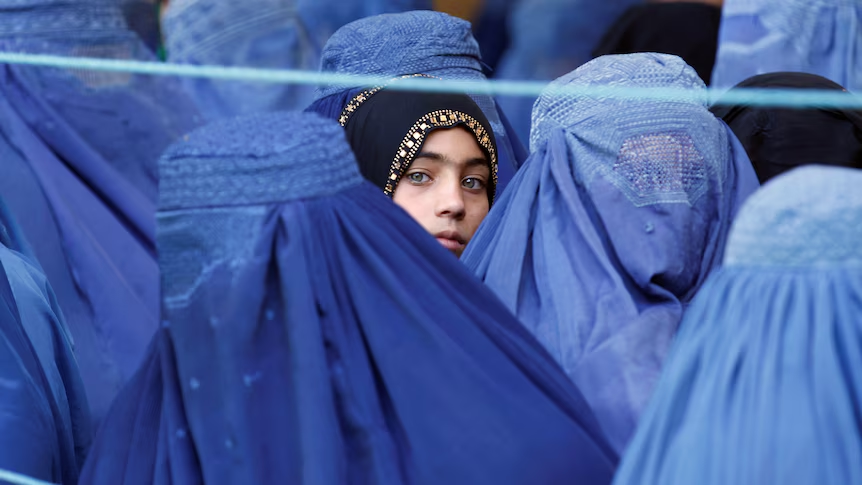
The treatment of women and girls exposes the gap between Taliban rhetoric and Islamic justice more clearly than anything else. Denying girls education, excluding women from public life, and shrinking their existence to the walls of the home are not signs of religious integrity. They are signs of political control. The Taliban has turned female presence into a field of domination, where every restriction signals who holds power. It is social engineering by decree.
A system confident in its moral legitimacy would not need to fear women in classrooms, offices, or civil society. It would not rely on constant policing of dress, movement, speech, and visibility
The same pattern appears in the Taliban’s wider approach to society. Independent media is constrained. Dissent is dangerous. Critics face intimidation, detention, or silence. Public space has been emptied of normal political life because normal political life threatens authoritarian rule. In a healthy Islamic polity, rulers are answerable to moral criticism. Scholars, citizens, and communities retain the right to question injustice. Under the Taliban, questioning power is treated as rebellion, even when that question is rooted in Islamic reasoning itself. This reveals the basic insecurity of the system. It does not trust Afghans to think, speak, or participate. It demands obedience first, then dresses that obedience in religious language.
Some defenders of the Taliban argue that Afghanistan needs order after decades of war, corruption, and foreign occupation. That point has emotional force, but it cannot excuse the creation of a state built on fear and exclusion. Order alone is not justice. Silence alone is not stability. A prison can be orderly. A frightened society can appear calm. The real test of government is whether it protects human dignity, creates fair institutions, and allows people to live as full members of their society.
By that test, the Taliban fails badly. It has replaced one form of crisis with another, offering a hard shell of authority without the substance of legitimate rule
There is also a deeper problem in the Taliban’s claim to religious legitimacy. When rulers insist that their political choices are identical with Islam itself, they close the door to honest disagreement and make reform look like heresy. That is both intellectually dishonest and spiritually corrosive. No movement, no matter how devout it claims to be, has the right to erase the long and diverse tradition of Islamic thought and present its own commands as unquestionable truth. Afghanistan is a Muslim society, but it is not the private estate of one leader and his inner circle. Islam is bigger than the Taliban, and Sharia is richer and more serious than a system of commands issued from above with no public consent.
The most accurate way to describe the Taliban system, then, is not Islamic governance in any meaningful, principled sense. It is authoritarian rule wrapped in religious legitimacy. It is coercive because it depends on force, intimidation, and the suppression of alternatives. It is monarchical because authority revolves around Sheikh Hibatullah Akhundzada as the central and decisive figure. And it is deeply damaging because it turns faith into a shield for unaccountable power. Afghans deserve better than this false choice between chaos and clerical absolutism. They deserve a future where religion is not weaponized against society, where justice is more than punishment, and where no ruler can claim to own both the state and the truth.

