




The Double Standards Behind Musk’s “Interference”

When Elon Musk showed up at the “Unite the Kingdom” march on 14 September, and gave a few remarks, it didn’t take long for Liberal Democrat leaders to respond with a sharp letter calling his comments “unwarranted Musk’s “Interference”” To them, a foreign billionaire weighing in on British politics was crossing a line.
It reveals where that instinct comes from. Outside influence is a touchy subject, especially in a country that has been wrestling with questions of sovereignty since Brexit. But the way this was framed raises a bigger issue. Besides, people are not very consistent about what counts as interference and what does not.
What Exactly Is Interference?
If a short speech by Musk counts, then what about international resolutions on another country’s domestic disputes? Parliaments in Europe and North America regularly pass motions condemning policies in Israel, China, Venezuela etc. These resolutions do not change laws directly, but they clearly put weight on one side of an argument, and in some cases, embolden protests.
So, the question is if Musk giving his opinion at a rally is a problem, why do not we treat those kinds of interventions the same way?
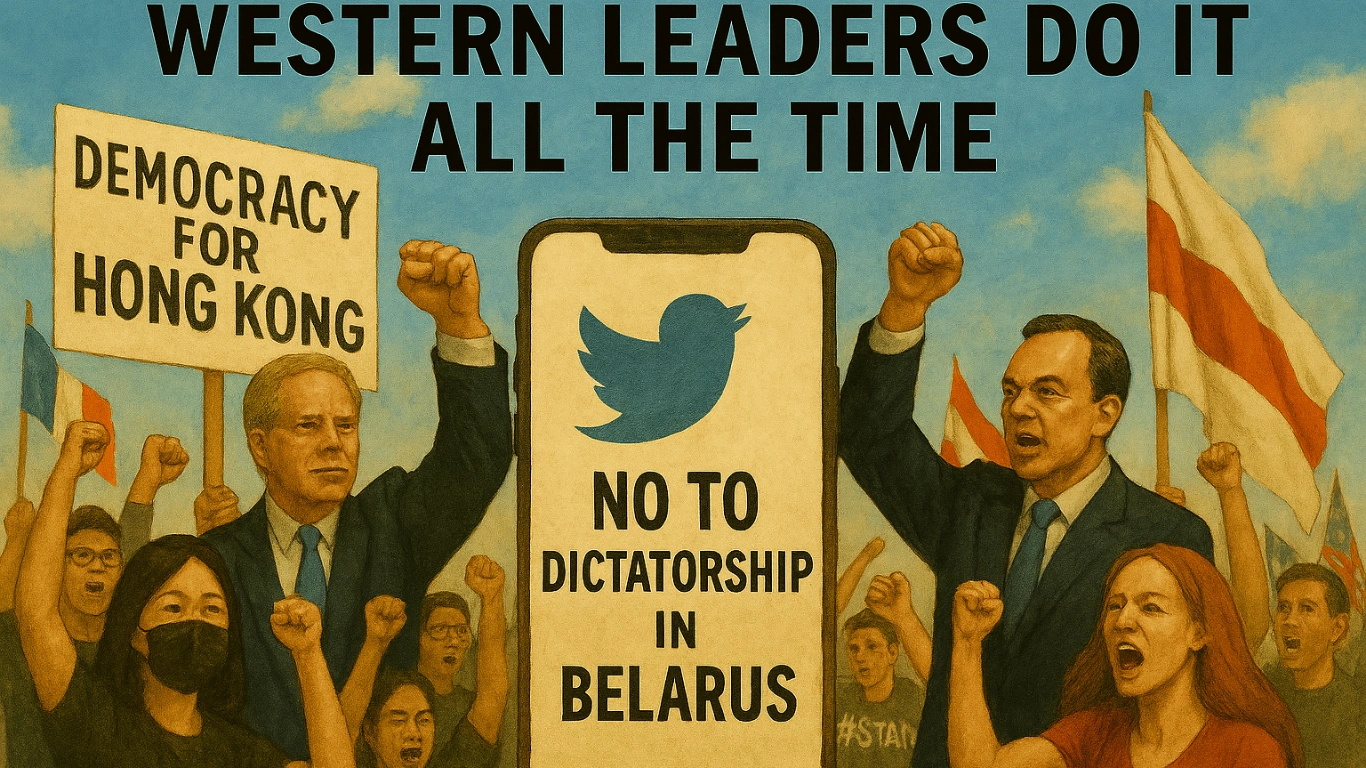
Western leaders do it all the time
Think about how often Western leaders openly support protests abroad. Some cases in point are mentioned here. Firstly, American officials praised demonstrators in Hong Kong. Secondly, European leaders stood shoulder to shoulder with opposition movements in Belarus. Even tweets from powerful figures can carry a lot of weight in those contexts.
That is not neutral observation. It is shaping political outcomes in someone else’s backyard. Also, most of the time, it is framed as solidarity and defending democracy. It is fair enough, but then why slam Musk for doing, in essence, a much smaller version of the same thing?
Picking and choosing
This is where it starts to look less about principle and more about convenience. Condemning Musk, while tolerating and even celebrating interventions that line up with our own politics makes it hard to take the outrage at face value.
If he had spoken at a rally about climate action and European integration. Would the same Liberal Democrats have rushed to call it interference? The answer is probably negative.
Hence, it is easier to accept outside voices when they echo our own values.
Principle of Sovereignty
Sovereignty is supposed to mean that a nation’s internal affairs are its own business. On the one hand, that’s the banner politicians raise whenever foreign criticism cuts against them. On the other hand, the same people often do not hesitate to weigh in on other countries’ politics when it suits their goals.

If sovereignty is invoked only when convenient, it starts to feel like an empty slogan. It is the same when either principle is applied selectively and admitted to be just another political tool.
There is also a danger in diluting the word “interference.” Real interference is hacking into election systems, spreading disinformation and funneling secret money into campaigns. So, Musk standing on a stage and voicing an opinion in public does not come close to that.
If people start calling every unpopular foreign opinion “interference,” the ability to distinguish between free speech and actual threats to democracy will become weaker. Thus, it only makes it harder to respond when the real thing happens.
At the end of the day, this flare-up says less about Musk than it does about how political actors use democratic values. Free expression is defended when it is convenient and condemned when it is awkward. Sovereignty is sacred when outsiders disagree, and it is flexible when they cheer us on. This inconsistency erodes trust. Therefore, people can see when principles are applied selectively, and it starts to feel like the rules are not about democracy at all, but they are just about protecting power.
Musk’s words may have been clumsy or provocative as he is not exactly known for subtlety. Treating them as some grave act of interference stretches the definition past recognition. Thus, for democracy, consistency is needed. Either respect free speech across the board or admit we are only defending it when it suits us.
Disclaimer: The views and opinions expressed in this article are exclusively those of the author and do not reflect the official stance, policies, or perspectives of the Platform.

