

UAE-Pakistan Strategic Partnership
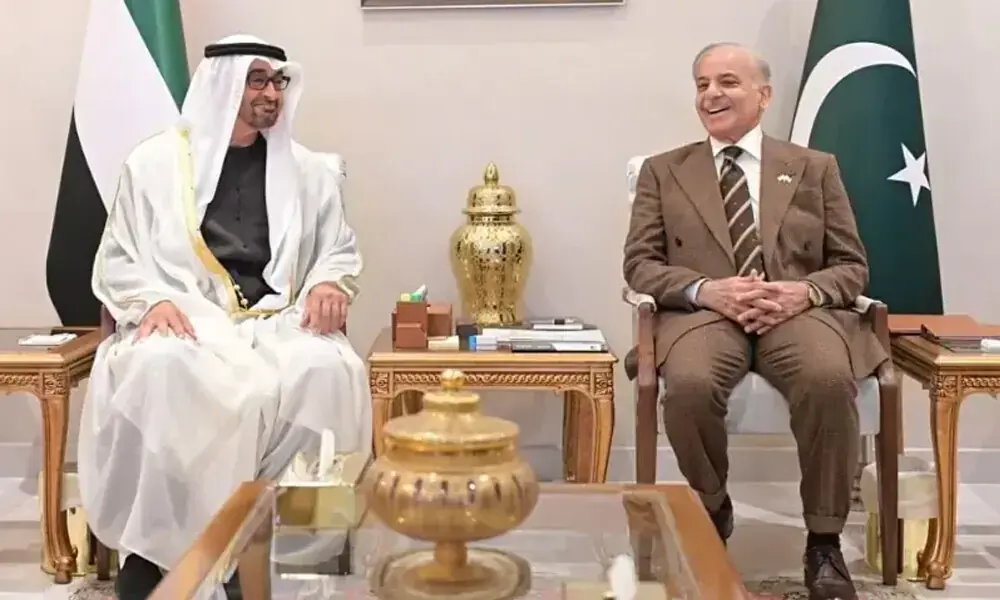
When UAE President Sheikh Mohamed bin Zayed Al Nahyan arrived in Pakistan on 26 December 2025, it was more than a ceremonial call. It marked a deliberate reaffirmation that the Islamabad-Abu Dhabi relationship is not episodic diplomacy, but a cornerstone partnership built on shared religious affinity, cultural familiarity, and decades of fraternal ties. Pakistan’s Foreign Office had framed the visit as a milestone engagement, and the day’s coverage underscored its symbolic and strategic weight.
The enduring strength of this relationship lies in its dual character: emotionally resonant and materially consequential. Shared heritage and values provide the trust premium that many bilateral ties lack, but it is the steady conversion of goodwill into practical cooperation that makes this partnership resilient. In today’s volatile region, where capital is cautious, supply chains are fragile, and geopolitics can change the temperature overnight, relationships that can withstand stress are those anchored in both sentiment and structure.
The UAE-Pakistan equation increasingly looks like that kind of relationship: future-oriented, interest-aligned, and designed to deliver
Few indicators are as revealing as mobility. The UAE’s recent visa facilitation steps for Pakistani nationals, reported as including online processing, e-visas without passport stamping, and faster system-to-system linkages, signal institutional confidence rather than transactional convenience. They reduce friction for legitimate travel and business, but they also communicate a deeper message: the UAE sees Pakistan’s citizens as a valued source of talent, enterprise, and connectivity. Reports that UAE visa arrangements in Pakistan are processing around 500 applications daily make the point even clearer: facilitation is being operationalized at scale, not merely announced.
This matters because people-to-people connectivity is not a soft add-on; it is strategic infrastructure. The Pakistani community in the UAE, often cited in the range of about 1.7 to 1.8 million, is not only a diaspora but a living bridge across markets, skills, and social capital. Pakistani professionals and workers are embedded across construction, logistics, retail, healthcare, and increasingly the knowledge economy, sustaining the UAE’s growth while supporting families and communities back home. That bridge is reinforced by dense air connectivity: multiple daily flights knit together families, commerce, and services, with some routes scaled to very high frequency.
Etihad, for instance, has announced four daily services to Karachi, illustrating the depth of demand
The economic logic is equally compelling. Bilateral trade has been reported at over $10.9 billion in FY 2023-24, and remittances from the Pakistani community in the UAE were cited at $6.7 billion in 2024, with expectations of exceeding $7 billion in 2025. WM+1 These are not just big numbers; they are stabilizing flows. For Pakistan, remittances are a macroeconomic shock absorber and a household lifeline. For the UAE, Pakistan is both a market and a partner in human capital, an economy that can supply skills, services, and demand as Gulf economies diversify beyond hydrocarbons.
What is most strategically interesting is the widening sectoral canvas. Recent briefings and reporting point to UAE-linked interest and activity across ports, digital banking, logistics, and infrastructure, alongside invitations for deeper participation in IT, AI, fintech, agriculture, minerals, and higher education. Pakistan’s pitch is straightforward: invest where Pakistan has scale, population, geography, and opportunity, and where the UAE has a comparative advantage, capital deployment, logistics excellence, financial innovation, and execution capacity.
The partnership works best when it is not framed as assistance, but as co-investment aligned to mutual gain
Logistics, in particular, is a natural convergence point. Dubai-based DP World’s reported $400 million investment plan tied to a freight corridor linking Karachi port movement to inland rail logistics signals that the UAE is not merely looking at Pakistan as a destination, but as a node in broader regional connectivity. Such projects sit at the intersection of trade competitiveness and state capacity: better movement of goods lowers costs for exporters, improves reliability for importers, and creates the backbone for industrial clustering. If Pakistan is serious about becoming a geo-economic corridor, partnerships with proven logistics players are not optional; they are foundational.
Of course, a mature partnership must also manage reputational and compliance risks, especially in mobility. Visa facilitation works when both sides ensure integrity in documentation, recruitment channels, and traveler conduct. The UAE’s reforms should therefore be matched by Pakistan’s own reforms, digitized verification, tighter oversight of intermediaries, skills certification, and consistent enforcement against fraud.
Trust is the partnership’s greatest asset; protecting it requires administrative discipline, not just diplomatic warmth
The 26 December 2025 engagement should therefore be read as a strategic signal: both governments want a partnership that is durable, diversified, and measurable. The opportunity now is to institutionalize delivery, sector-specific roadmaps, bankable pipelines, and performance benchmarks that translate intent into outcomes. Done right, the UAE-Pakistan partnership can become a model of how shared history and culture can power modern statecraft: trade that scales, investment that upgrades productivity, mobility that is safer and faster, and a people-to-people bond that remains the most credible guarantee of continuity.

