

Saira Jabeen Makes History
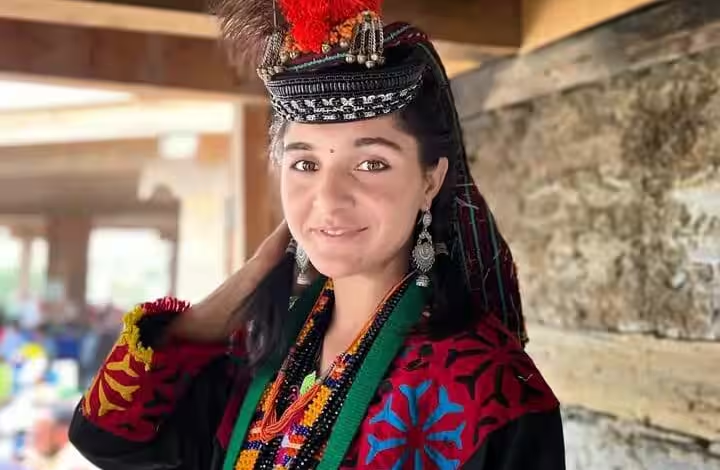
From the narrow lanes of Rumbur in the Kalash valley to the bright lights of international cricket, Saira Jabeen has done far more than earn a call-up. She has shifted the boundaries of what is seen as possible for girls from Pakistan’s most remote regions. As the first woman from Chitral to be selected for the national cricket team, she has written her name into the country’s sporting history and forced us to rethink who gets to dream of wearing the Pakistan shirt.
To understand the weight of this moment, you have to picture where she comes from. Chitral is beautiful but distant, a place more often mentioned in travel features than in sports pages. The Kalash valley is known for its unique culture and centuries-old traditions, not for turf wickets and high-performance camps. For a girl from Rumbur, organized sport is not just a matter of talent. It is a daily negotiation with distance, limited facilities, family expectations, and a system that rarely looks beyond the big cities.
That is why Saira’s rise is not a simple success story. It is a quiet indictment of the structural gaps that kept girls from places like Chitral invisible for so long. She had to fight geography, lack of infrastructure, and social barriers at the same time. Yet she kept going, ball in hand, insisting that the mountains around her were not walls.
Her journey says something powerful. When opportunity is offered, talent from so-called peripheral regions is not just adequate, it is exceptional
Her stint with a cricket club in Australia is a crucial part of this story. It takes courage for any young athlete to leave home, even more for a woman from a remote valley with limited support systems. Those matches abroad gave her more than experience of foreign pitches and faster outfielders. They gave her a sense that she belonged in a wider world, that her game could stand up in a different environment, under different pressures. That global exposure has now turned into national gain, her international experience becoming the base for a breakthrough with Pakistan.
Saira’s selection in the Pakistan T20 squad for the series against South Africa is therefore symbolic on several levels. It is a personal victory for her and her family. It is a landmark for Chitral, where many may have followed cricket from afar, never imagining that their own valley would be represented on the field. It is also an institutional statement.
By picking her, selectors and administrators are signaling that the net of talent identification is finally stretching beyond Lahore, Karachi, and Rawalpindi. Regional representation in Pakistan women’s cricket is beginning to grow, and that change was long overdue
There is a deeper cultural dimension as well. The Kalash community is known for its vibrant, distinct identity within Pakistan. Saira carries that heritage with her onto the ground. Her presence tells young Kalash girls that their culture and their dreams are not in conflict. A daughter of the mountains can be a symbol of national pride. The girl who once watched cricket on television from a faraway valley will now walk out in green, representing both Chitral and Pakistan. For many girls in distant districts, that single image may have more impact than any policy speech.
Opinion pieces often celebrate such stories, then quickly move on. That would be a mistake here. Saira’s rise should force some hard questions. How many other Sairas remain undiscovered in Chitral, Gilgit Baltistan, interior Sindh, or rural Balochistan? How many have already left the sport because there was no proper ground, no coach, no safe transport back from practice, no parent who felt confident their daughter would be respected and protected?
Talent is not the problem. The system is.
If we are serious about using this moment, then Saira’s selection must not stand alone as a feel-good headline. It should become a case study that shapes concrete action. That means investment in basic facilities in remote areas, more school and college level competitions for girls, targeted scholarships, female coaches who can travel to mountain and border regions, and talent camps that do not only hover around the big cities. Media coverage also matters. When television and digital platforms highlight women like Saira, they help families see sport as a respectable path, not a risky distraction.
Saira Jabeen has done her part. She worked, persisted, and proved that distance is not destiny. Now she is ready to face South Africa in T20 cricket, carrying on her shoulders the hopes of a valley that rarely makes national sports news. Whether this becomes a turning point for women’s sport in Pakistan depends on what we do next. If institutions treat her story as the start of a wider opening, if more girls from neglected regions are brought into the fold, then this will truly stand as a historic moment for Chitral and for the country. From the echo of Kalash drums to the roar of a cricket crowd, Saira’s journey tells every young girl in a forgotten corner of Pakistan that the path to the international arena is hard, but it exists, and it has room for them too.

