
Pakistan’s Practical Role in Gaza
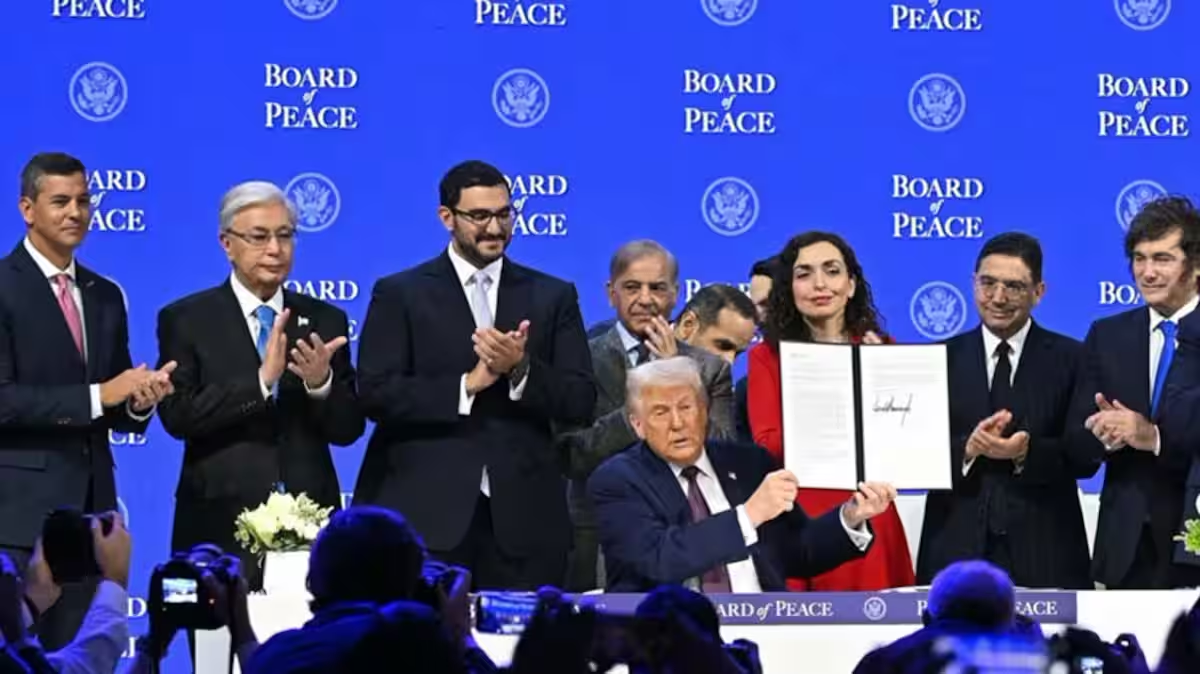
Pakistan’s choice to join the Board of Peace has triggered a familiar argument at home: Is this principled diplomacy, or is it a trap dressed up as humanitarian concern? That argument matters because Palestine is not a distant issue for Pakistanis; it is a moral touchstone. Still, the real test is not whether the decision feels emotionally satisfying in a television studio. The test is whether Pakistan can use this seat to protect Palestinian lives, defend the demand for statehood, and prevent a bad endgame from being locked in while the world is distracted.
To understand why the Board of Peace matters, you have to accept the current balance of power on the ground. Gaza has been battered, the social fabric is torn, and the space for ordinary political life has been almost erased. When war reaches this level of exhaustion, the side with superior force tends to dictate terms, unless a credible diplomatic structure blocks that path. This is why a transitional arrangement, backed by a wider international framework, can become the difference between a ceasefire that holds and a pause that simply resets the battlefield for another round.
Pakistan’s participation is, at its core, an attempt to influence that structure from the inside rather than shouting at it from the outside
Critics often say that joining any mechanism linked to a plan led by Washington turns Pakistan into an accessory. That concern should not be mocked, because history gives plenty of reasons for caution. But caution should lead to smart conditions, not automatic rejection. Pakistan can engage without surrendering its core position. It can insist, repeatedly and publicly, that any transition must protect the right to self-determination, must reject forced displacement, and must keep the goal of a sovereign Palestinian state on pre 1967 borders with Al Quds Al Sharif as its capital. The point of joining is not to sign away these fundamentals; it is to keep them on the table when implementation details are negotiated.
There is also a hard humanitarian logic here. When children are dying, when hospitals collapse, and when food and medicine are used as pressure tools, the ethical priority becomes stopping the bleeding. A political process that reduces daily deaths and opens aid corridors is not a moral failure, even if it is imperfect. In fact, refusing to participate in a mechanism that can deliver food, shelter, and protection can become its own kind of moral choice, one that feels pure but leaves civilians exposed. Pakistan’s diplomacy is most credible when it can combine strong language with tangible relief for people under siege.
Pakistan’s added value is not only sentiment, but it is also strategic positioning. Pakistan is not a Middle East power seeking regional dominance, and it is not tied to a military camp inside the conflict zone. That relative distance gives it room to act as a mediator and a verifier, especially when talking to major capitals that do not listen to smaller or more polarized states.
Pakistan also has working relations with multiple global powers, which means it can press for restraint and compliance in more than one channel. In a crisis shaped by competing patrons and veto politics, that ability to talk across divides is an asset, not a weakness
Still, participation comes with real risks, and pretending otherwise would be dishonest. The first risk is mission creep. A transitional board can quietly expand its scope, and what begins as humanitarian coordination can slide into security responsibilities. Pakistan should block that drift by setting explicit red lines in advance, including clarity that any separate security arrangement would require a credible mandate, alignment with national interest, and political consent at home, plus genuine Palestinian acceptance. Without these safeguards, Pakistan could be dragged into blame for actions it does not control.
The second risk is reputational. If the process becomes a cover for permanent control over Gaza, or if it enables displacement by slow administrative pressure, participants will be accused of complicity. Pakistan can reduce that risk by tying its continued involvement to measurable benchmarks. Those benchmarks can include sustained aid access, protection of civilians, transparent reconstruction rules that benefit local Palestinians, and a clear political timeline that does not erase the two-state end goal. Pakistan should also push for independent monitoring and regular reporting, so violations cannot be buried under diplomatic language. The third risk is domestic polarization. In Pakistan, Palestine is not a niche policy file; it is an emotional and religious issue, and that makes it easy for political actors to weaponize. The answer is not to avoid engagement; it is to raise the standard of accountability.
The government should brief parliament regularly, share the goals and limits of participation, and invite serious input from foreign policy experts, humanitarian organizations, and legal scholars. When the public sees a clear framework, the space for conspiracy and cynicism shrinks
What does success look like? It starts with lives saved, fewer airstrikes, fewer mass casualty days, and a steady humanitarian flow that reaches ordinary families, not just warehouses. It also means preventing forced displacement in practice, not just on paper. It means rejecting annexation moves and keeping the West Bank file linked to any durable settlement. And it means pushing for a political horizon that Palestinians can actually recognize as dignity, not as a managed cage with a new label.
Pakistan cannot solve this alone, and it should not pretend it can. But Pakistan can shape the coalition of Muslim states so that it speaks with one voice, applies pressure consistently, and resists being split into competing camps. If this unity holds, it increases the cost of renewed escalation and makes it harder for any party to sabotage the process without consequences. That is the central logic of joining the Board of Peace: collective presence creates collective leverage, and collective leverage is the only non-military tool left that can restrain a conflict driven by force.
In the end, Pakistan’s importance lies in refusing the false choice between resistance and diplomacy. Palestine needs both moral clarity and political realism, because a starving child cannot eat a slogan, and a destroyed city cannot be rebuilt by speeches alone. If Pakistan uses the Board of Peace to lock in ceasefire discipline, expand aid, and keep statehood at the center of negotiations, then participation becomes a service to the Palestinian cause, not a compromise of it. The moment calls for principled engagement, with eyes open and conditions firm.

