




China launches stealth fighter jets J-35 from futuristic super-carrier Fujian
China’s J-35 Stealth Jet Takes Flight From Futuristic Carrier Fujian
A first-of-its-kind catapult launch signals a big step for China’s naval ambitions
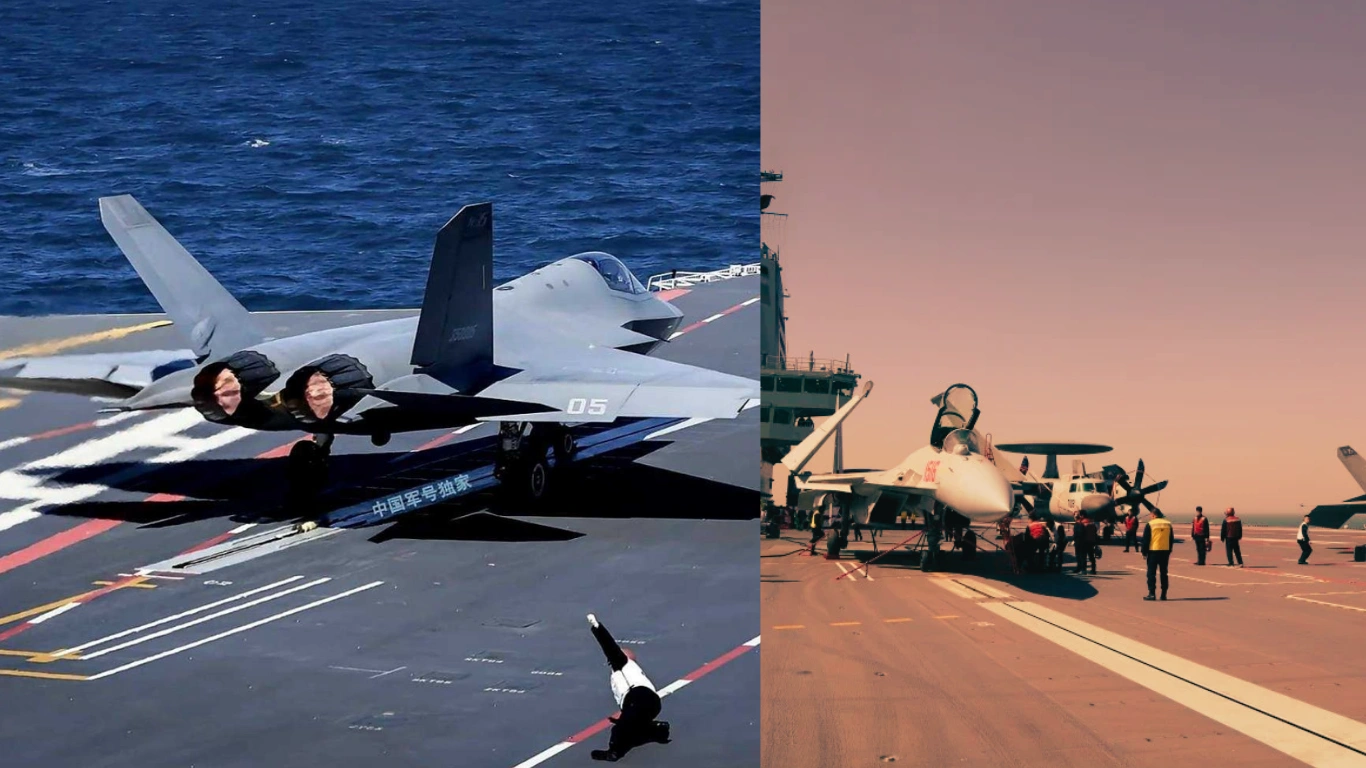
China just showed off a big leap in its naval game: the J-35 stealth fighter was launched from its newest aircraft carrier, the Fujian, using an electromagnetic catapult. For years, China’s carriers relied on ski-jump ramps that limited how heavy and capable their jets could be. The Fujian changes that, putting them into the same conversation as the US Navy’s most advanced carriers.
The J-35 itself has been in the works for a while. It’s a twin-engine stealth jet built specifically for carrier operations, with folding wings, a stronger frame for the stress of catapult launches, and a tailhook for landings. Think of it as China’s answer to the US Navy’s F-35C. What makes this launch stand out is that it might be the first time anywhere that a stealth fighter has actually been catapulted off a carrier using EMALS. The US has tested EMALS with older jets, but getting a stealth fighter into that mix has been tricky.
Also Read:China’s Journey to a Modern Carrier Navy
The symbolism here is hard to ignore. For Beijing, proving it can launch a stealth jet this way is about more than just a new toy. In fact, it’s about saying, “We can operate at the same level as the US.” Whether they can actually sustain that capability over months at sea is a different question. Running a carrier air wing is one of the most complicated things a navy can do. You need reliable tech, well-trained pilots, and a lot of practice. Even the USA, with decades of experience, has had hiccups with its own EMALS system.
Still, for the region, this is a wake-up call. A carrier like the Fujian equipped with stealth fighters, early warning planes, and all the rest makes China’s navy far more capable than it was just a few years ago. It adds pressure in hotspots like the South China Sea and around Taiwan, where carrier strike groups are meant to send political as much as military signals.
It’s worth being cautious though. Announcing a breakthrough and actually building a reliable, combat-ready force are two different things. Stealth coatings wear down, catapult systems break, and training takes years. This might be the start of a new chapter for China’s navy, or it could be more of a flashy milestone that takes a long time to translate into real-world power.
Still, the fact that we are even talking about China in the same breath as the US when it comes to launching stealth jets off carriers shows how fast things have shifted. Not long ago, the idea of China doing this would have sounded far-fetched. Now, it’s happening, and that alone changes how everyone else in the region has to plan.
Disclaimer: The views and opinions expressed in this article are exclusively those of the author and do not reflect the official stance, policies, or perspectives of the Platform.