




Missing Persons Debate
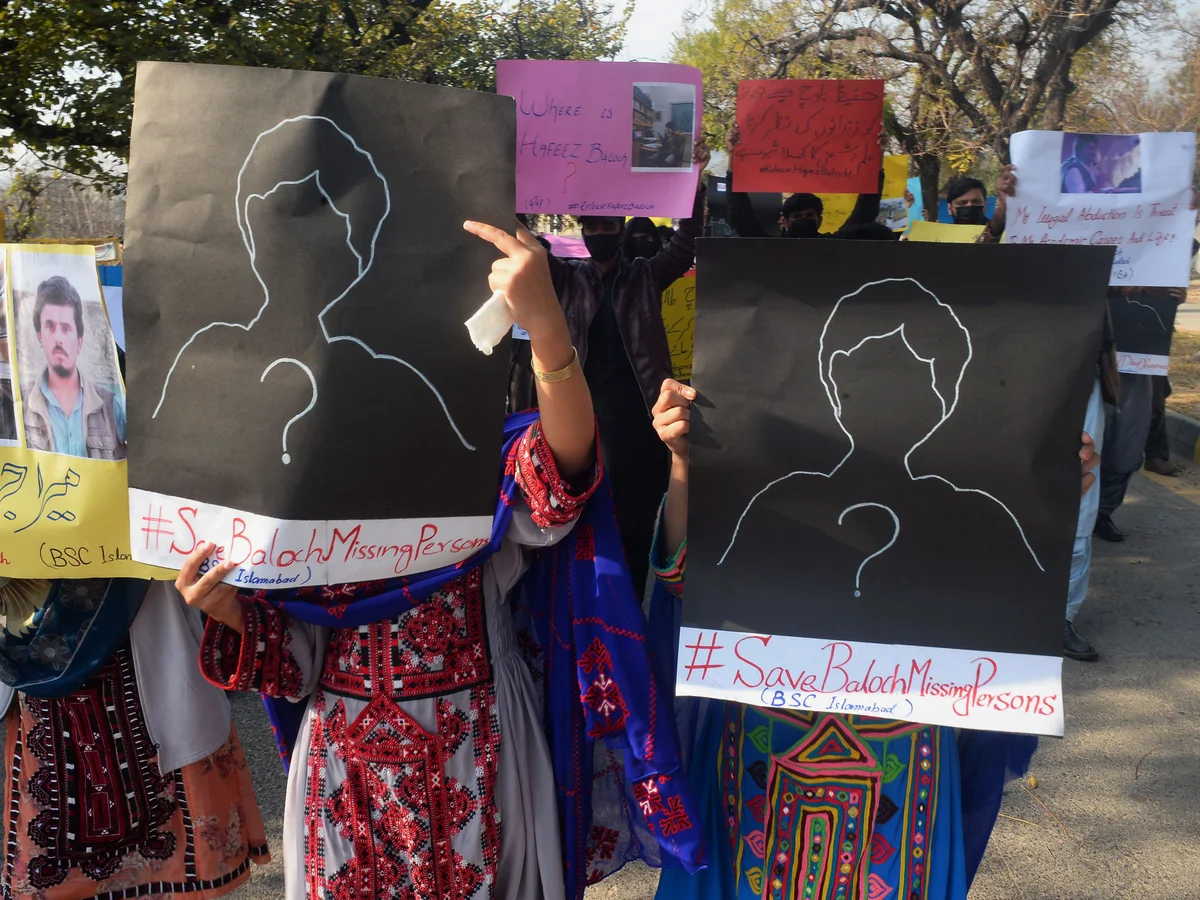
The discourse around missing individuals and claims of enforced disappearances in Pakistan occupies a critical intersection of law, security, and politics. It is simplistic to condense the issue into slogans, either by negating the suffering of families or by categorizing every counterterrorism action as misconduct. Both alternatives are expensive. A state must simultaneously safeguard civilians against militant violence and prevent illegal imprisonment. Pakistan’s problem lies not just in asserting its seriousness over the issue, but in demonstrating, on a case-by-case basis, that the system is proficient in truth-finding, accountability, and providing solutions.
Pakistan has not seen the issue as a trivial grievance. The Commission of Inquiry on Enforced Disappearances has operated for years as the primary platform for documenting instances, conducting hearings, and locating persons, in conjunction with constitutional lawsuits and judicial supervision. The Press Information Department has always characterized the matter as a legal procedure with quantifiable results. The Commission’s numbers published in September 2025 indicated that it had resolved 8,873 cases out of 10,618 received from March 2011 to August 2025, or around 83.56 percent.
One month later, a further official announcement indicated that the overall disposal rate was 84.48 percent, according to the Commission’s cumulative totals
Balochistan, a region characterized by significant political tension, is often portrayed by the state as a demonstration of the system’s efficacy. A recent report referencing the Commission’s province statistics indicated that of the 2,888 incidents documented in Balochistan, 2,693 had been resolved, or around 93 percent, while the balance remains under investigation. This aligns well with the assertion of “approximately 94 percent” that often appears in official communications. If such figures are accurate, they are significant. They propose that, at the very least, the state has a centralized system for processing complaints on a large scale instead of disregarding them.
Nevertheless, “disposed” does not equate to “justice delivered,” and critics have consistently emphasized this distinction. International and local rights groups contend that disposal may include results that fail to address the fundamental inquiries of what happened, who authorized it, and if accountability will be enforced. The International Commission of Jurists has condemned the Commission’s capacity to provide effective justice and substantial remedies, and has interrogated the implications of disposal for families without clarification. Coverage in Pakistan’s media has highlighted the discrepancy between official assertions of progress and the realities reported by families who continue to encounter fear, delays, and disobedience with production requirements.
A framework may exist yet still fail critical evaluations if it does not provide believable results and implications
Legislative and parliamentary scrutiny is crucial, particularly in a region like Balochistan, where insurgency and counterterrorism are persistent challenges. In 2025, provincial improvements, including modifications to the Anti-Terrorism law framework, augmented the state’s preventive detention authorities and established new protocols deemed essential by officials for deradicalization and security operations. Proponents contend that these solutions provide organization and documentation to what would otherwise be ambiguous security management. Critics contend that such powers legitimize prolonged incarceration without charges and transfer the cost onto civilians. For Pakistan to attain credibility on the problem of missing individuals, it must not depend just on the presence of legislation. It must demonstrate that any preventative system is constrained by stringent notification requirements, access to legal counsel, familial information, independent oversight, and tangible repercussions for misconduct.
Simultaneously, it is accurate to assert that the narrative around missing individuals is significantly politicized, not only by the state. The Pakistani government and other analysts see organizations like the Baloch Yakjehti Committee and Baloch National Movement as using the issue for international communication, particularly in Western capitals where the discourse on human rights has significant sway. Their statements are not inherently wrong; nonetheless, each assertion needs verification via proof. In insurgent contexts, information warfare is a fundamental strategy. Militant organizations exaggerate narratives of civilian suffering to enlist members, undermine state legitimacy, and restrict security forces.
Investigations into the Baloch insurgency reveal a continual regional and propagandistic aspect to the fight, rather than only a local law enforcement issue
The most detrimental tendency is the reallocation of names among roles: first listed as “missing” in activist records, thereafter emerging in militant propaganda as armed participants, or being reported deceased during operations. Pakistani media coverage of Saleem Baloch’s execution portrayed his case as an example of how the story of missing individuals may be used to obscure militant identity. Independent verification is crucial in this context; yet, the premise is unequivocal. Inaccurate lists undermine all parties involved: the families of genuine victims suffer a loss of credibility, while the state gains a pretext to reject all claims as fabrications.
This does not alter the fundamental principle: counterterrorism operations must adhere to legal standards, and claims of wrongful detention must be examined with rigor rather than defensiveness. Pakistan endures violent assaults, exemplified by the March 2025 Jaffar Express hostage crisis, which highlighted the lethal nature of the extremist threat and the need for ongoing operations. A state’s legitimacy is not derived only from coercion. It arises from discipline, paperwork, due process, and a readiness to address misconduct within its own framework.
In my opinion, Pakistan needs to cease seeing this issue as a public relations battle and begin to approach it as a credibility assessment. Establish more distinct classifications for “disposed” outcomes. Enhance transparent reporting, including the number of individuals tracked, those in detention, the deceased, and instances leading to criminal culpability. Enhance legislative oversight by granting genuine subpoena authority and appointing independent inspectors. Activists create fabrications, pursue legal action against the fabrications, but do it in court with facts rather than by sweeping generalizations. This is how to safeguard counterterrorism operations from misinformation while also safeguarding civilians from illegal abduction.