

Pakistan Faces Three Tests of State Power and Regional Unity
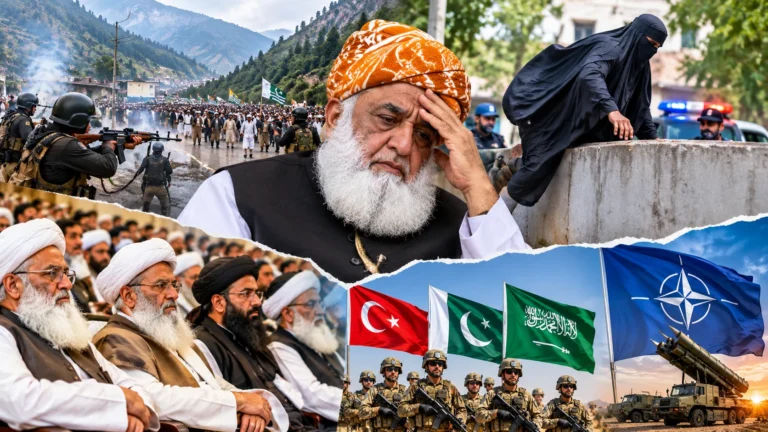
Three stories dominated Pakistani political consciousness this week: the proscribed JAAC’s violent descent in Azad Kashmir, Maulana Fazlur Rehman’s crumbling seminary support base, and the Makkah Defence Pact’s emerging test against Houthi aggression. Individually they look separate. Together, they reveal something deeper: a country deciding what kind of state it wants to be, and whether its alliances mean anything.
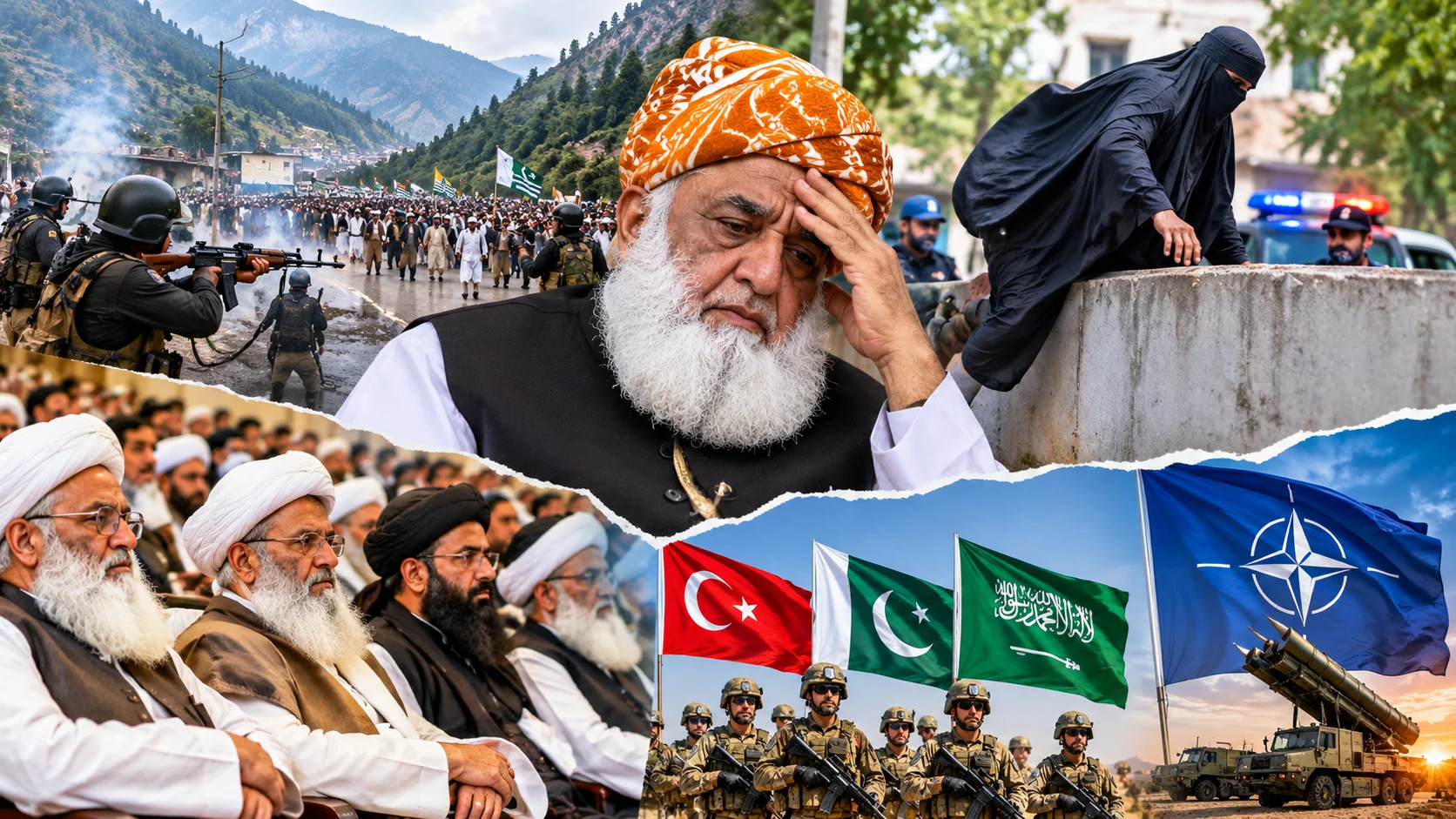
Start with AJK. What began as a civil rights protest movement demanding relief on electricity tariffs and legitimate representation in the legislative assembly has quietly but unmistakably transformed into something the state can no longer treat with the patience of a mediator. AJK police spokesperson SSP Riaz Mughal directly accused the proscribed JAAC of deliberately targeting law enforcement personnel, stating that 26 security personnel had been martyred this year alone during incidents of unrest. A Rangers official was killed while approximately 15 police and other law enforcement personnel sustained injuries during clashes in Rawalakot. And now Plandri adds to that grim ledger, with two police officers wounded by gunfire in the latest round.
The critical observation here is the trajectory. AJK Police accused the JAAC of working under a specific agenda, saying sophisticated weapons had been seized from arrested suspects. This is no longer a crowd of aggrieved citizens waving banners. When armed men take to the hills with modern weapons, force shopkeepers to close at gunpoint, and fire on law enforcement, the character of the movement has fundamentally changed. Its leaders may still invoke the language of peaceful protest, but language and conduct are two separate things. The state cannot respond to live ammunition with talking points. When you fire at police, you forfeit the shield of civic protest. The AJK Police spokesperson confirmed the JAAC was operating under an agenda aimed at destabilising the region, and the evidence on the ground increasingly supports that assessment. Those who fire bullets should expect bullets in reply. That is not brutality; that is the basic logic of a functioning state.
Meanwhile, the electoral picture tells its own story. Elections in AJK proceeded, power transferred, and a new government announced its development agenda, all things the JAAC had vowed to prevent. That is not a small failure for the movement. That is a comprehensive political defeat. Frustration converts into militancy precisely when the political path closes, but in this case, it was the movement itself that abandoned the political path, not the state that blocked it.
Turn now to Maulana Fazlur Rehman. For years, his central bargaining chip has been the same: I control the seminaries, the seminaries mobilise the students, the students fill the streets. That formulation rested on an assumption, that seminary administrators were willing foot soldiers in his political campaigns. That assumption is now publicly unraveling. Over 100 scholars in Balochistan, his own political heartland, gathered at a press conference in Quetta to announce they would not send madrasa students to political protests or anti establishment campaigns. The scholars were categorical: seminaries exist to teach Quran, Sunnah, and Islamic values, not to supply warm bodies to political rallies.
This deserves to be understood properly. Balochistan is not peripheral to Fazlur Rehman’s politics. It is the very ground beneath his feet. He contests elections from Balochistan because Khyber Pakhtunkhwa, his ancestral terrain around Dera Ismail Khan, no longer offers him a safe seat. His natural constituency turned its back. Now his adopted constituency is showing similar signs of fatigue. Similar declarations have come from scholars in KP and Punjab. The pattern is consistent enough to suggest not coincidence but a systematic reassessment within religious educational circles.
The harder truth for Fazlur Rehman is this: the anti establishment posture that he hoped would generate street power has instead generated institutional distance. The scholars are not necessarily pro establishment. Many have genuine grievances over seminary registration laws and government raids. But there is a difference between fighting for seminary rights and becoming instruments of a broader resistance politics that targets state institutions wholesale. The scholars appear to understand that distinction even if their nominal leader does not. When the base refuses to march, the general’s strategy collapses regardless of how bold his rhetoric remains. JUI F in Balochistan had earlier announced a protest movement against raids on religious seminaries, but that specific grievance is a far cry from blank cheque endorsement of anti state political campaigns. The scholars drew that line themselves, in public, on the record.
Then there is the Makkah Defence Pact, the story with the longest strategic shadow. Turkey and Pakistan agreed to prepare forces and other military support for rapid deployment to Saudi Arabia under their trilateral defence pact, following an emergency meeting in Riyadh amid ongoing Houthi attacks on the kingdom and intensifying fighting in Yemen. Turkish legislators ratified the defence cooperation agreement as Riyadh sought increased regional support in its conflict with Iran backed Houthi rebels. This is the pact’s first real test, and how it responds will define its credibility for a generation.
Turkish Foreign Minister Hakan Fidan clarified that the Makkah pact is defensive in nature, and that nuance matters. Critics in Pakistan who ask why Pakistani soldiers should fight in Yemen’s mountains are asking an incomplete question. The pact’s logic is collective deterrence, the same logic that underlies NATO. If Saudi Arabia falls to sustained Houthi pressure and the pact does nothing, then Pakistan and Turkey gain nothing from their membership except a ceremonial document. Alliances earn their credibility precisely in the moments when activation is inconvenient.
The NATO parallel is instructive. When the alliance sends forces to defend Poland against Russian pressure, no one asks why Dutch or Romanian soldiers should die for Warsaw. The answer is the same everywhere: because an alliance that only exists on paper protects no one. Turkey does not expect its troops to engage in combat with the Houthis, with Defence Minister Yasar Guler clarifying this position as foreign ministers met in Istanbul to discuss regional security. The posture is deterrence, not deployment into active combat, a critical distinction that Pakistani domestic discourse tends to collapse.
The broader strategic reality is this: the era of American guaranteed regional security is over. France confirmed it is sending troops to guard the major oil terminal at Yanbu as Saudi officials meet with peers from Pakistan and Turkey to discuss options under their mutual defence pact. Multiple powers are repositioning. The Gulf states know Washington’s attention is finite. Europe is building its own security architecture. Pakistan and Turkey made a choice to be part of a credible regional deterrence structure, one that could matter enormously if Pakistan faces a threat of its own tomorrow.
Three crises, one underlying question: does Pakistan have the institutional confidence to enforce order at home, the political clarity to distinguish genuine grievance from khawarij style armed disruption, and the strategic maturity to honour collective defence commitments abroad? The answers this week are cautiously encouraging, but only if the state follows through with the same consistency it is demanding from everyone else.

