



The Sindoor Report Falls Apart
Strategic writing is not just storytelling with military terms. It is a discipline with rules. You start with what can be checked, you separate fact from claim, you explain what you do not know, and you keep your logic consistent from one page to the next. When the subject is crisis behaviour between two nuclear-armed rivals, those rules are not academic niceties. They are guard rails. A report that treats one side’s press lines as truth, while treating the other side’s statements as deceit by default, does not merely produce a slanted reading of events. It produces a misleading picture of escalation, capability, and intent. That is exactly why the CHPM report on “Operation Sindoor: The India-Pakistan Air War (7 to 10 May 2025)” should worry any serious reader, even readers who sympathise with India’s broader narrative. It fails the evidence test, and once that happens, every later conclusion becomes suspect.
The first giveaway is how the report handles disputed starting points. In security studies, contested triggers are where you slow down and widen your source base, not where you speed up and narrow it. When Pulwama is presented as settled history without grappling with the absence of independent forensic disclosure and without acknowledging Indian dissenting voices that questioned the event, the report is not weighing evidence. It is decided that one state’s accusation is enough to anchor the entire chain of causality.
That matters because once you lock in a trigger as proven, every action that follows can be framed as a justified response, and every restraint by the other side can be framed as weakness or guilt. A report built on that kind of foundation is not an analysis. It is a moral framing to wear a uniform
A competent military assessment also understands that modern conflicts leave data trails. Not perfect trails, and not always immediately, but trails nonetheless. Open source intelligence has its limits, yet it is now a baseline tool. Aircraft wreckage, missile debris, crater patterns, satellite imagery, time-stamped videos, flight tracking artefacts, radio logs, and local eyewitness footage can all be used carefully. The right approach is to treat official statements as hypotheses, then test them against the best available public indicators, and clearly label what remains unverified. The CHPM report instead reverses this. It treats Indian official claims as the default truth and treats contradictory indicators as noise. That method is not neutral, and it is not even stable. It guarantees that the report will drift toward implausible claims because there is no check on wishful thinking.
Balakot is a clear example of how this drift works. Once you accept, without proof, that strikes hit a major camp and caused meaningful effects, you can present India as having crossed a threshold while still “controlling” escalation. But if the publicly observed effects point to limited physical damage and no demonstrated casualties, the meaning changes. The episode becomes a signalling strike aimed at domestic and international messaging, not a decisive tactical blow. That difference is not a footnote. It changes how you interpret Pakistan’s next move, and it changes how you assess deterrence. The report’s refusal to seriously engage with publicly available on-ground reporting and visible site outcomes is not an oversight. It is a choice, and it pushes the reader toward a story of Indian coercion that the available evidence does not compel.
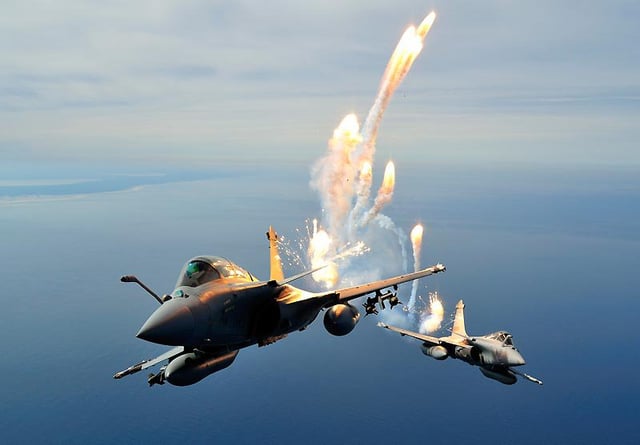
The report’s logic problems get worse when it tries to narrate air engagements. Air warfare is unforgiving to sloppy reasoning because basic questions have crisp answers. Was the strike package detected? Were aircraft engaged at release? Were weapons launched from a standoff range inside the home airspace? If you say detection failed, you cannot also claim real-time engagement at release. If you say engagement happened, you cannot later retreat into a claim that only patrols were engaged, unless you specify which tracks were which, where they were, and what the timing was.
The CHPM report slides between these positions as if they are interchangeable. They are not. This is not a debate about interpretation. It is a debate about whether the author is tracking their own storyline
The Erieye claim is where the credibility cost becomes obvious. Long-range surface-to-air systems are powerful, but they are not magic. A deep-reach engagement against a high-value airborne early warning platform inside hostile territory would be an extraordinary event. Extraordinary events require extraordinary evidence. At minimum, you would expect consistent corroboration, credible wreckage, confirmed loss records, or some form of technical disclosure that survives cross-checking. The report offers none of this. It simply asserts the outcome and moves on, as if the reader should accept it because it flatters the chosen narrative of Indian dominance. That is not how serious military history is written. It is how rumours are given a uniform and saluted.
Timeline errors compound the damage. Chronology is the easiest part to get right because public statements and visible operational cues can often be anchored to specific times. When a report misstates when missile or air strikes occurred, or distorts the sequence of ceasefire messaging, it signals either poor source discipline or purposeful shaping. Both are fatal in strategic analysis. In crisis studies, timing is not trivial. Timing is intent. If you move actions earlier or later, you can manufacture first mover advantage, desperation, or restraint. The report’s framing of the ceasefire as Pakistan “begging” is a classic example of rhetorical loading. A study that leans on that language, instead of sticking to verifiable sequences of public announcements and reciprocal signalling, is trying to win a debate, not explain an event.
The most revealing weakness is the report’s double standard on proof. Claims of destroyed assets are easy to make and hard to hide, especially in the social media era. If multiple aircraft were shot down, if major ground assets were struck, if large-scale damage occurred, there should be at least some credible physical trace that can be photographed, geo-located, or otherwise verified. When a report accepts one side’s destruction claims without demanding supporting evidence, while dismissing widely circulated physical indicators on the other side, it is not evaluating information.
It is allocating credibility based on national preference. That is propaganda logic, even if it is wrapped in academic formatting
A responsible alternative is not hard to imagine. The report could have separated claims from confirmed facts. It could have listed what evidence supports each major assertion and what evidence cuts against it. It could have flagged gaps, uncertainties, and competing interpretations. It could have avoided loaded language and focused on capability, decision cycles, and escalation control. It could have treated both states as rational actors managing risk under uncertainty, rather than casting one as inherently truthful and the other as inherently deceptive. If CHPM wanted to contribute to understanding, that is the path.
Instead, the report teaches a different lesson: how strategic writing collapses when it starts with a conclusion and backfills the story. That is not just an academic failure. It is a policy risk. Biased narratives harden public attitudes, shrink leaders’ room for compromise, and increase the chance that the next crisis begins with overconfidence. Between nuclear-armed states, overconfidence is not a slogan. It is a hazard.

