

Excuses Over Facts Kasim Sulaiman Khan Politics of Delay
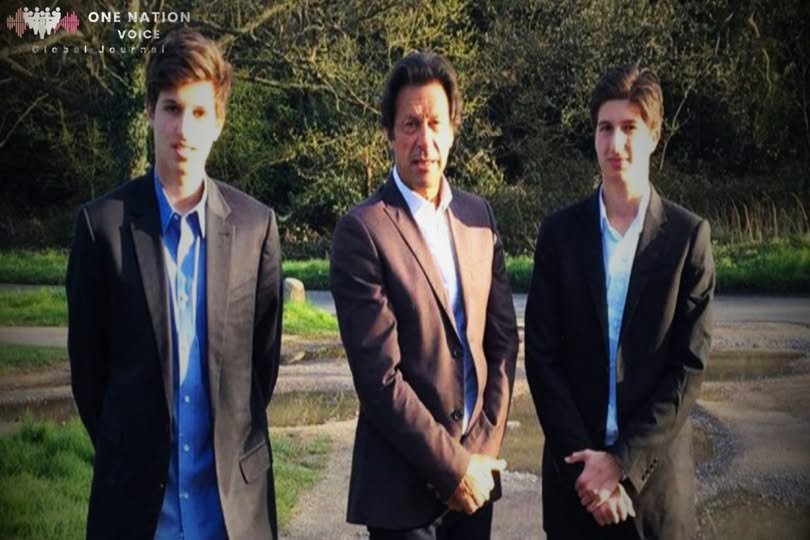
There is something deeply uncomfortable about watching a family’s pain be weaponised in real time. Nobody doubts that Kasim and Sulaiman Khan love their father. Nobody questions that sons separated from a parent would feel anguish and distress. The human emotion at the centre of this story is real, and it deserves to be treated with some care.
But sentiment and scrutiny are not mutually exclusive. And once a private family matter is carried into the studios of Sky News, the corridors of Zeteo, the pages of The Telegraph, and the microphones of the Australian Broadcasting Corporation all within a single week in early September 2026 it stops being purely private. It becomes a public argument, and public arguments invite examination.
So let us examine the central claim: that Kasim and Sulaiman Khan have been denied the ability to visit their father, former Prime Minister Imran Khan, currently serving a sentence at Adiala Jail in Rawalpindi.
The Pakistani government has responded to this claim with a consistency that is worth noting. In March 2026, Information Minister Attaullah Tarar stated plainly that the Khan sons are welcome to travel to Pakistan as Pakistani citizens using their National Identity Cards for Overseas Pakistanis their NICOPs for which no visa is required. Defence Minister Khawaja Asif went further still, publicly sharing the partially censored NICOP numbers for both brothers, confirming that Sulaiman’s card remains valid until January 2030 and Kasim’s until November 2032. “They can visit Pakistan today if they wish,” Asif said. These are not vague promises. They are specific, documented, and verifiable.
The brothers have at various points claimed their NICOPs are expired, that their separately applied for visas have been deliberately blocked, and that technical obstacles have been placed in their path. The government has described those claims as incorrect. The NICOP validity dates are now part of the public record.
A Pakistani citizen holding a valid NICOP does not require a visa to enter Pakistan. That is not a political position it is the law.
And yet, week after week, interview after interview, the framing remains the same: two sons locked out, a father locked in, a heartless government refusing to let them meet. The media campaign has spanned CNN, Sky Sports, Sky News, ABC Australia, Zeteo, The Spectator, and now The Telegraph. One can marvel at the organisational discipline involved while still asking: if a plane ticket and a valid travel document are what stand between these young men and their father, why has neither been purchased?
The internationalisation strategy has been deliberate and extensive. The brothers have appealed to Donald Trump, to British Foreign Secretary David Lammy, to the United Nations, to the international cricket community, and to any “person of influence” willing to amplify their message. When Pakistan Cricket Board officials reacted to their Sky Sports interview during a Lord’s Test match by threatening to halt play, Kasim dismissed it as a panicked attempt to suppress human rights concerns. The optics of that incident were real. But so was the strategic positioning around it the interview was conducted not in any quiet diplomatic channel but inside Lord’s Cricket Ground, on a global broadcast platform, precisely when Pakistani officials and international cricket bodies were paying maximum attention.
This is not the behaviour of two private citizens trying to arrange a family visit. It is the behaviour of a coordinated public pressure campaign and that distinction matters.
None of this means Imran Khan’s prison conditions are above scrutiny. The government’s own accounts contain contradictions worth probing. Pakistan’s Ministry of Information says Khan has received over 900 visits from family, lawyers, doctors, and political representatives since his imprisonment in August 2023, and that his sisters met him as recently as August 18 and 19, 2026. It says he has access to home cooked meals, books, a television, exercise equipment, and a seven cell compound with a corridor and lawn. It records his last telephone conversation with one of his sons on March 21, 2026.
Meanwhile, the Adiala Jail superintendent told the Islamabad High Court in August 2026 that solitary confinement has been largely abolished in Pakistani prisons, and that Khan moves freely within his compound during the day and is only inside his cell during designated night time lock up hours. A court appointed advocate who inspected the facility in February 2026 submitted findings to the Supreme Court confirming his conditions. These are judicial processes and court submitted records, not government press releases.
The health claims the eye condition, the blood pressure, the contaminated water deserve follow up through proper channels. Some of those channels are already open. Pakistani courts have been actively hearing petitions about Khan’s health and conditions. His legal team has access to him. His wife has court ordered weekly meetings. His sisters have visited him. The institutional machinery of the Pakistani legal system, imperfect as it is, continues to function around his case.
What the brothers are demanding, by contrast, is something different: not a family visit facilitated through available legal and travel mechanisms, but a recognition that Pakistan’s handling of their father is a matter for British foreign policy, international cricket governance, and global civil society. That is a categorically different ask, and one the British government rightly, in this instance, has declined to meet by characterising it as a domestic matter.
There is a cruel irony worth naming. These young men say they have not seen their father since November 2022, when he survived an assassination attempt and they travelled to be with him. They travelled then on their NICOPs. The documents that carried them to him then are still valid today. What has changed is not the legal route. What has changed is the political context surrounding their father’s imprisonment and with it, the apparent calculation that a media campaign serves certain purposes better than a flight to Islamabad.
Sympathy for sons separated from their father is easy to extend.
It is also possible simultaneously to note that when a clear, legal, documented path to visit that father exists and remains unused, the professed priority of that visit becomes harder to take at face value. Grief is real. Grief can also be managed. And sometimes, managing it loudly, internationally, and in front of cameras, is itself a choice.
Disclaimer:
The views and opinions expressed in this article are exclusively those of the author and do not reflect the official stance, policies, or perspectives of the Platform.

Author

Dr. Zubair Gul is a lecturer and researcher with a particular interest in the China-Pakistan Economic Corridor, regional connectivity, development cooperation, and Pakistan-China relations. His academic work focuses on CPEC’s economic and strategic dimensions, infrastructure development, regional integration, and its broader implications for Pakistan’s growth and regional engagement.
