



They Defied the State Now They Beg for Mercy

History has always proven one principle true: those who attempt to bring the state to its knees through violence and armed force must ultimately answer for their actions. The Home Department of Azad Jammu and Kashmir had formally declared the Joint Awami Action Committee a banned organization under anti terrorism laws. And now that very organization, which until recently was openly defying the state, is running from door to door seeking “face saving” for its ringleaders.
Reports indicate that the former head of the disruptive committee, Umar Nazir, now wishes to surrender along with 25 to 30 armed individuals, and is sending messages to the state through various delegations and third parties. This is the same Umar Nazir who openly challenged the state, turned the innocent youth of Azad Kashmir into tools in his hands, and now that his own turn has come to face the music, he is looking for a way out with his “dignity” intact.
The AJK Police spokesperson SSP Khawar Ali Shaukat made it clear that the banned committee had become an armed group involved in attacking police and law enforcement agencies, and that sophisticated foreign made weapons were recovered from their possession. The question is: where did these weapons come from? What was their financial source? And when these people surrender, what will happen to the young men they dragged along with them?
The government of Azad Kashmir stated in its official notification that the organization was involved in terrorism, engaged in activities harmful to the peace and security of the state, intimidating the public, spreading hatred, and creating a sense of insecurity in society. These are not mere allegations. They are formal legal documents compiled without fabrication by state institutions.
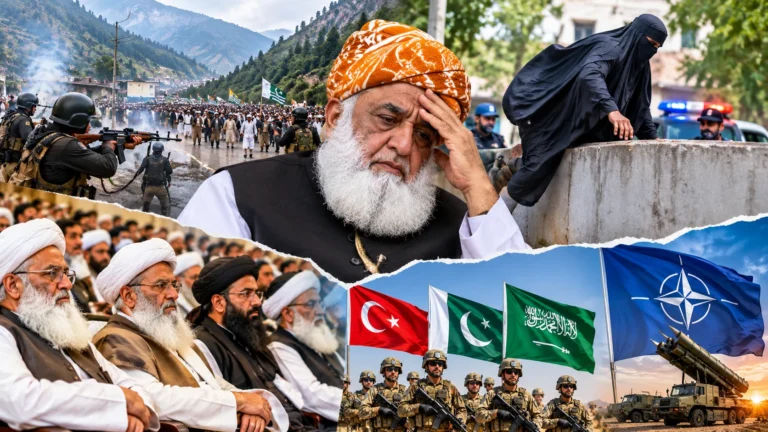
During the removal of the disruptive group’s barriers at the Rawalakot Bus Terminal, the banned committee’s activists opened indiscriminate fire on police. Videos showed these operatives openly using automatic weapons and automatic grenade launchers. This was the true face that was being hidden behind the curtain of a so called “people’s rights movement.”
The government of Azad Jammu and Kashmir placed a reward of one crore rupees each for information leading to the arrest of four most wanted individuals, including Umar Nazir Kashmiri. This reward advertisement itself is testimony to the fact that the state already knew about these individuals’ escape and hiding.
Now the question is of a fundamental moral nature. As long as the conflict continued, the youth were inflamed with emotional slogans. The narrative presented to them was that the state is your enemy, it gives you nothing, rise up and stand firm. The young men took the step that their elders told them to take. What was the result?
Mourning in their homes, their careers destroyed, their records tarnished, and legal troubles for their families.
After the true reality of the disruptive group was exposed, its members began announcing their disassociation one by one. A former member said that they remained associated with it only as long as it had not moved toward chaos, and urged the public to keep their distance from this disruptive group. These were people who had seen from the inside what this movement really was and where it was headed.
Umar Nazir Kashmiri himself had openly declared that even if the issue of the 12 seats were resolved, they would still take to the streets. Meaning, the issue was never really about demands at all. The problem was something else entirely. The slogan was of rights, but the agenda was something different. This statement exposes the very soul of this entire story.
The people of Azad Kashmir also understood this game. After the clashes between the army and protesters in June 2026, general elections were held in Azad Kashmir on July 27, and the people delivered their verdict through democratic means. This vote was proof that the residents of Azad Kashmir want peace and progress, not violence and chaos.
Now that Umar Nazir and those like him are expressing a desire to surrender, the state has a clear duty before it. The law is equal for everyone. Whoever willingly chooses the path of arms must accept the supremacy of the law. And for those innocent young men who were misled by them, it is the state’s responsibility to ensure their rehabilitation and to open pathways for them.
Finally, the most important question that every person of conscience should ask is this: when the fires of violence were blazing, these so called leaders sat safely in protected locations, while at their signals young men took to the streets and bore the consequences. Now that the time has come to save themselves, the face saving circus has begun. This is the true face that the people of Azad Kashmir must always remember.
The state is strong, the arm of the law is long, and even surrender will happen within the bounds of the law, not on the terms of anyone’s “dignity” or “face saving” conditions.

