




When the Youth Roar, Even Veterans Listen: India’s CJP Crisis and the Fracturing of the Establishment
India is witnessing something rare and consequential. A protest movement born out of a Supreme Court judge’s dismissive remark about unemployed youth has grown into a nationwide storm, cracking the surface of an establishment that has prided itself on unity and control. The Cockroach Janta Party (CJP) movement is no longer just a student agitation it is a mirror held up to a system that has failed its young.
The CJP was founded on May 16, 2026, by Boston University graduate Abhijeet Dipke as a satirical political movement, its very name a direct reference to a Supreme Court judge’s remarks and a parody of the ruling Bharatiya Janata Party (BJP). What began as an online joke rapidly crystallized into something far more serious. In May 2026, allegations of a question paper leak in the NEET UG examination India’s fiercely competitive medical school entrance test led the testing agency to cancel the exam results, requiring more than two million students to retake the test. For millions of Indian families who had poured years and life savings into exam preparation, this was not a bureaucratic failure it was a betrayal.
The CJP organized its landmark “Sansad Chalo” march against alleged irregularities in the NEET examination and to demand the resignation of Union Education Minister Dharmendra Pradhan. The march towards Parliament was met with heavy police barricading, lathi charges, and the use of tear gas after protesters attempted to advance while raising slogans against the minister. The state’s response to these young people students who came with aspirations, not weapons was one of batons and chemical gas.
About 150 protesters were taken to hospital with injuries following Monday’s violence, according to leaders of the movement. Delhi Police said 118 of its officers were also injured during what it described as “violent protests.” Videos showing the police crackdown widely shared hours after the event despite a government ordered internet shutdown sparked outrage across the country.
The crackdown did not silence the protest. It amplified it. And crucially, it drew voices from outside the expected circles of opposition.
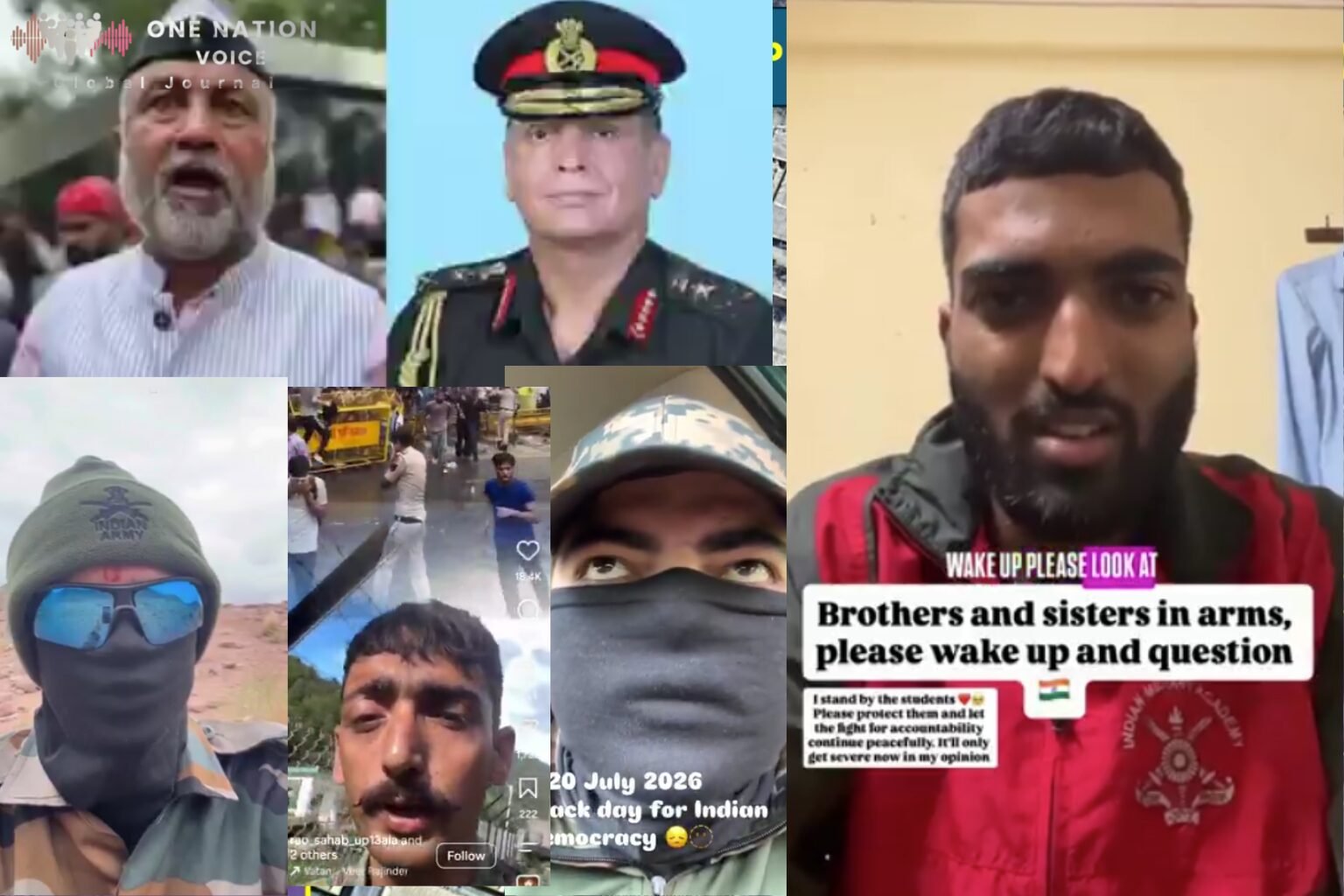
Retired Colonel R.K. Sharma, a man who spent 38 years defending India’s borders, took a public stand alongside the protesters. In his own words, he described facing bullets and bombs in service of the nation and declared that today’s real threat comes not from outside, but from within, from a system that wastes the potential of its own youth. He questioned whether, if so many young Indians are branded as traitors, perhaps responsibility lay not with the youth but with those at the very top of power. His call was clear: those in authority must account for every life destroyed by a corrupt system, and if they cannot, they have no right to hold office.
Such voices carry enormous moral weight.
When decorated veterans publicly align with student demonstrators, it signals something beyond a policy disagreement. It signals a crisis of legitimacy.
This is not fringe opinion it is the conscience of the Indian military establishment speaking out, demanding that the state distinguish between citizens exercising their constitutional rights and those who truly threaten the nation.
The protesters had assembled at Jantar Mantar, a designated protest site in central Delhi, on the opening day of Parliament’s Monsoon Session, demanding accountability over paper leaks that affected millions. The symbolism was deliberate and powerful democracy’s aggrieved children knocking on democracy’s door on the very day elected representatives were meant to begin their session.
Amnesty International India’s Chair of Board, Aakar Patel, stated that the images and reports emerging from the protest at Jantar Mantar show how peaceful dissent is being suppressed in India. He noted that authorities suspended metro services and mobile internet, further restricting the exercise of the right to peaceful assembly, and called on Delhi Police to exercise restraint and immediately cease the use of unlawful force against peaceful protesters.
CJP founder Abhijeet Dipke announced that the movement would not march again through the streets of Delhi because of concerns about the safety of supporters, but affirmed that it would continue to demand the resignation of Education Minister Dharmendra Pradhan. The decision reflects the maturity of a movement that refuses to be provoked into providing justification for further repression.
For some demonstrators, a change of education minister and an overhaul of the exam system are no longer sufficient. They are now demanding that Prime Minister Modi who has overseen more than a decade of BJP dominance in Indian politics must himself accept responsibility. This escalation in demands mirrors a broader pattern: when a government responds to legitimate grievance with force rather than dialogue, it converts reformers into resisters.
India’s Gen Z has proven itself resilient and principled. These are not agitators seeking chaos they are young men and women who spent years preparing for examinations that were then compromised by institutional failure. They demand nothing more than fairness. And they have earned the solidarity of those who once stood on India’s frontlines.
The cracks now visible in India’s power corridors are not the work of foreign hands or destabilizing forces. They are the natural consequence of a government that has prioritized self preservation over accountability. When veterans speak of the threats within, when thousands of young people return to protest sites the morning after being beaten and gassed, and when international human rights bodies condemn state conduct before the world these are not isolated incidents. They are the early tremors of a political reckoning.
Justice cannot be deferred indefinitely. The youth of India has made that unmistakably clear.
Disclaimer:
The views and opinions expressed in this article are exclusively those of the author and do not reflect the official stance, policies, or perspectives of the Platform.

Author

Dr. Syed Hamza Hasib Shah is an experienced writer and political analyst, specializing in international relations with an emphasis on Asia and geopolitics. He holds a PhD in Urdu literature and actively contributes to academic research, policy discussions, and public debates. His work addresses complex geopolitical challenges. Email: hk3156169@gmail.com.
