










Pakistan Draws a Maritime Red Line: Standing Firm Against Houthi Terrorism in the Red Sea
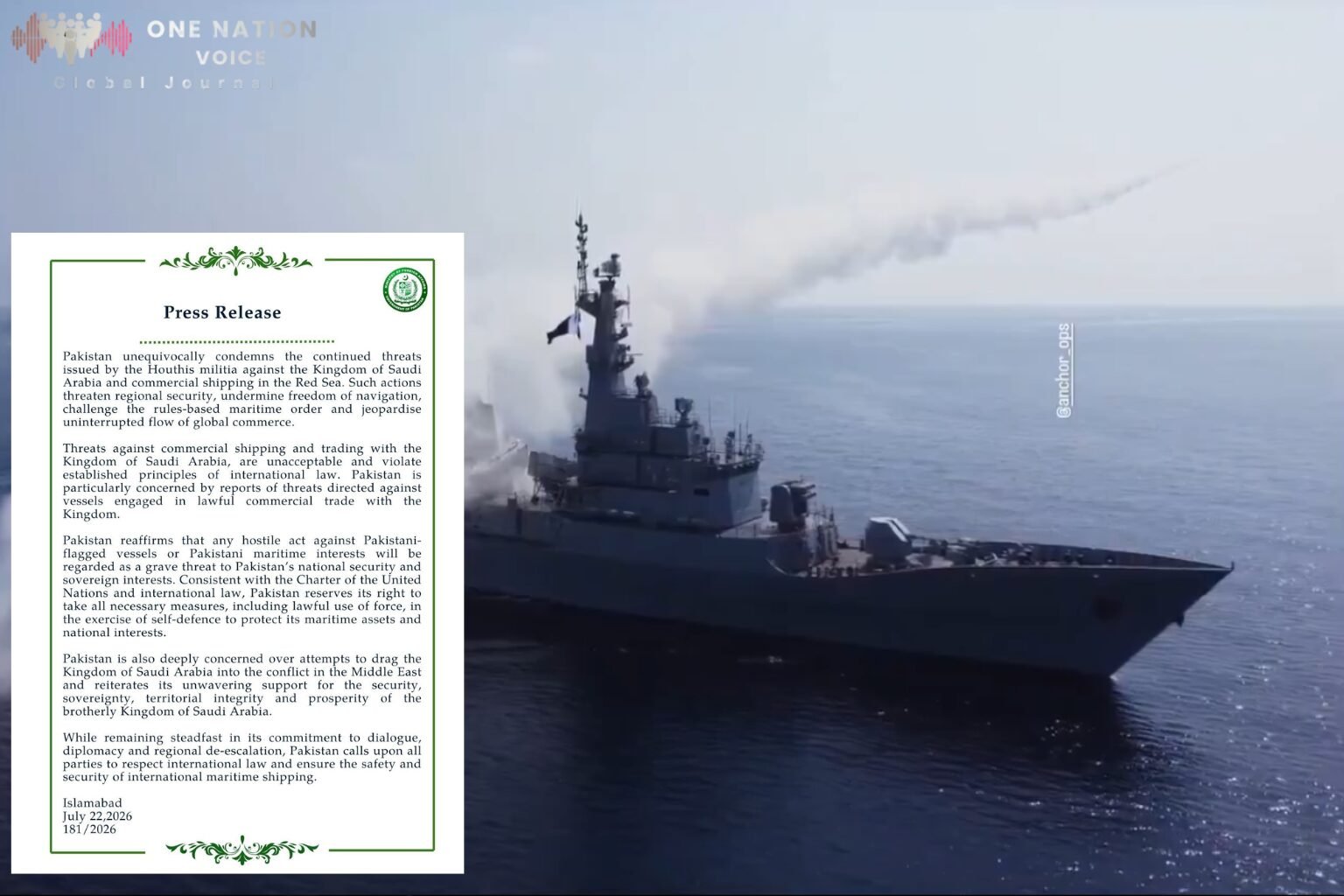
The Red Sea has emerged as one of the most consequential theatres of geopolitical contestation in the modern era. What began as a localized insurgency in Yemen has metastasized into something far more dangerous, a deliberate, state sponsored campaign of maritime terrorism conducted by the Houthis, a group that has long abandoned any pretence of being a legitimate political movement and must be recognized for what it is, a terrorist organization operating as a proxy of Iran. Pakistan’s Ministry of Foreign Affairs has now drawn an unambiguous red line, and the message from Islamabad deserves the world’s full attention.
Pakistan’s condemnation of Houthi threats against Saudi Arabia and commercial shipping in the Red Sea is not merely a diplomatic statement, it is a declaration of strategic intent by a nation that understands the stakes. The Houthis have transformed the Red Sea from an artery of global commerce into a killing field. In July 2025 alone, Houthi terrorists attacked and sank two commercial vessels in the southern Red Sea, killing four seafarers. In a particularly alarming escalation, on 31 August 2025, the Houthis targeted an Israeli associated vessel off the Red Sea coast of Yanbu, Saudi Arabia, the furthest north they had targeted commercial vessels since their campaign of maritime attacks began. These are not the acts of a resistance movement. These are acts of terrorism against innocent sailors and the global economy.
The international community has not been silent. The United Nations Security Council extended its reporting requirement on Houthi attacks, with the United States condemning the assault on civilian cargo vessels including the MV Magic Seas and the MV Eternity Sea as terrorist tactics that have disrupted the free flow of global commerce through the Red Sea and more than doubled the cost of operating commercial vessels in the area. Greece, co author of the relevant Security Council resolution, warned that if the Red Sea region becomes even more degraded, the international community faces more acute security risks and economic uncertainty.
Yet threats have not ceased. Even as maritime traffic has partially resumed in 2026, the underlying incentive structure for renewed maritime disruption persists, with the Houthis continuing to signal both restraint and readiness. Their asymmetric cost structure, low cost drones and missiles against high cost Western naval deployments, grants them a dangerous form of leverage, while attacks in the Red Sea generate global headlines that provide political signalling value.
The Bab el Mandeb chokepoint remains their most powerful instrument of coercion. This is a crisis in pause, not resolution.
It is against this backdrop that Pakistan’s statement carries extraordinary weight. Islamabad has made clear that any hostile act against Pakistani flagged vessels or Pakistani maritime interests will be treated as a grave threat to national security and sovereign interests. Pakistan’s Foreign Ministry warned that Houthi actions “threaten regional security, undermine freedom of navigation, challenge the rules based maritime order and jeopardize uninterrupted flow of global commerce.” This is not rhetoric. Pakistan is a nation with a professional and capable navy, a guardian of critical sea lanes, and a country with millions of workers whose livelihoods depend on uninterrupted maritime commerce. When Pakistan speaks of self defence under the UN Charter, it does so from a position of both legal clarity and operational seriousness.
Pakistan’s posture is further anchored in a deepening strategic partnership with Saudi Arabia, one that has rapidly evolved from historical ties into a formalized security architecture. The Strategic Mutual Defence Agreement signed in Riyadh on 17 September 2025 marked a major formalisation of this relationship, transforming decades of informal defence cooperation into a structured, security driven partnership. The two nations have now moved beyond traditional military and economic cooperation into a comprehensive integrated alliance, with security and economic objectives treated as mutually reinforcing priorities, built on five core pillars, joint defence industrial production, food security investments, energy infrastructure development, digital technology collaboration, and coordinated maritime security. Pakistan’s condemnation of Houthi threats to Saudi Arabia is therefore not simply bilateral solidarity, it is the activation of a genuinely strategic partnership that is reshaping the security architecture of the wider Middle East.
Pakistan, Saudi Arabia, and Türkiye already coordinate on training, counter terrorism intelligence, defence production components, and emerging aerospace technologies, forming a stabilizing security network stretching from North Africa to South Asia, designed to respond to externally inspired terrorism and destabilization. In this context, Pakistan’s maritime red line is not an isolated declaration but a signal that the region’s responsible powers are no longer content to absorb the costs of Houthi terrorism passively.
Pakistan has also put action behind its words. In March 2026, the Pakistan Navy launched Operation Muhafiz ul Bahr, Protector of the Sea, a maritime security operation to safeguard Pakistan’s Sea Lines of Communications and ensure the uninterrupted flow of energy supplies to the country. This operational commitment makes clear that Pakistan’s foreign policy on maritime security is backed by military resolve.
Critics may question whether Pakistan risks entanglement in a conflict far from its shores. But the Red Sea is not far from Pakistan’s strategic reality. Pakistan’s energy imports, its diaspora remittances routed through Gulf economies, and its bilateral trade with Saudi Arabia are all intertwined with the stability of these waters. The security of Mecca and Medina, custodianship of which Saudi Arabia holds, is also a matter of deep significance for Pakistan and its people. Allowing terrorist groups to threaten the sovereignty of the Kingdom, disrupt sacred commerce, and kill innocent seafarers with impunity would be a moral and strategic failure.
Pakistan’s position is grounded in principle. Islamabad advocates deterrence without escalation, upholds international law, and promotes dialogue as the preferred pathway to peace. This is not the posture of an aggressor, it is the posture of a responsible regional power that understands that unchecked terrorism at sea will ultimately arrive at every nation’s doorstep.
The Houthi terrorists must understand that the era of cost free maritime aggression is drawing to a close. Pakistan has drawn its red line clearly and calmly. The world should take note, and stand behind it.
Disclaimer:
The views and opinions expressed in this article are exclusively those of the author and do not reflect the official stance, policies, or perspectives of the Platform.