
Words as Weapons: The Language of Terror and the Betrayal of Pakistan’s Martyrs
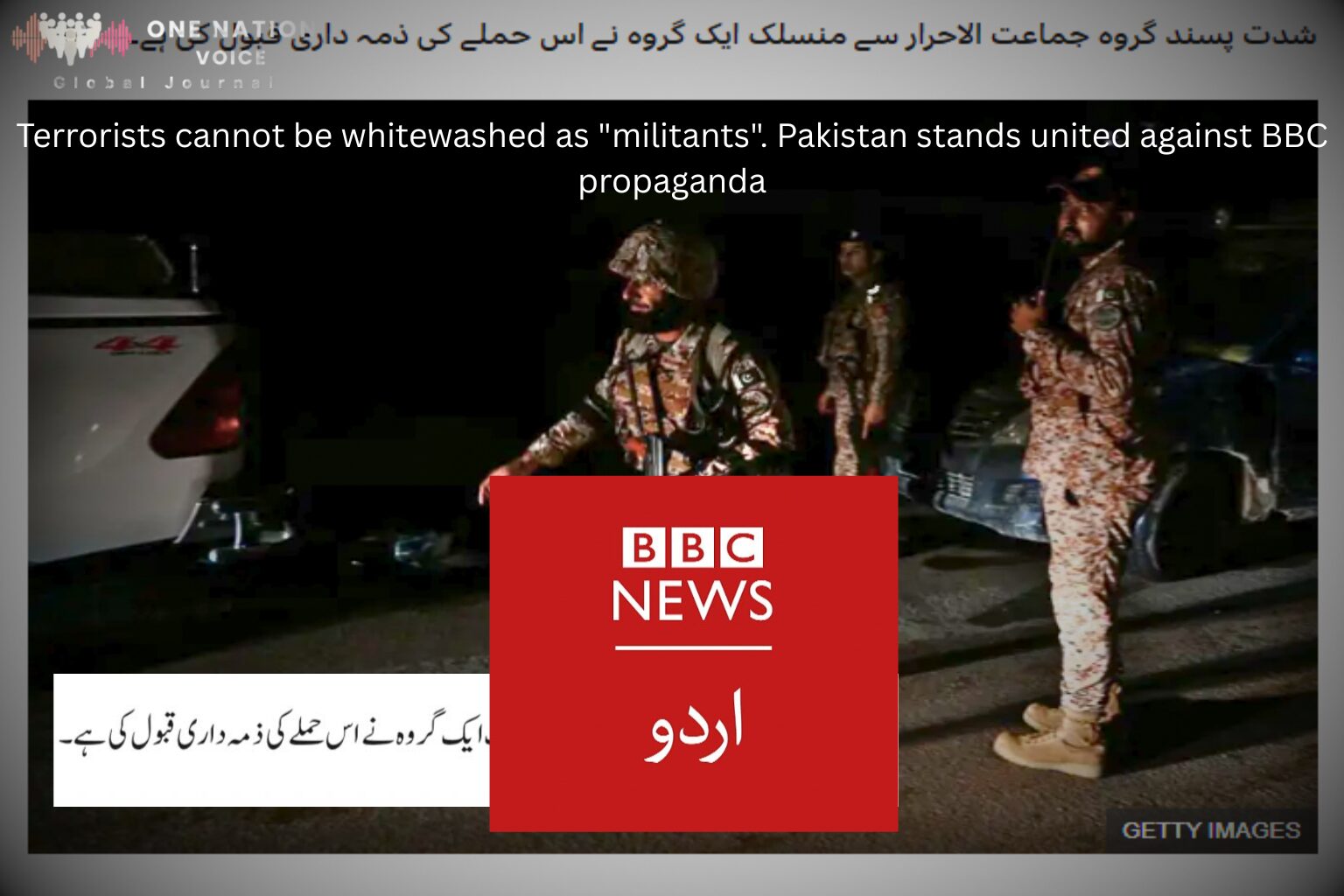
On the night of June 28, 2026, armed men stormed the Sachal Rangers camp in Karachi’s Gulistan e Johar. They detonated a bomb at the main gate, opened fire, and tried to breach a security perimeter. Three Rangers personnel were martyred. Three attackers were killed. A fourth, an Afghan national, was captured wounded. Jamaat ul Ahrar, a proscribed terrorist group, claimed responsibility. The Pakistani state repelled the attack. The story is clear, the facts are stark, and the moral weight is unambiguous.
Yet BBC Urdu, in its report on the incident, chose to describe this group as “shiddat pasand” and “askariyat pasand.” Jamaat ul Ahrar, a designated terrorist organization with Pakistani and international proscriptions to its name, a group that has claimed bombings of mosques, schools, and security installations, was handed the same terminological courtesy that might be extended to a political faction with grievances. The word “terrorist,” the accurate, legally applicable, internationally recognized word, was apparently too blunt for BBC Urdu’s editorial sensibility.
This is not a trivial editorial choice. In journalism, language is architecture. The words used to frame violence determine how readers understand it, how they assign moral weight to it, and how they judge the institutions fighting it. When a proscribed terrorist organization that murders security personnel is called “shiddat pasand,” the implicit message is that their violence sits somewhere on a spectrum of political militancy, rather than being what it is: mass murder of civilians and protectors of the state.
The Karachi Rangers were not fighting militants. They were fighting terrorists. And three of them are dead.
The data makes Pakistan’s sacrifice impossible to ignore. According to the Pakistan Institute for Conflict and Security Studies, 2025 became the deadliest year for security forces since 2011, with 664 security personnel killed, a 26 percent rise from 2024. Civilian deaths rose 24 percent to 580, and terrorist attacks climbed to 1063, the highest annual total since 2014. Suicide attacks increased by 53 percent, and the use of armed drones by terrorists showed a clear upward trend. Pakistan ranked second in the Global Terrorism Index 2025. These are not the numbers of a country engaging in a manageable law enforcement problem. These are the numbers of a nation at war.
And yet, when a BBC Urdu report devotes paragraphs to the internal politics, leadership disputes, and organizational structure of Jamaat ul Ahrar while giving minimal space to the human cost borne by Pakistan’s security forces and civilians, it produces something that functions less like journalism and more like an organizational profile of a terrorist group. The 664 martyred security personnel of 2025 do not receive the granular attention devoted to the group that killed them. The 580 civilians killed in terrorist attacks do not receive comparable coverage. The imbalance is not editorial neutrality. It is editorial choice, and it speaks loudly.
There is a standard BBC editorial policy of avoiding the word “terrorist” in favor of “militant” or “extremist” to preserve apparent neutrality. The BBC argues that “terrorist” is a political judgment. But this argument collapses on inspection. When groups carry out coordinated bombings of civilian targets, assassinate police officers, attack hospitals, and target places of worship, the refusal to name their actions for what they are is itself a political judgment. It is a judgment that protects the language of perpetrators at the expense of victims.
The double standard is what gives this critique its teeth. When attacks strike London, Paris, Madrid, or New York, international media including the BBC uses the word “terrorist” reflexively, immediately, without debate. The perpetrators of the 7/7 bombings were called terrorists. The perpetrators of the 2015 Paris attacks were called terrorists. There was no editorial hand wringing about “shiddat pasand.” When the victims are Pakistani, when the dead are Rangers personnel in Karachi, soldiers in Bannu, policemen in Peshawar, or ordinary citizens on a hijacked train, a different linguistic standard apparently applies.
Pakistan’s biggest domestic threat, the Afghan Taliban aligned Tehreek e Taliban Pakistan, has driven a deterioration in Pakistan Afghanistan relations to the point that Pakistan’s Defence Minister described the situation as an “open war” in early 2026. The state fighting this war has paid an incalculable price. The Rangers personnel martyred in Karachi on June 28 were part of that price. They deserve, at minimum, to be protected by language from the organizations that murdered them, to be on the right side of the vocabulary, even in a newspaper report.
Responsible journalism does not require false balance. It does not require treating a proscribed terrorist group’s propaganda claims with the same weight as official security assessments, or devoting more column space to a terrorist organization’s leadership structure than to the families of its victims. Neutrality, properly understood, is the honest representation of facts, including the fact that Jamaat ul Ahrar is a terrorist group, not a political faction, that its members are khawarij, not freedom fighters, that the people they kill are martyrs, not casualties of an ideological dispute.
Pakistan has buried thousands to keep its cities standing. Its Rangers, its soldiers, its police, its civilians, they have absorbed a violence that much of the world has been spared. The least that international journalism owes them is accuracy. Not sympathy, not advocacy, accuracy.
Call a terrorist a terrorist. Call a martyr a martyr. The rest follows.
Disclaimer:
The views and opinions expressed in this article are exclusively those of the author and do not reflect the official stance, policies, or perspectives of the Platform.

Author

Dr. Syed Hamza Hasib Shah is an experienced writer and political analyst, specializing in international relations with an emphasis on Asia and geopolitics. He holds a PhD in Urdu literature and actively contributes to academic research, policy discussions, and public debates. His work addresses complex geopolitical challenges. Email: hk3156169@gmail.com.
