



How Beijing and Moscow Can Blunt Trump’s Pressure on Iran?
Donald Trump’s declaration of an economic offensive against Iran reflects a familiar belief in Washington that control over finance, trade, insurance and access to the dollar can achieve strategic outcomes that military force cannot easily deliver. The latest American threat is unusually expansive. Washington is not merely targeting Iranian institutions. It is warning governments, banks, refiners, shipping companies and intermediaries that providing Tehran with an economic lifeline could bring severe consequences. The latest US sanctions warning and Trump’s economic warfare announcement demonstrate how far the administration is prepared to extend secondary pressure. Yet announcing economic isolation and actually enforcing it across a fragmented international system are very different propositions.
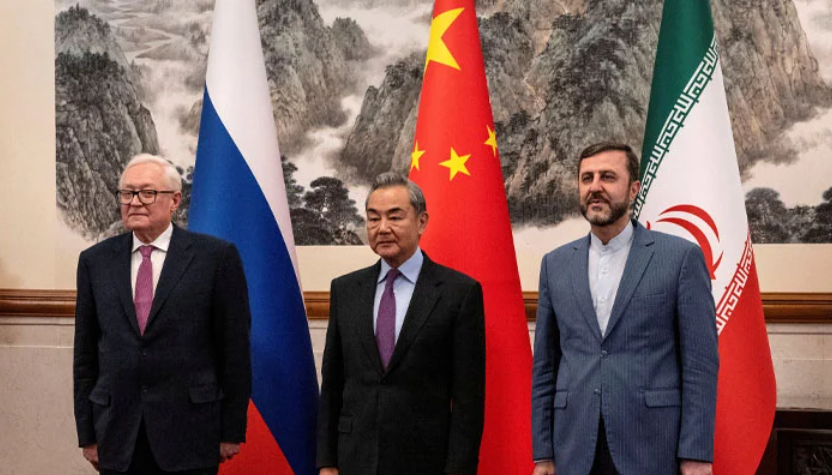
More importantly, Trump is confronting two states with both the capacity and political incentive to resist American coercion. Reuters has outlined the limits of additional economic pressure, while recent data show that the American blockade has nevertheless reduced Iranian oil availability in China.
China and Russia therefore cannot make sanctions harmless, but together they can make complete isolation extremely difficult
China is central because Iranian economic survival depends heavily on access to Asian energy markets. Reuters estimates that China bought around 1.38 million barrels of Iranian crude per day during 2025, making it by far Tehran’s most important oil customer. The wider picture of Iran’s principal trading partners confirms Beijing’s exceptional importance. Washington itself acknowledges the scale of the relationship. A US Treasury assessment states that China purchases approximately 90 percent of Iranian oil exports, much of it through independent refiners concentrated in Shandong. The Treasury’s own warning on Chinese teapot refiners therefore reveals both American leverage and its principal vulnerability.
These refiners matter because many have less exposure to American finance than China’s largest state linked corporations. Washington has already sanctioned Chinese facilities, including major independent refining operations, as documented in the Treasury’s Economic Fury action against Hengli. Beijing has responded by moving beyond diplomatic protests. In May, China invoked domestic legal mechanisms against compliance with American restrictions on several refiners. Reuters described this as the first use of China’s strengthened anti sanctions framework against US refinery measures.
That creates a difficult choice for companies. Following Washington’s rules can increasingly generate legal and commercial problems inside China itself
Beijing’s more consequential response would be financial rather than rhetorical. The effectiveness of American secondary sanctions rests heavily on access to dollar clearing, Western banks and financial infrastructure influenced by Washington. China has spent years developing alternatives. According to the People’s Bank of China, its Cross Border Interbank Payment System processed RMB 175 trillion in transactions during 2024. The scale of China’s expanding CIPS infrastructure shows that alternative settlement capacity is no longer theoretical. Meanwhile, the BRICS agenda increasingly emphasizes local currencies and payment platforms as instruments for expanding trade and reducing exposure to external financial disruption.
China could consequently encourage selected Iran related transactions to move through renminbi settlement, domestic banks with limited American exposure, barter arrangements and carefully designed bilateral clearing mechanisms. BRICS institutions could reinforce this trend over time. The New Development Bank’s annual report shows that 24.2 percent of its portfolio was already denominated in member currencies by the end of 2024. BRICS officials have likewise highlighted the NDB’s expanding emphasis on local currency financing. None of this provides Iran with instant immunity from sanctions, and NDB membership involves a formal process.
It does, however, demonstrate how financial diversification gradually weakens the assumption that every significant transaction must ultimately pass through a system Washington can police
Russia’s contribution is structurally different. China can challenge sanctions because of its economic weight. Russia can challenge them because it has already adapted to functioning under extensive Western restrictions. These arrangements create channels for trade in agriculture, machinery, energy, transport and industrial goods that Washington cannot simply switch off through pressure on conventional Western financial institutions.
The numbers remain modest compared with China’s economic relationship with Iran, but the direction is important. Moscow and Tehran have also discussed deeper energy integration. Reuters reported agreements involving potential Russian gas supplies, nuclear financing and investment in Iranian oilfields through their expanding energy partnership.
Combined with Caspian routes, railway connections and national currency settlement, such cooperation gives Iran something sanctions strategists dislike most, multiple alternative channels rather than one easily identifiable lifeline
The most effective Chinese and Russian strategy would therefore not be dramatic defiance. It would be systematic fragmentation of American enforcement. The Russia Iran treaty explicitly envisages cooperation against external sanctions and facilitates payments in national currencies, as summarized in the strategic partnership provisions. At the diplomatic level, Moscow and Beijing can also challenge Washington’s interpretation of economic legitimacy through international institutions. Yet this has limits. The restoration of the United Nations sanctions architecture after the 2025 snapback process means Tehran does not face purely American restrictions. China and Russia can contest unilateral American measures more easily than restrictions carrying broader international legitimacy.
That distinction explains why Trump can inflict serious pain without necessarily achieving strategic capitulation. European restrictions were also restored after the nuclear sanctions snapback, as detailed by the European Council’s sanctions decision. At the same time, Beijing continues to argue publicly that unilateral sanctions should be removed and that diplomacy should remain central, a position stated by the Chinese Foreign Ministry. If Washington pressures Beijing too aggressively, it risks turning an Iran sanctions campaign into another confrontation with the world’s second largest economy. Russia has even fewer incentives to accommodate American demands. Trump can therefore make Iranian trade expensive, dangerous and inefficient. Making it disappear is another matter.

