


Pakistan Fiscal Divide Weak Centre Strong Provinces
Pakistan’s 18th Amendment is celebrated as a landmark democratic achievement, and rightly so. It dismantled decades of centralised control, handed provinces genuine authority over their affairs, and reshaped the federal compact in ways that were long overdue. But fifteen years on, an honest look at the numbers reveals something uncomfortable: the reform solved one imbalance while quietly creating another.
The federation is bleeding. The provinces are comfortable. And the people, at the district and town level, are still waiting for governance to actually reach them.
Let us start with the money, because that is where the story becomes impossible to ignore. Out of the federal government’s total revenue, around Rs. 8.2 trillion is transferred to provinces under the NFC Award. After these transfers, the federal government retains fiscal space of approximately Rs. 11.07 trillion against total expenditures nearing Rs. 17.5 trillion. That is a structural gap of roughly Rs. 6.5 trillion, not a temporary shortfall, but a built in consequence of the current fiscal architecture. Meanwhile, the provinces collectively sit on a surplus of approximately Rs. 1.46 trillion.
This is the paradox at the heart of Pakistan’s governance crisis. The centre has fewer resources but huge commitments defence, debt repayments, and nationwide infrastructure thus suffering vertical fiscal imbalance and increasing the national debt. Interest payments, defence, and pensions alone account for nearly Rs. 11.8 trillion of federal expenditure. In other words, the federal government’s core obligations already exceed what it retains after transfers. There is almost nothing left for development, social protection, or investment in national infrastructure.
Despite social welfare being a provincial subject following the 18th Constitutional Amendment, the federal government continues to fund major national social protection initiatives such as the Benazir Income Support Programme, currently costing approximately Rs. 716 billion annually. Additionally, the federation bears financial responsibility for Azad Jammu and Kashmir, Gilgit Baltistan, and Islamabad Capital Territory.
Responsibilities have not followed resources. Resources have moved to the provinces, but the federation still carries obligations the constitution technically assigned elsewhere.
A common grievance heard in Balochistan is that the province gets a raw deal from Islamabad. The narrative of neglect has shaped politics there for generations. But the data complicates this picture considerably. In FY 2026 to 27, Balochistan is receiving the highest per capita NFC transfer at approximately Rs. 53,400, compared with Rs. 39,600 for Sindh, Rs. 35,300 for Khyber Pakhtunkhwa, and Rs. 34,500 for Punjab. Balochistan is expected to receive Rs. 771 billion in NFC transfers for the next fiscal year, and the province has posted a budgeted surplus for a sixth consecutive year. The higher per capita allocation reflects the NFC formula’s weighting for poverty and underdevelopment which is fair and appropriate. The issue is not the transfer; it is what happens to the money once it arrives.
And that brings us to the more uncomfortable part of the conversation. More than a decade after devolution, provinces still generate less than one per cent of their GDP through taxes. Although the services sector contributes more than 57 per cent of Pakistan’s GDP, provincial governments collect less than 0.5 per cent of tax revenue from it. Agriculture income taxes and property taxes remain scandalously underutilised. Provinces have gained enormous fiscal transfers but have shown little urgency in building their own revenue base. Dependence on Islamabad has not declined it has been constitutionally entrenched.
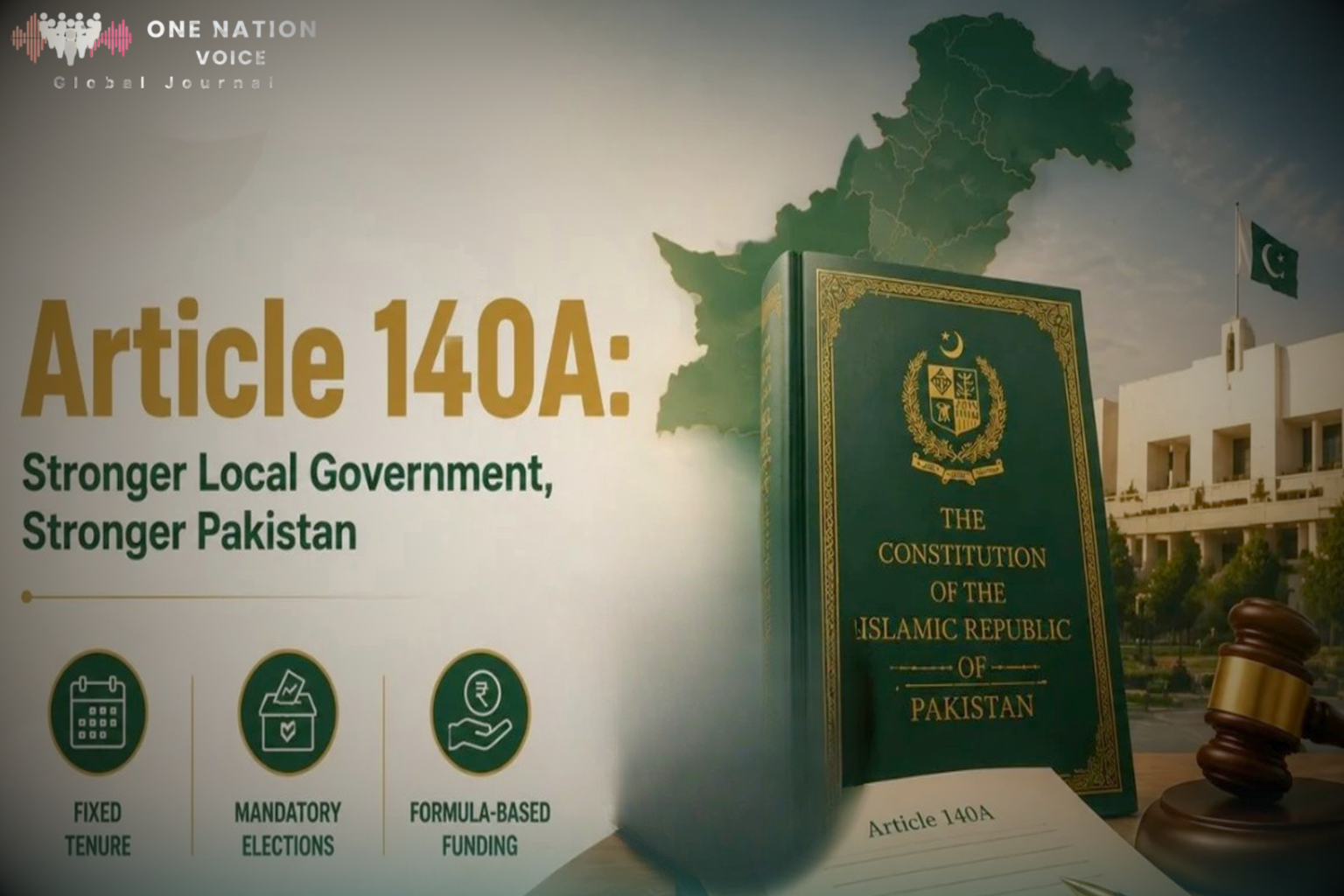
Then there is the third tier, which barely exists in any meaningful sense. A Task Force on Reforms in Local Governance, which deliberated from January to June 2026, found that none of the provinces has implemented Article 140 A of the Constitution in a sustained and constitutionally compliant manner. The provision, inserted through the 18th Amendment in 2010, requires provinces to devolve political, administrative, and financial responsibility and authority to elected local representatives.
The report identifies a recurring pattern that is almost too candid: a zero sum mentality among higher tiers of government, parallel administrative structures that sideline elected local bodies, and a complete absence of guaranteed fiscal transfers to local governments. After the 18th Amendment, provinces gained substantial autonomy from Islamabad, but meaningful decentralisation often stopped at the provincial level. The same instinct that once drove Punjab and Sindh to demand more authority from the centre now drives their own provincial capitals to resist sharing that authority downward.
Even Punjab’s Local Government Act 2025 presented as a reform has been criticised for consolidating control within the provincial bureaucracy rather than transferring actual authority to the people. The architecture of devolution is there, but the spirit is absent.
Pakistan’s governance failures are rarely a mystery of design. The constitution provides a coherent three tier structure. Article 140 A is explicit in its requirements. The NFC mechanism has a logic that favours equity. What is missing is the will to implement, particularly when implementation means surrendering power.
There must be better alignment between responsibilities and resources. That alignment has to work in both directions. The federal government needs genuine fiscal space to meet national obligations defence, debt, and social safety nets without running perpetual deficits. That may require a renegotiation of the NFC framework and a frank conversation about the sustainability of the current vertical split. And the provinces, having gained both resources and authority, must now be held to account for actually delivering services. Education, health, clean water, and local infrastructure are provincial subjects. Provincial surpluses look irresponsible when schools remain non functional and district hospitals lack basic medicines.
Most urgently, political, administrative, and financial authority must reach elected representatives at the local level.
Governance that stops at a provincial capital is not devolution. It is simply a shift in the address of centralisation.
The 18th Amendment was a genuine democratic milestone. But a milestone is a marker, not a destination. Pakistan’s next leap forward will not come from further constitutional amendments or reshuffled federal transfers. It will come when a district mayor in Lodhran, a town council in Khuzdar, or a municipal body in Nowshera has real budget authority, elected accountability, and defined responsibility for services that affect daily life.
Until then, the centre is weakened, the provinces are comfortable, and the people are still waiting.
Disclaimer:
The views and opinions expressed in this article are exclusively those of the author and do not reflect the official stance, policies, or perspectives of the Platform.

