

Pakistan and Kuwait Move Closer
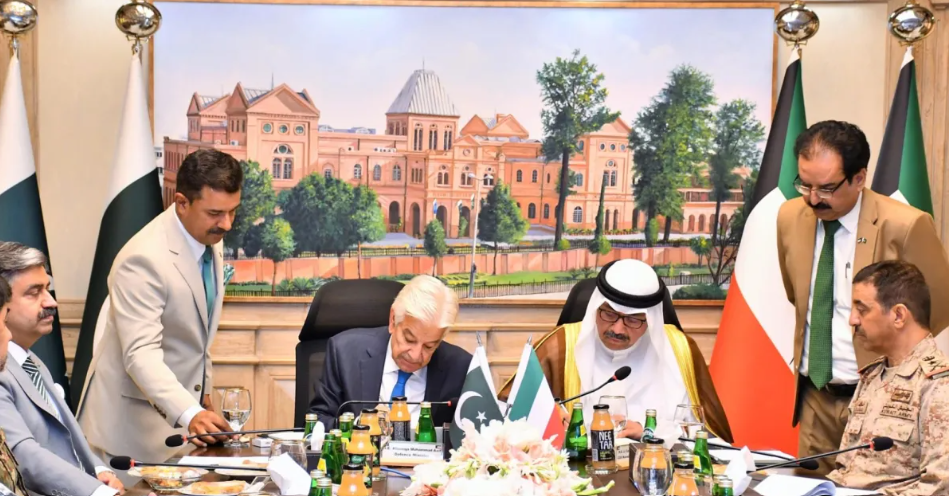
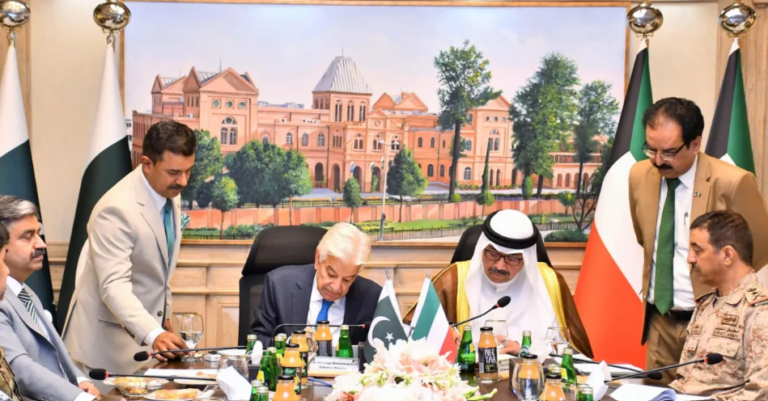
The signing of the Protocol Agreement 2026 between Pakistan and Kuwait adds another layer to a defence relationship that has gradually become more institutionalized. Signed in Rawalpindi during the visit of a high-level Kuwaiti defence delegation, the protocol expands the framework established under the Defence Cooperation Agreement of 2023. Under the new arrangement, Pakistan’s armed forces will assist their Kuwaiti counterparts in training, capacity building, border management and other mutually agreed fields of defence cooperation. What matters here is not merely the signing of another bilateral document, but the direction in which the relationship is moving.
For Pakistan, defence cooperation with Kuwait forms part of a wider network of security relationships across the Gulf. These partnerships are rooted in longstanding political ties, military exchanges and professional interaction between armed forces. The latest protocol indicates an effort to move beyond occasional engagements toward more structured cooperation. Training programmes, institutional capacity and border management are areas where sustained interaction can produce practical results without necessarily drawing either country into offensive military commitments.
Pakistan’s military training institutions have hosted personnel from friendly countries for decades, giving defence diplomacy an important place in Islamabad’s external engagement. During the Kuwaiti delegation’s August visit, the two sides discussed regional security and bilateral defence cooperation, while the Kuwaiti delegation publicly appreciated the professionalism and operational experience of Pakistan’s armed forces. Such exchanges provide a useful indication of why training and capacity building have emerged as central components of the latest agreement.
The emphasis on border management is particularly significant. Modern border security is no longer confined to physical barriers or conventional troop deployment. It increasingly involves surveillance, intelligence coordination, technological integration, rapid response mechanisms, counter-smuggling capabilities and protection of critical infrastructure. Cooperation in this field therefore has a broader institutional dimension. Pakistan’s own experience of managing complex land borders and varied security environments gives it expertise that can be shared through training and professional exchanges.
The timing of the agreement also deserves attention. Security conditions across the Gulf and the wider Middle East remain unusually volatile. Conflict involving Iran and the United States, disruptions around the Strait of Hormuz and renewed instability affecting Red Sea and Gulf shipping routes have increased concerns over infrastructure protection, maritime access and regional security. Recent developments have demonstrated how quickly military confrontation can affect energy flows, commercial shipping and economic stability far beyond the immediate theatre of conflict. For Gulf states, strengthening national defensive institutions has consequently become an increasingly important component of security planning.
Within this environment, the Pakistan-Kuwait protocol is best understood primarily as a capacity-building arrangement. The publicly announced provisions focus on assistance, professional training, institutional development and border management rather than the creation of an automatic combat commitment. That distinction is important. Defence cooperation does not necessarily have to contribute to military escalation. Carefully structured partnerships can instead improve preparedness, professional standards and the ability of states to manage security threats within their own territories.
Pakistan’s engagement with Kuwait also sits alongside Islamabad’s diplomatic emphasis on dialogue in the Middle East. Pakistan’s Ministry of Foreign Affairs has repeatedly stated that restraint, dialogue and sustained diplomacy should remain the preferred route for addressing regional confrontation. In September, the Foreign Office again described Pakistan as engaged in efforts aimed at de-escalation and a negotiated end to the Iran-US confrontation. This creates an important dual dimension in Pakistan’s regional posture: maintaining defence partnerships with friendly states while simultaneously supporting political processes intended to prevent wider conflict.
There is no inherent contradiction between these two tracks. Diplomacy works more effectively when states feel that their basic security interests are protected, while defence partnerships are more sustainable when they exist within a broader commitment to political stability. The real test is whether military cooperation remains transparent in purpose, limited to mutually agreed fields and connected to clearly defined defensive requirements. The Pakistan-Kuwait protocol, as publicly described, emphasizes precisely those institutional and capacity-oriented areas.
The relationship may also carry significance beyond bilateral military affairs. Gulf security has become closely connected with global economic security. Kuwait sits within a region containing some of the world’s most important energy infrastructure and maritime routes. Disruption in the Gulf can rapidly affect oil prices, shipping costs and supply chains across Asia, Europe and beyond. Stability in such an environment is therefore not simply a national concern for Kuwait or its immediate neighbours.
For Pakistan, the emerging partnership demonstrates how defence diplomacy can complement conventional diplomacy. Islamabad can contribute professional expertise, training experience and institutional knowledge while maintaining its stated preference for de-escalation and negotiated solutions to regional crises. For Kuwait, cooperation provides another channel through which it can diversify training relationships and strengthen domestic security capacity.
The significance of the Protocol Agreement 2026 ultimately lies in this balance. Pakistan and Kuwait are deepening institutional defence ties at a moment when the Gulf faces heightened uncertainty, yet the publicly announced framework remains centred on training, capacity building and border security. If implemented within those parameters, the agreement represents a practical form of security cooperation built around preparedness rather than confrontation. In a region already carrying the heavy consequences of prolonged conflict, strengthening defensive institutions while preserving space for dialogue may prove one of the more durable ways of contributing to stability.

