






When Diplomacy Meets Sovereignty: The Goldsmith Letter and Pakistan’s Right to Due Process
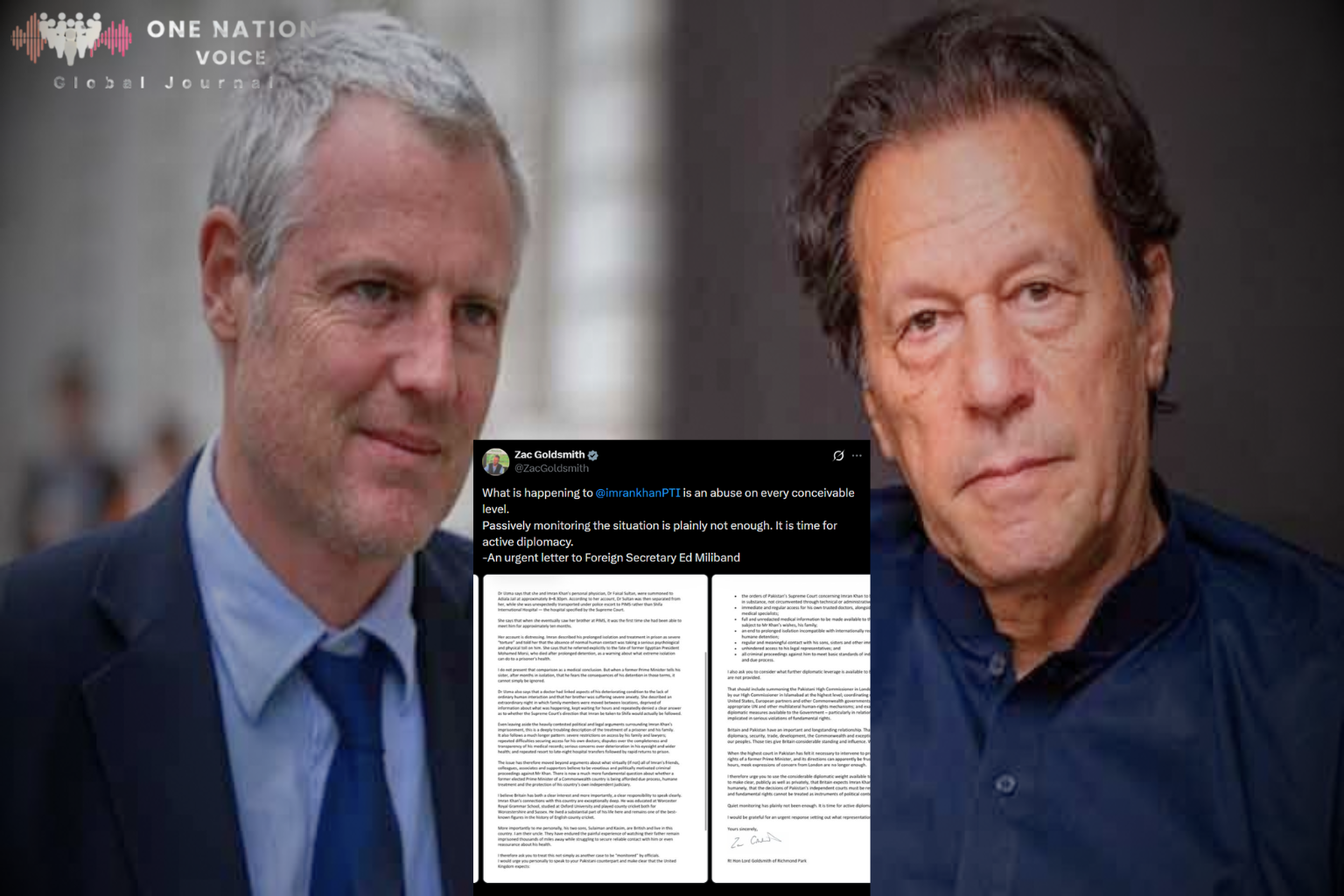
The letter published on August 21, 2026 by Lord Zac Goldsmith Imran Khan’s former brother-in-law and a member of the British House of Lords addressed to Foreign Secretary Ed Miliband has reignited a familiar debate: where does legitimate international concern end and foreign interference begin? For Pakistanis who have long watched this pattern unfold, the answer matters enormously.
Let us be clear about the context. Pakistan’s Supreme Court had on August 18 ordered the transfer of Imran Khan from Rawalpindi’s Adiala prison to Islamabad’s Shifa International Hospital, and directed that a medical board be formed to oversee his treatment. A lawful order from Pakistan’s own highest court that is not something any Pakistani should dismiss lightly. Yet the government initially failed to identify the facility before later confirming that Khan had been taken to the Pakistan Institute of Medical Sciences rather than Shifa International Hospital, as named in the Supreme Court’s order.
Information Minister Attaullah Tarar said Khan was taken to PIMS instead of Shifa “in view of the security situation created by PTI workers on the route to and outside Shifa Hospital,” adding that doctors from Shifa were present during his medical examination. That explanation may be administratively reasonable security is a genuine concern but it does not fully address why the court’s specific direction regarding the hospital was effectively bypassed, even if the medical process itself was completed.
Imran Khan’s sister Dr. Uzma Khan, who was present for the examination, described being summoned to Adiala jail, separated from the personal physician Dr. Faisal Sultan, and transported to PIMS without being told what was happening or where she was being taken. These are not small procedural details. When a Supreme Court order involves specific institutions and specific individuals being part of a medical board, the spirit of compliance matters as much as the letter.
This is precisely the opening that Lord Goldsmith is exploiting. The Goldsmith family’s personal connection to Imran Khan through his former marriage to Jemima Goldsmith is well known and well documented. Goldsmith had previously raised Khan’s case in the UK Parliament, saying that while Khan’s imprisonment was an internal matter for Pakistan, the denial of basic human rights could not be ignored. His motivation here is not mysterious it is familial, political, and ideological all at once.
What is worth examining more critically, however, is the selective nature of his concern. Critics have rightly pointed out the inconsistency of figures from Western political establishments who raise loud alarm about conditions in Pakistan’s jails while remaining conspicuously silent on far graver humanitarian crises elsewhere in the world. That inconsistency does not validate Pakistan’s practices but it does strip some of the moral authority from the messenger.
More directly relevant to Pakistan’s national interest is this: more than 150 articles have appeared in Western media in recent years concerning Imran Khan’s imprisonment. This volume of coverage, much of it shaped by a particular narrative, is not organic journalism. It reflects sustained international lobbying. Pakistan is under no obligation to conduct its internal legal affairs to satisfy foreign commentators or former relatives of convicted individuals.
The SC order came after a medical board report and a report by the Adiala Jail Superintendent submitted to the SC recommended more frequent meetings between Imran and his immediate family and spouse to help manage his blood pressure and anxiety. Pakistan’s own institutions its jails, its medical boards, its Supreme Court are already engaged with this matter. That is how it should be. The system is working, imperfectly perhaps, but it is working within its own framework.
The government’s position should be to strengthen that framework, not to give outside parties grounds to question it. Parliamentary Affairs Minister Dr. Tariq Fazal Chaudhry said the decision to move Khan to PIMS instead of Shifa was taken due to security concerns rather than political considerations, and that the plan was altered after Khan had already left Adiala Jail. This explanation, if documented properly with a transparent security assessment, is perfectly defensible. It needs to be put on record clearly, with dates, names, and the sequence of decisions so that no ambiguity remains for international actors to exploit.
Pakistan’s sovereignty is not an abstract principle. It means that when the country’s Supreme Court issues an order, that order must be implemented not because London demands it, but because Pakistan’s own legal institutions deserve respect.
It means that when a former Prime Minister’s health is in question, the response must be documented transparently, with medical records, visit logs, and independent assessments made available through proper channels. These are not concessions to foreign pressure they are the basic standards of a functioning state.
The Goldsmith letter calls for Britain to summon the Pakistani High Commissioner, coordinate with the United States and European partners, and raise the case through multilateral human rights mechanisms. Pakistan should firmly reject this interference while simultaneously ensuring that its own conduct gives no ammunition to such efforts. The best answer to a politically motivated foreign campaign is not defensiveness it is impeccable documentation, transparent process, and consistent adherence to court orders.
Pakistan has every right to manage its legal and political affairs without external dictation. The Pakistani government’s law minister argued that the Supreme Court order directing transfer to a private hospital “does not fall within the legal parameters governing the facilities that can be provided to a convicted person in jail.” That is a legitimate legal argument and it should be made through proper legal channels, as indeed the government is doing by filing review petitions.
The bottom line is this: Pakistan does not need Lord Goldsmith’s guidance.
What Pakistan needs is its own institutions operating with complete integrity, its own courts being respected fully, and its own standards of humane treatment being met not for the approval of Westminster, but for the dignity of Pakistan itself. That is the only credible answer to foreign interference: make it irrelevant by being demonstrably right.
Disclaimer:
The views and opinions expressed in this article are exclusively those of the author and do not reflect the official stance, policies, or perspectives of the Platform.

Author

Dr. Anees Rahman is a writer and analyst currently pursuing a PhD. With a passion for Urdu and expertise in international relations, he frequently publishes thoughtful analyses on global affairs. His work reflects deep insight and research. For inquiries or collaborations, he can be contacted at aneesdilawar8@gmail.com.