





Adrift and Forgotten: The Crisis of Stranded Pakistani Seafarers
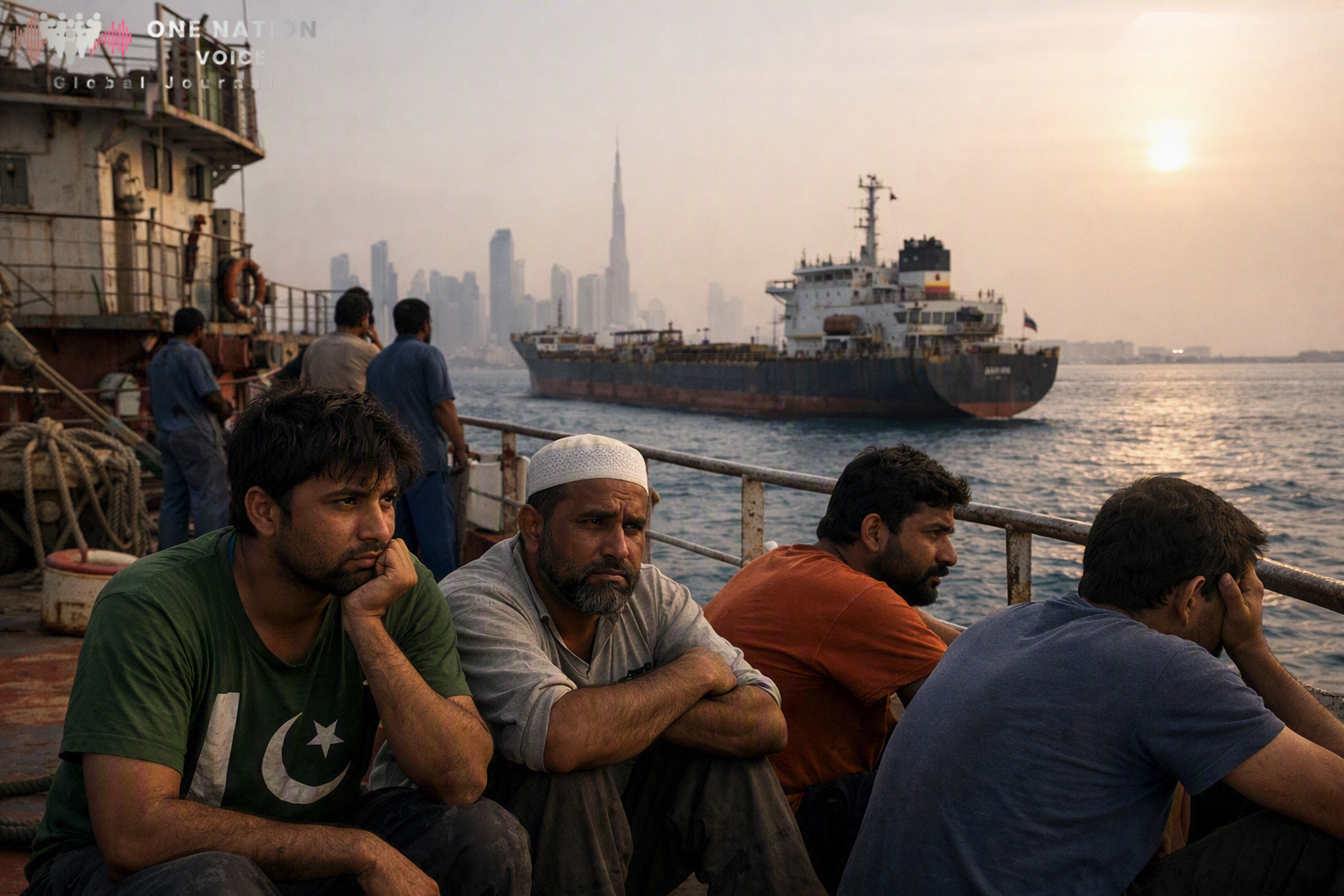
In an era when the world claims to champion workers’ rights and humanitarian principles, eight Pakistani seafarers have spent nearly a year locked aboard the MT RMS, a Panama flagged tanker anchored off the port of Sharjah unable to disembark, transit, or return to their families. Their torment is not a consequence of criminality, negligence, or dereliction of duty. It is a consequence of a transit visa that has not been issued. This is not merely an immigration matter. It is a humanitarian emergency unfolding in plain sight.
The crisis facing these men sits at the intersection of two converging storms: the broader and well documented difficulties Pakistani nationals have faced in obtaining UAE visas, and a deepening global crisis of seafarer abandonment that international bodies have described in the starkest terms.
In January 2025, Pakistan’s Senate Standing Committee on Overseas Pakistanis was informed that some visas to the UAE had been “unofficially closed.” By November of that year, travel agents were reporting rejection rates of 70 to 80 percent for first time Pakistani applicants, with younger applicants facing especially heightened scrutiny. On 27 November, the UAE halted the issuance of most new visas for Pakistani nationals, citing security concerns a freeze that disrupted recruitment pipelines, family travel and business mobility between the two countries. For ordinary tourists or job seekers, these restrictions were painful. For seafarers awaiting transit to complete legitimate crew change, disembarkation, and repatriation, they became a trap with no exit.
The UAE has long held a troubling distinction in the maritime world. ITF data shows that more seafarer abandonments take place in the UAE than in any other country in the region, with 32 vessel abandonments recorded in the first eight months of 2025 second only to Türkiye’s 43. Critically, the UAE has not ratified the Maritime Labour Convention (MLC), the international treaty widely regarded as the Seafarers’ Bill of Rights, which mandates minimum standards covering wages, repatriation, accommodation, and welfare. The absence of MLC ratification leaves seafarers in UAE waters in a legal grey zone, stripped of the structural protections that most of the world’s maritime workforce can claim.
The scale of this neglect is staggering at the global level. In 2025, 6,223 seafarers were abandoned on 410 ships the sixth yearly increase in a row while abandoned seafarers were owed USD $25.8 million in unpaid wages, of which just $16.5 million was recovered. Early indications for 2026 suggest the number of seafarers abandoned by shipowners has already exceeded 6,000 cases. The ITF has warned that Gulf states, particularly the UAE, and European states must do much more to hold shipowners accountable and prevent abandonments in or near their ports.
The Pakistani seafarers aboard the MT RMS are caught in a double bind that the existing system was never designed to address: their right to repatriation exists in principle, but the visa mechanism that would give it practical effect has been denied. Their contracts which almost certainly conform to MLC standards guarantee them the right to return home. Yet without a transit visa, that right is rendered meaningless. The Pakistani Embassy in the UAE has made sustained diplomatic efforts, but the matter remains unresolved. This is not a failure of individual will; it is a failure of systemic coordination between immigration authorities and maritime law.
The broader geopolitical context adds another layer. Analysts have pointed to a quiet but accelerating strategic divergence between Pakistan and the UAE, rooted in competing regional alignments, as one explanation for the increasing difficulty Pakistani nationals have faced in securing UAE visas. Whether or not one accepts this geopolitical framing, the consequences for working seafarers men who have no role in foreign policy are the same.
They sit on a vessel, watching weeks turn to months, their families waiting, their mental health fraying, their futures uncertain.
The International Transport Workers’ Federation has described the condition of stranded seafarers in the Gulf as one in which there is “lack of food, lack of provisions, lack of water” men left “exposed and absolutely vulnerable.” While the eight Pakistani seafarers aboard the MT RMS have not been described as facing such extreme deprivation, the psychological and humanitarian toll of eleven months of involuntary confinement aboard a vessel must not be minimized. Seafarers are trained for the sea, not for indefinite detention on it.
As one maritime welfare expert noted, global shipping is structured in a way that creates multiple channels of ownership and operation across different jurisdictions and it is seafarers who risk falling through the gaps and having their rights denied. The MT RMS case is a textbook illustration of this systemic flaw: a Panama flagged vessel, Pakistani crew, UAE anchorage, and a transit visa bottleneck that no single party has claimed ownership of resolving.
There is also a consequential economic dimension to this crisis that Pakistan cannot afford to ignore. The monthly average of Pakistani workers moving to the UAE on employment visas dropped from 5,344 in 2024 to just 2,310 in the first seven months of 2025, reflecting how profoundly the visa climate has contracted. Shipping companies, which depend on reliable crew change logistics and transit access, are watching this situation closely. If Pakistani seafarers cannot be disembarked, relieved, or repatriated through UAE ports, shipping operators will simply stop employing them for routes that pass through Gulf waters. The long term damage to Pakistan’s maritime workforce already competing in a global market against the Philippines and India could be lasting and severe.
There are reasons for measured hope. As recently as August 2026, the UAE resumed issuing visit visas to Pakistani citizens applying through registered travel agents, following months of complaints over prolonged delays. The UAE’s ICP also announced in September 2025 a new dedicated visa category for cruise ship and leisure boat personnel a category that addresses a longstanding gap for maritime workers who transit through or operate in UAE ports. These signals suggest that the UAE understands the maritime sector’s specific needs and has the institutional capacity to address them when it chooses to.
What is needed now is a specific, time bound commitment. The UAE authorities including the ICP and the GDRFA must recognise that seafarer transit visas occupy a distinct humanitarian and legal category, wholly separate from general immigration policy considerations. Crew change and repatriation are not discretionary travel. They are obligations rooted in international maritime law.
The denial of transit to seafarers who have completed their contracts and are seeking to return home is not a visa policy decision it is a rights violation.
Pakistan’s government must simultaneously press this case through every available bilateral channel, ensuring that its Embassy in Abu Dhabi treats the MT RMS crew’s situation as a matter of highest diplomatic priority. The International Maritime Organization, which has been closely monitoring developments to protect more than 20,000 seafarers in the region, should also be formally engaged.
These eight men did not choose to become symbols of a diplomatic and humanitarian impasse.
They chose a profession that keeps global trade moving the profession that, as the world was reminded during the COVID 19 pandemic, is essential to the functioning of modern civilisation. They deserve to go home.
The sea does not wait. Neither should we.
Disclaimer:
The views and opinions expressed in this article are exclusively those of the author and do not reflect the official stance, policies, or perspectives of the Platform.

