

KP’s New Security Plan Must Deliver Lasting Peace
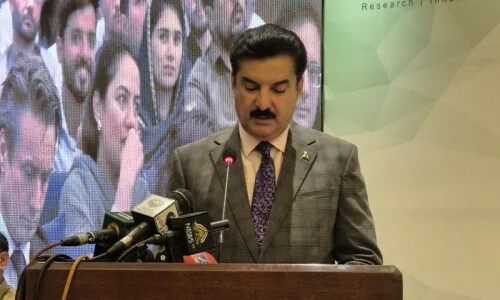
hyber Pakhtunkhwa has heard promises before. Every administration that has walked through the doors of the Governor’s House in Peshawar has spoken the same language: more police, better equipment, tougher operations, lasting peace. What makes the high level security briefing chaired by Governor Faisal Karim Kundi different is not simply what was said, but the blunt, almost uncomfortable honesty about what had been left undone.
The numbers revealed at that briefing were damning. Over 17,000 police vacancies sitting unfilled. When Governor Kundi assumed executive control of the province after the Centre imposed governor’s rule, he made clear that development would be the second priority: the first would be giving whatever resources were needed to the police and the Counter Terrorism Department. That is a refreshingly clear eyed hierarchy of priorities. You cannot build schools and hospitals in a province where law enforcement personnel cannot safely travel after sunset.
The financial picture painted by Home Secretary Amjad Ali Khan was even more striking. The previous provincial administration had allocated Rs6.4 billion for police across 22 districts yet released only Rs1 billion, a release rate of barely 15 percent. The merged districts, already among the most vulnerable and under served areas in Pakistan, received just 3.2 percent of the police budget under earlier arrangements. These are not abstract statistics. They translate directly into under equipped officers facing one of the most sophisticated and well armed terrorist networks in the region.
The scale of that threat cannot be overstated. Comparative data reveals a sharp escalation in terrorism linked violence nationwide, with fatalities rising from 2,555 in 2024 to 3,417 in 2025, a roughly 34 percent year on year surge. Of the 5,397 terror incidents recorded across Pakistan in 2025, some 3,811, fully 71 percent, were reported from KP alone. These are not the numbers of a province experiencing routine unrest. They reflect a province that has been, for years, bearing the overwhelming weight of Pakistan’s national security burden while receiving a fraction of the resources that burden demands.
In 2025 alone, 2,597 terrorists were eliminated, of whom 1,800 were killed in KP. Security forces conducted intelligence based operations at an average of over 200 per day. And yet the Fitna al Khawarij adapted, regrouped and kept striking. The brutality of their campaign is matched only by the resilience of the security personnel who faced it: 1,200 law enforcement martyrs over two years is a figure that should humble every political debate in this country.
What the new provincial setup is now pledging, Rs70 billion for KP Police and Rs10.3 billion for the CTD in a single year, represents a step change in commitment. Governor Kundi has pledged full support to the provincial police, the CTD, the Frontier Constabulary and other security agencies, and announced plans to improve compensation for the families of security personnel killed in the line of duty. KP Police have already sought substantial security challenge allowances for personnel serving in the southern and merged districts along with billions in additional funding for weapons, modern equipment and transport. These are the demands of a force that has been fighting far above its weight class for far too long.
The decision to install anti drone systems in Dera Ismail Khan, Lakki Marwat and Bannu is particularly significant. The Fitna al Khawarij were among the first non state actors in the region to weaponise commercial drones for targeted strikes. In the first quarter of 2026, security forces conducted seven drone strikes of their own against militant targets within KP, marking a consolidation of state drone capability in the province. The battlefield has evolved, and the response must evolve with it. Anti drone capability in the southern belt is not a luxury; it is a necessity that should have arrived much sooner.
The new counterterrorism strategy’s emphasis on intensified intelligence based operations and targeting terrorist facilitators is equally sound in principle. Facilitator networks are the connective tissue of any insurgency: they provide logistics, finance, safe houses and early warning. Disrupting them does not make headlines the way a large operation does, but it degrades the enemy’s operational capacity in ways that endure. The goal of reducing the police manpower shortfall from 15 to 5 percent through accelerated recruitment is achievable if the institutional will holds.
What must be watched carefully is follow through. KP’s history is littered with well announced plans that dissolved between the announcement and implementation. As recently as July 2026, the province expanded its police force by more than 4,300 officers, a real and tangible step, but KP remains at the centre of Pakistan’s battle against a persistent resurgence in terrorism. Recruitment alone is not enough. These officers need training, equipment, operational support and, crucially, the political backing that Governor Kundi has now explicitly promised.
The pointed remarks about political figures who send other people’s children for jihad while their own children study comfortably in Europe and Turkey cut to something real. The human cost of terrorism in KP has not been distributed equally. It has fallen heaviest on those with the fewest options: the constables from Bannu and Lakki Marwat who face the Fitna al Khawarij with outdated weapons and inadequate pay. The least any government can offer them is genuine institutional support, not photo opportunities.
There are early signs of promise: Pakistan recorded a nearly 18 percent quarter on quarter decline in violence during the first quarter of 2026, suggesting that consistent operational pressure is beginning to yield results. The trajectory can be sustained, but only if resources flow as promised, vacancies are filled without the usual delays, and the coordination between federal and provincial institutions that Governor Kundi has staked his authority on actually materialises.
KP’s people have waited long enough. They deserve more than better briefings. They deserve results.

