

AFGHANISTAN UNDER TALIBAN RULE
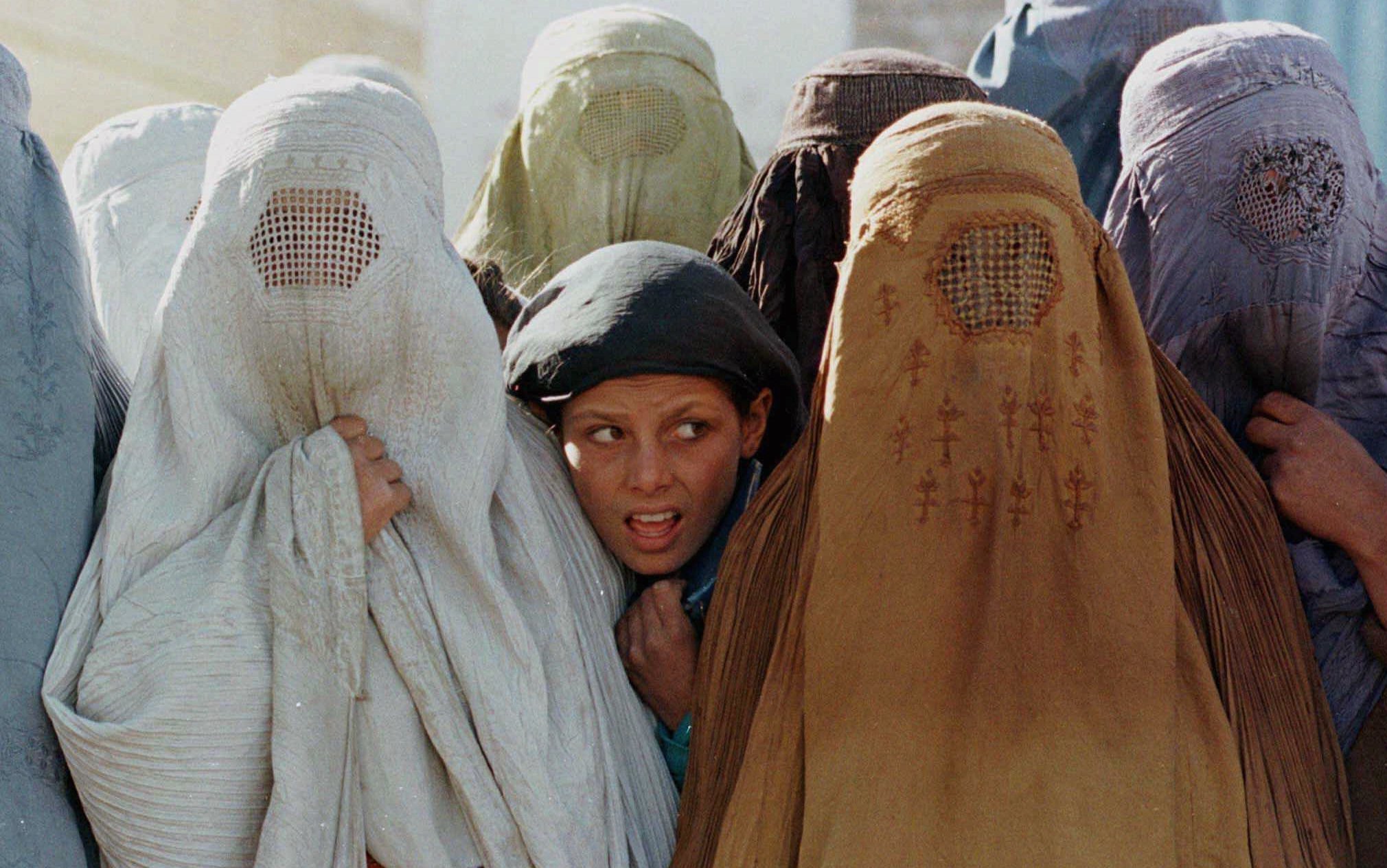 FOR USE WITH FEATURE PACKAGE FOR SUNDAY, DEC. 15--FILE--A young girl peers out from a group of Afghan women wearing the Burqa covering at a Red Cross distribution centre in Kabul, Afghanistan, Nov. 13, 1996. The Taliban guerrillas who took over Kabul, the capital of Afghanistan ordered women to completely cover themselves and banned them from schools and workplaces. (AP Photo/Santiago Lyon)
Afghanistan under Taliban rule has become a country governed not by legitimacy, consent or representation, but by fear. Since returning to power in August 2021, the Taliban have dismantled civil liberties, crushed dissent and imposed an authoritarian order rooted in ideological extremism. The promise of stability has been replaced by coercion, surveillance and punishment. Public life is regulated through intimidation, and private life is increasingly invaded by officials claiming religious authority. What exists today is not governance in any meaningful democratic or humane sense; it is a machinery of repression designed to force society into submission.
The most devastating symbol of Taliban rule is the systematic erasure of women and girls from public life. Afghan girls have been denied education beyond grade six for years, and more than 2.2 million girls and women have been pushed out of secondary and higher education since 2021. This is not simply a policy failure; it is a deliberate assault on the future of an entire generation. A society that bars girls from schools and universities is not protecting culture or religion.
It is destroying its own human capital, deepening poverty and institutionalizing gender apartheid
The repression of Afghan women does not end at the classroom door. Women have been removed from civil service payrolls, barred from many forms of employment and even prevented from entering United Nations premises. In public spaces, Taliban inspectors humiliate and terrorize women under the pretext of enforcing dress codes and moral conduct. Women have been forced out of taxis and buses for not wearing Taliban-approved clothing. In several provinces, health centers have reportedly been instructed not to treat women unless they are accompanied by a male guardian. Such restrictions turn ordinary acts, traveling, shopping, seeking medical care, into ordeals of fear and dependency.
The Taliban’s Ministry for the Propagation of Virtue and the Prevention of Vice has become the visible face of this oppression. Its inspectors monitor clothing, movement, fasting, mosque attendance and social behavior. Shopkeepers have been ordered not to sell goods to women unless they are accompanied by a mahram and wearing Taliban-approved hijab. Real estate agents have been told not to rent property to women independently.
These measures are not isolated incidents; they represent a nationwide system that seeks to make women invisible, dependent and powerless
The Taliban’s repression also reaches deep into Afghanistan’s cultural and private life. During Ramadan, inspectors monitored fasting compliance and mosque attendance. Flower shops were targeted to prevent Valentine’s Day celebrations, while officials publicly warned people against celebrating Nowruz. These acts expose the Taliban’s broader project: to replace Afghanistan’s diverse cultural traditions with a narrow, coercive ideology. Cultural expression, religious pluralism and personal choice are treated as threats. The result is a society where citizens must constantly calculate what they say, wear, celebrate and believe.
Justice under the Taliban is equally brutal. Public lashings, arbitrary detentions and humiliating punishments have become tools of control. Hundreds of individuals, including women and children, have reportedly been subjected to corporal punishment. In Bagram district, Taliban courts ordered men and women to receive lashes inside school premises over alleged “illicit relationships,” with some also sentenced to prison. Such punishments are intended not only to discipline individuals but to terrorize communities.
They send a clear message: the Taliban state owns the body, the conscience and the behavior of every citizen
Taliban decrees further institutionalize repression. Rules allowing women to be imprisoned for staying outside a husband’s home without permission reduce women to legal dependents. Provisions punishing criticism of Taliban authorities, their interpretation of Sharia or their leaders criminalize dissent itself. Even failure to report meetings of “opponents of government” can lead to imprisonment. A justice system that punishes thought, speech and association is not justice; it is political control disguised as law.
Former Afghan officials and members of the Afghan National Defense and Security Forces remain especially vulnerable. Despite Taliban promises of amnesty, reports of arbitrary arrests, torture and killings continue. The so-called amnesty has proven hollow for many families who live with the fear that past service to the former republic may invite revenge. This pattern reveals the Taliban’s deeper insecurity: a regime confident in its legitimacy would not need to hunt former opponents after promising forgiveness.
Independent journalism has also been systematically dismantled. Media organizations have lost licenses, television stations and radio outlets have been suspended, and journalists operate under constant threat. Female journalists have been nearly erased from the media landscape, while many others have fled the country. With more than half of Afghanistan’s media outlets reportedly closed, the information space has been suffocated by censorship and fear.
A country without free media becomes a country where abuses can multiply in darkness
Religious minorities and cultural communities are also under pressure. Shia communities have reportedly been pushed to abandon their own religious calendars and conform to Taliban-designated observances. This coercion reflects the sectarian nature of Taliban rule, where diversity is not tolerated but disciplined. Afghanistan’s rich religious and cultural fabric is being narrowed by force.
Afghanistan today stands as a warning of what happens when extremist ideology captures the machinery of the state. The Taliban have not brought justice, dignity or stability. They have built a system of fear, repression and systematic human rights abuse. The world must not normalize this rule or mistake silence for peace. Afghans deserve education, freedom, representation and basic human dignity. Under the Taliban, those rights are not merely denied; they are being deliberately dismantled.

