


India Between BRICS and the West
India’s place in BRICS has always contained an unusual contradiction. New Delhi wants to be counted among the leading voices demanding a more multipolar international system, yet it simultaneously cultivates some of its most consequential strategic relationships with the United States and other Western powers. India is also a member of the Quad alongside the United States, Japan and Australia. None of this automatically makes India hostile to BRICS. States routinely maintain overlapping partnerships. The difficulty begins when those relationships appear to pull New Delhi in opposing strategic directions.
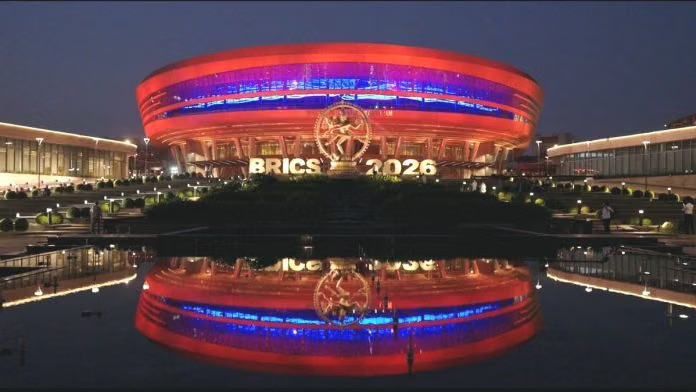
BRICS has evolved from an economic grouping into a wider platform demanding greater representation for emerging economies and reform of institutions long dominated by Western powers. Its members are now discussing greater financial cooperation, local-currency transactions, alternative payment arrangements and changes to global governance. At the September 2026 New Delhi summit, BRICS members again called for a more representative international order and stronger economic coordination.
Yet India appears far less comfortable than China, Russia or Iran with allowing BRICS to develop into an explicitly geopolitical counterweight to the West
That distinction is important. India clearly benefits from BRICS. Membership gives New Delhi diplomatic visibility, access to the New Development Bank ecosystem, influence across the Global South and a seat at a table whose international importance continues to grow. India can present itself simultaneously as a major developing country, an advocate of institutional reform and an indispensable bridge between competing power centres. But critics increasingly ask whether India wants BRICS to become genuinely powerful or merely useful.
This criticism is not limited to India’s traditional rivals. Brazilian economist Paulo Nogueira Batista Jr., who served as vice president of the New Development Bank from 2015 to 2017, has described India as an “outlier” in BRICS, while commentary surrounding his criticism has invoked the image of India as a potential “Trojan horse” because of its close relationships with Washington and Israel. The metaphor is provocative, but it captures a real debate over whether India’s strategic preferences place limits on how far BRICS can travel toward financial and geopolitical autonomy.
China provides perhaps the clearest example of this balancing act. For years, Indian political discourse has treated China as a major security competitor. The 2020 border confrontation hardened public attitudes, while New Delhi deepened Indo-Pacific cooperation with Washington and other partners. Yet inside BRICS, the tone changes considerably. During the 2026 summit, Narendra Modi and Xi Jinping welcomed improving bilateral ties, promised to expand economic and people-to-people exchanges and agreed that differences should not become disputes.
Diplomacy requires such pragmatism, certainly. But the contrast illustrates how India speaks differently to different strategic audiences
The same tension appears in New Delhi’s claim to leadership of the Global South. India frequently presents itself as a voice for developing countries, sovereignty and inclusive international governance. Yet relations with neighbours such as Bangladesh have repeatedly been troubled by political mistrust and diplomatic disputes. A country aspiring to represent the Global South cannot rely only on summit rhetoric. Leadership also requires sensitivity toward smaller states whose interests may not coincide with those of a regional power.
Iran presents an even more revealing test. Tehran is now a full BRICS member. India maintains important relations with Iran and has strategic interests connected to regional connectivity and Chabahar. Yet India has simultaneously taken its relationship with Israel to a markedly higher level. During Modi’s February 2026 visit, India and Israel formally elevated their relationship to a “Special Strategic Partnership for Peace, Innovation and Prosperity,” including expanded cooperation in defence and security. India is entitled to maintain relations with both countries, but when Israel and Iran are directly confronting each other, such balancing inevitably raises questions inside a grouping that includes Tehran.
India would answer these criticisms by invoking strategic autonomy. New Delhi does not regard BRICS as an anti-Western alliance and has repeatedly resisted attempts to force its foreign policy into fixed camps. That argument deserves recognition. Indeed, India’s ability to communicate with Washington, Moscow, Beijing, Tehran and Tel Aviv can occasionally give it diplomatic flexibility that more rigidly aligned states lack.
BRICS itself contains enormous political differences, so ideological uniformity was never realistic
The problem, however, is that strategic autonomy can become strategic opportunism when a state wants the benefits of every alignment while accepting few of the costs. India wants American technology, Western markets and Indo-Pacific security cooperation. It wants Russian energy and defence ties. It wants access to BRICS economic mechanisms. It wants improved trade with China while simultaneously presenting Beijing as its principal Asian competitor. It wants relations with Iran while dramatically deepening strategic cooperation with Israel. Individually, each decision may be rational. Collectively, they create uncertainty about what India ultimately wants BRICS to become.
That uncertainty matters because multilateral institutions are weakened not merely by open hostility but by internal hesitation. SAARC demonstrated how regional rivalries can reduce an organisation with considerable potential to little more than an occasional diplomatic forum.
BRICS is far larger, economically stronger and globally more consequential, but it is not immune to the same disease
There is an old South Asian expression about saying “Ram Ram” publicly while carrying a dagger beneath one’s arm. Critics of Indian policy increasingly see something similar in its BRICS diplomacy: solidarity in the conference hall and strategic hedging outside it. Whether that judgement is entirely fair is debatable. What is harder to dispute is that India cannot indefinitely present itself as both an architect of an autonomous multipolar order and a strategic partner of the power structure that such an order is supposed to reform.
The real question, therefore, is not whether India should leave BRICS. It is whether India wants BRICS to succeed strongly enough to change the international balance of power. If New Delhi continues extracting the prestige of membership while resisting deeper strategic cohesion whenever it threatens its Western partnerships, the “Trojan Horse” metaphor will remain difficult to dismiss.

