




Where Does Sindh’s Education Budget Go?
There is a bitter irony in the condition of many government schools across Sindh. Education is officially free, but in some places it appears to be so free that the state itself has stopped paying enough attention to what children actually receive. A school may exist on an official list, a teacher may be posted there, and students may be enrolled, yet the building around them can tell an entirely different story. Broken roofs, inadequate classrooms, missing electricity, insufficient furniture and children studying in uncomfortable conditions raise a question that cannot be answered merely by announcing another large budget. What does a government education budget mean if it does not produce a safe and dignified place for a child to learn?
For the 2025–26 financial year, Sindh allocated Rs613.36 billion to the education sector. Of this, Rs524.32 billion was identified for service delivery and Rs89.04 billion for development. On paper, this is a substantial public commitment. Yet budgets should ultimately be judged not by the number of billions printed in financial documents but by what those billions change on the ground. A parent in rural Sindh does not experience education through budget books. A child experiences it through the classroom, the roof, the desk, the drinking water, the toilet, the teacher and the electricity supply.
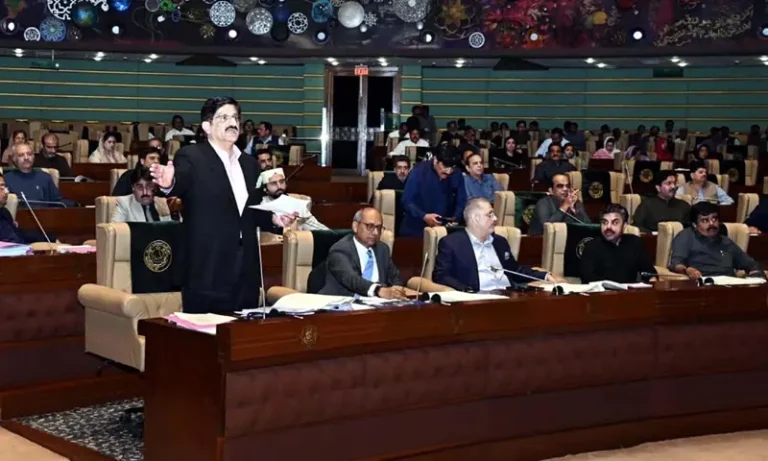
That is where the contradiction becomes difficult to ignore. Information provided by the Sindh education minister to the Provincial Assembly records 40,978 government schools under the School Education and Literacy Department. Only 13,013 were reported as having electricity. In other words, roughly 68 percent were without the facility reflected in those figures. The same official response reported drinking water in 26,006 schools, toilets in 17,136 and boundary walls in 20,913. These are not abstract administrative shortcomings. They directly shape whether children can learn safely, whether girls remain in school and whether families continue trusting the public education system.
After the 18th Constitutional Amendment, education became primarily a provincial responsibility. This gave provinces considerably greater responsibility for policy, administration and service delivery. Sindh consequently possesses the constitutional space to shape an education system according to its own needs. But devolution from Islamabad to Karachi cannot be considered complete if decision making remains heavily centralized within the province itself. Real devolution should not simply move power from the federal capital to a provincial capital. It should take meaningful administrative and financial authority closer to districts, towns, union councils, schools and communities.
This is where Sindh’s governance model deserves serious scrutiny. The Pakistan Peoples Party has governed the province continuously since 2008. Eighteen years is long enough to move beyond explanations based on inherited weaknesses. Governments are entitled to point to population growth, floods, poverty, infrastructure damage and historical neglect, all of which genuinely complicate educational reform. But political longevity also creates responsibility. After nearly two decades in power, the governing party must be judged against conditions produced or left unresolved during its own tenure.
That question should not automatically be converted into an allegation that hundreds of billions of rupees have been stolen. Education budgets include salaries, pensions, administration, grants, universities, boards, development schemes and numerous other expenditures. The Rs613.36 billion figure represents the broader education sector, not money intended solely for classroom construction. Responsible criticism should recognize that distinction. But this clarification does not remove the accountability problem. It actually makes stronger scrutiny necessary. Citizens should be able to see, district by district and school by school, how much is being spent and what measurable improvement that expenditure purchases.
Sindh needs to move from budget announcements to expenditure transparency. Every school should have a publicly accessible infrastructure profile showing classrooms, electricity, water, toilets, boundary walls, furniture, teacher strength, enrolment and development expenditure. Every approved construction or rehabilitation project should carry a completion deadline and expenditure record. Independent inspections should verify whether work shown as completed in government files actually exists on the ground.
Local government also has to become part of the solution. A damaged roof in a village school should not require a bureaucratic journey through several layers of provincial administration before action can be taken. District and local institutions need defined budgets, authority and responsibility for routine school infrastructure and maintenance. At the same time, decentralization must be accompanied by auditing and public disclosure so that transferring power does not simply transfer opportunities for misuse.
There is also a moral dimension that spreadsheets cannot capture. The child of a farm worker, labourer, driver or domestic worker has precisely the same claim to physical safety and human dignity as the child of a minister, bureaucrat or wealthy businessman. Public education is supposed to make citizenship meaningful by narrowing the disadvantages created by birth. When one child enters an air-conditioned private classroom and another sits under a damaged roof simply because his parents are poor, the state is not merely providing two different educational experiences. It is reproducing inequality.
Sindh does not suffer from a shortage of policy declarations. It suffers from the persistent distance between allocation and delivery. The province already spends at a scale that demands visible results. The next debate should therefore not be about whether the education budget has crossed another impressive numerical milestone. It should be about whether every child has a classroom that is safe, functional and fit for learning.
Billions at the top mean little when basic facilities do not reach the bottom. The true measure of Sindh’s education policy is not the size of the budget presented in Karachi. It is the condition of the classroom in the village where a child opens a textbook and expects the state to have kept its promise.