


UNAMA HR Update Exposes Deepening Repression in Afghanistan
Afghanistan Under the Boot: The UN’s Damning Verdict on Taliban Terror
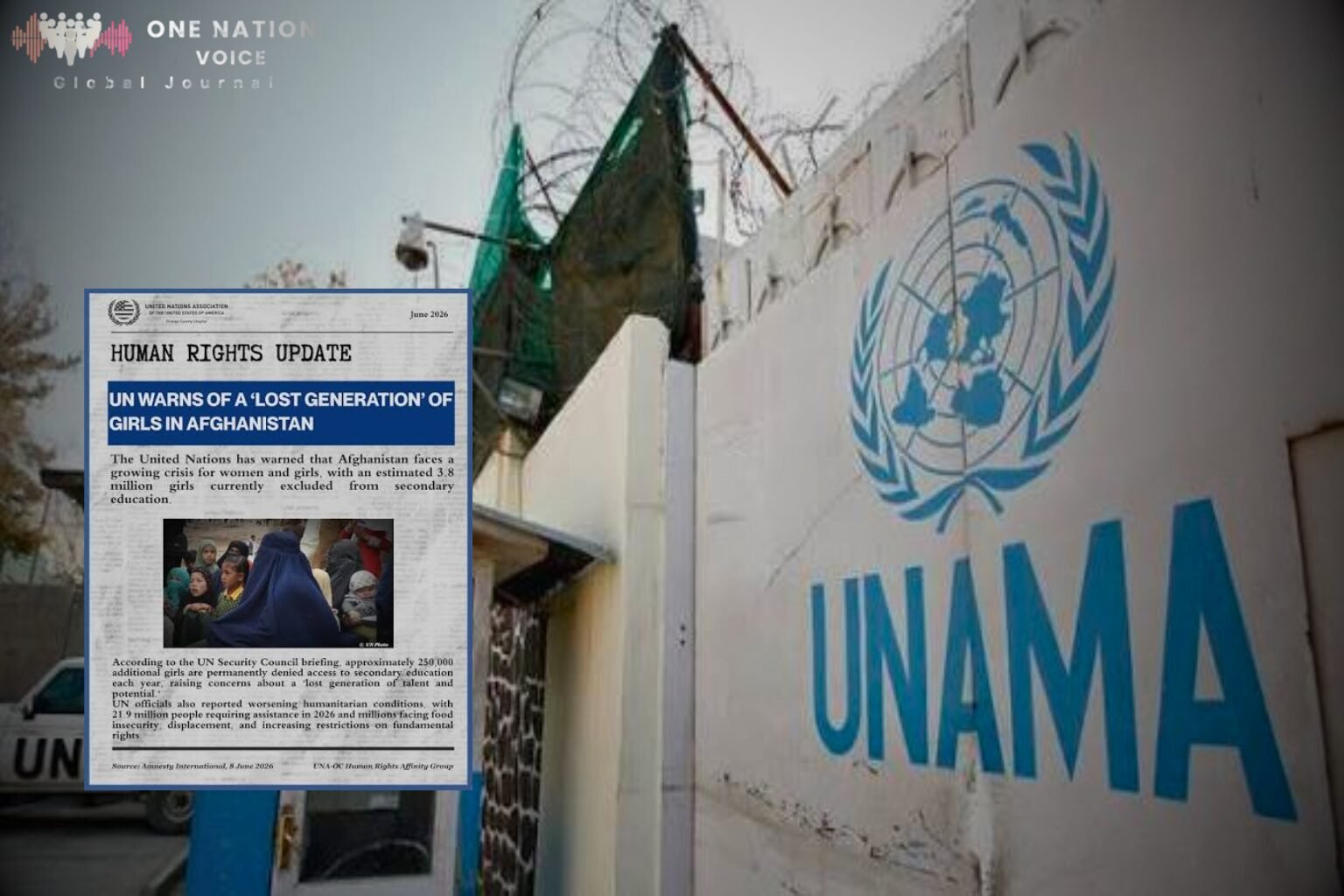
Five years into Taliban rule, the international community has grown alarmingly accustomed to reading quarterly horror catalogues from Afghanistan. Yet the latest United Nations Assistance Mission in Afghanistan (UNAMA) human rights update, covering April to June 2026 and released on 28 July, does not allow the conscience of the world to settle into numbness. It demands attention and demands action.
The report is not merely a documentation exercise. It is a forensic indictment of a terrorist group masquerading as a state of Khawarij ideologues who have weaponised governance itself as an instrument of mass punishment against their own population. What emerges from its pages is a portrait of a country not governed, but occupied occupied by its own rulers.
Women: An Entire Gender Erased
Nothing in the UNAMA report strikes as deeply as the systematic annihilation of Afghan womanhood. Decree No. 18 has further strangled women’s rights in marriage, divorce, and separation, reducing Afghan women to legal non persons within their own families.
The mahram requirement compelling women to be accompanied by a male guardian for virtually every public act has been extended to hospitals and shops, meaning a woman suffering a medical emergency may be turned away at a health facility in Uruzgan province if unaccompanied. This is not tradition. This is cruelty institutionalised.
The hijab enforcement apparatus has become a full blown security state of its own. Between 6 and 8 June alone, at least 30 women and girls were arrested in Herat for allegedly wearing improper hijab and were released only after signing pledges of compliance. Days later, Friday sermons were directed across the country to focus on hijab observance a state mobilisation of religion for the purpose of social control. The education ban, the university exclusion, the barring of female UN staff now stretching beyond 296 consecutive days each is a nail in the coffin of Afghan women’s existence in public life.
The Morality Machinery: Numbers That Shame Humanity
UNAMA’s statistics are stark and should be repeated loudly. The Taliban’s Ministry for the Propagation of Virtue and Prevention of Vice carried out at least 389 arbitrary arrests and detentions during the three month period, with 65 documented incidents of ill treatment. Men were arrested for trimmed beards and Western haircuts. Citizens were detained for listening to music. Between April and June, at least 137 individuals 112 men and 25 women were subjected to judicial corporal punishment, including flogging. In Balkh province, six men convicted of breaking the Ramadan fast each received 20 lashes after serving prison sentences.
What is particularly chilling is not only the brutality but the evolving concealment. Since April, the Taliban Supreme Court has largely stopped publicly announcing flogging sentences on its website and social media not because the beatings have stopped, but to reduce international visibility. Punishments continue across all provinces, often before smaller gatherings. This is a terrorist administration that has learned to hide its crimes, not abandon them.
Dissent Silenced: Journalists, Media, and the Right to Know
The Taliban’s war on information is prosecuted with the same ferocity as its war on women. Afghanistan ranked 175th out of 180 countries in Reporters Without Borders’ 2026 World Press Freedom Index a number that speaks to total systemic collapse of press freedom. Since 2021, 43 percent of media outlets have been shuttered. Over 300 journalists and media workers have been arrested or detained, with at least seven still held in custody.
The April–June period brought fresh outrages. In May, three radio stations in Kandahar Tahsin al Quran, Sanga, and Zama Ziwer were closed on pretextual administrative grounds. In June, armed members of the Taliban’s Ministry of Justice raided Tamadon TV in Kabul, sealed its offices, and forced it off air. Tamadon was one of the very few stations still broadcasting Shia religious programming. Its closure was not incidental it was ideological. Even government employees were barred from using smartphones in some provinces, severing ordinary Afghans from information and from each other.
The silencing of media is not a secondary policy issue. It is the foundation on which all other abuse rests. When there are no witnesses, there are no crimes or so the Khawarij logic runs.
Religious Minorities and the Architecture of Persecution
UNAMA’s documentation of attacks on religious freedom adds yet another dimension to this landscape of terror. Ismaili places of worship in Badakhshan province have been closed or forcibly converted into mosques. Ashura commemorations the most solemn observances of Shia Islam faced communication blackouts, restrictions, and the arrest of Shia worshippers. The closure of Tamadon TV specifically targeted the last major Shia broadcaster in the country.
These are not spontaneous acts of sectarian tension. They are the deliberate, organised suppression of minority religious identity by a state apparatus driven by a literalist Khawarij interpretation of Islam that the overwhelming majority of the world’s Muslims reject. The Taliban’s version of Islam is not a faith it is a totalitarian ideology wearing religious clothing.
Extrajudicial Terror Against Former Officials
The cycle of reprisal against those who served the previous republic continues without mercy. UNAMA documented eight killings, 29 cases of arbitrary arrest and detention, and five cases of torture involving former government officials and Afghan National Defence and Security Forces personnel during just three months. Many of these victims had returned or been deported from neighbouring countries only to find themselves targeted immediately upon arrival. The Taliban’s amnesty announcements were always fiction. This data confirms it.
A nine year old child was killed during protests in Badakhshan a province that has seen Taliban forces fire on civilian crowds protesting the poppy eradication campaign. Children paying with their lives for the act of protest represents the lowest point in a report already saturated with lows.
The World Must Stop Treating Normalisation as Diplomacy
The UNAMA report should serve as a direct challenge to any government or international body tempted by the logic of quiet engagement with the Taliban. Every diplomatic visit that is not conditioned on measurable human rights progress, every softening of sanctions framed as pragmatism, and every financial channel opened without accountability becomes complicity in the documented suffering of 40 million Afghans.
The Taliban are not evolving. They are entrenching. Five years of data show not a learning curve but a consolidation curve of power, of repression, of impunity.
The international community must recommit to robust, principled engagement anchored in the language of accountability, not the language of accommodation.
Afghanistan’s people its women, its journalists, its minorities, its young people who know no adulthood beyond Taliban rule deserve better than the world’s weary resignation. The least the international community owes them is an honest reading of what the United Nations has placed before it.
Disclaimer:
The views and opinions expressed in this article are exclusively those of the author and do not reflect the official stance, policies, or perspectives of the Platform.

