


UNSC Reform Through the IGN
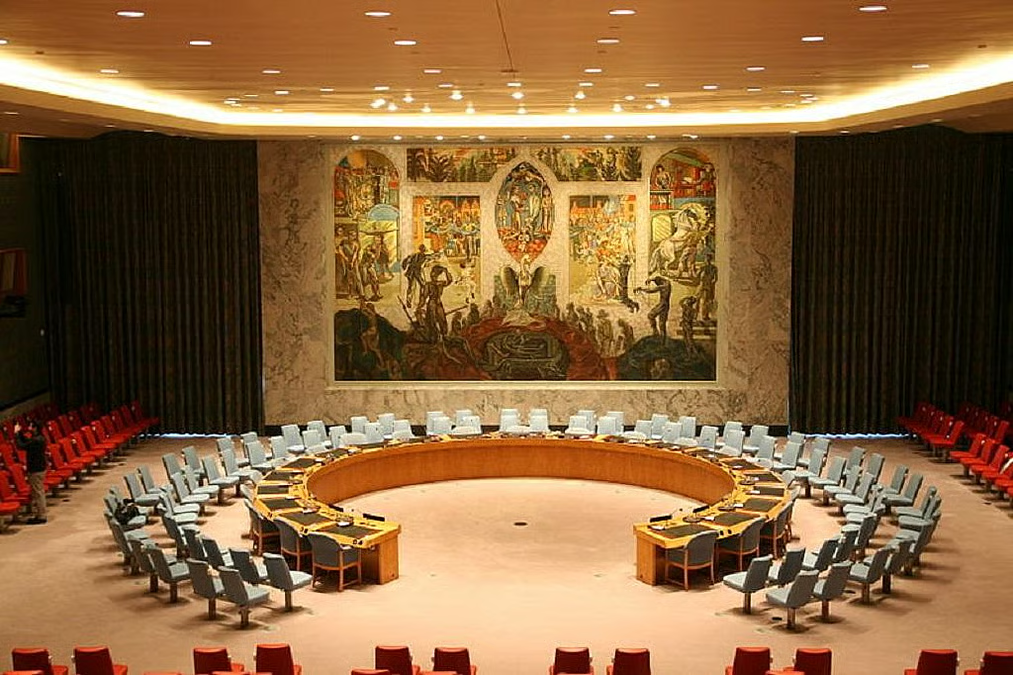
The United Nations Security Council was designed for a world that no longer exists. When the UN was established in 1945, its institutional architecture reflected the distribution of power after the Second World War. Five victorious powers received permanent seats and veto authority, while the remaining seats were elected. The Council expanded in 1965 to its present composition of fifteen members, including ten elected members, but its basic power structure has otherwise endured. Today, the United Nations represents 193 Member States in a world of more than eight billion people, yet the institution responsible for international peace and security continues to reflect the strategic hierarchy of 1945.
This imbalance is precisely why reform of the Security Council is necessary. The General Assembly decided in 2008 to begin Intergovernmental Negotiations, or IGN, covering five interconnected areas including categories of membership, the veto, regional representation, the size of an enlarged Council and its working methods. The process remains alive. In July 2026, the General Assembly agreed to continue the negotiations into its eighty-first session, confirming the IGN as the central arena in which competing reform proposals must be reconciled.
The fundamental problem is no longer whether the Council should change. There is widespread recognition that it should. The real question is what kind of reform would make it more representative without making it more paralysed. Africa remains without a permanent seat despite comprising 54 UN Member States, while large parts of Asia, Latin America, the Caribbean and the wider developing world remain inadequately represented.
The African Common Position therefore continues to demand at least two permanent seats with the same prerogatives enjoyed by existing permanent members, alongside additional elected representation
Yet simply creating more permanent members could reproduce the very inequality reform is supposed to correct. Permanent membership is not merely representation. It is institutional privilege without periodic electoral accountability. Once granted, it would be extraordinarily difficult to reverse. Adding several new permanent powers could also multiply competing national interests inside a Council already struggling to respond collectively to major crises.
The veto illustrates the danger. Under existing Security Council rules, a negative vote by any permanent member can prevent the adoption of a substantive resolution even when most Council members favour it. Gaza has demonstrated the resulting credibility problem. The United States vetoed proposed ceasefire resolutions in February and November 2024 and again blocked a draft demanding an immediate ceasefire in June 2025. Whatever Washington’s stated reasons, repeated vetoes amid extensive civilian suffering strengthened perceptions that strategic alliances can override collective international action. Expanding the number of veto-wielding states could therefore produce not greater democracy but additional possibilities for paralysis.
This is where the Pakistan-supported Uniting for Consensus approach deserves serious consideration. UfC, a cross-regional group including Pakistan, Italy, Argentina, Canada, Mexico, Türkiye, the Republic of Korea and others, opposes creating new individual permanent seats and instead emphasises broader elected representation. Its evolving proposals include additional elected seats and possibilities for longer-term arrangements that preserve electoral accountability.
UfC argued during the 2026 negotiations that expansion of elected representation enjoys considerably broader convergence than the creation of additional permanent national seats
This model offers an important democratic advantage. Elected members must return to the General Assembly for political support. Rotation allows states from Africa, Asia-Pacific, Latin America and other underrepresented regions to participate without permanently closing the door behind a handful of new privileged powers. A Council enlarged through elected membership could therefore become more representative while retaining a mechanism of accountability to the wider UN membership.
The debate over the G4 demonstrates why permanent expansion remains contentious. Brazil, Germany, India and Japan continue to advocate new permanent seats, alongside additional representation for Africa and other regions. Their economic and political importance is undeniable, but permanent membership requires more than demographic size or economic influence. It implies exceptional responsibility for international peace, respect for the UN Charter and confidence extending well beyond a candidate’s immediate partners.
India’s candidature consequently deserves scrutiny rather than automatic endorsement. The unresolved Jammu and Kashmir dispute remains associated with historic UN Security Council and UN Commission resolutions concerning a plebiscite, even though India and Pakistan continue to disagree fundamentally over their interpretation and implementation. Canada’s security intelligence service has also publicly identified India in connection with transnational repression activities, adding another dimension to international concerns surrounding state conduct beyond national borders.
These questions do not erase India’s global importance, but they reinforce the case for rigorous standards before any state receives irreversible permanent status
Germany presents a different problem. It is a major economy and committed multilateral actor, but Europe already holds two permanent seats through France and the United Kingdom. Another permanent European seat could deepen rather than reduce geographical imbalance. Moreover, Germany’s failure in June 2026 to secure one of the elected Council seats for 2027-2028 is politically significant. Portugal received 134 votes and Austria 131, while Germany obtained 104. That result does not invalidate Germany’s contribution to the UN, but it demonstrates that permanent membership cannot simply be assumed to enjoy sufficiently broad international backing.
Security Council reform should therefore be judged by one test above all others: does it democratise representation or merely redistribute privilege? The objective should not be to create another generation of permanent powers insulated from electoral accountability. A larger elected membership, stronger regional representation and meaningful restraint in the use of the veto would make the Council more inclusive without multiplying permanent centres of obstruction. The France-Mexico initiative calling for voluntary veto restraint in situations involving mass atrocities offers one complementary avenue for reducing abuse of existing privilege.
The IGN provides the appropriate framework for achieving such compromise. Sustainable reform will require patience because competing models remain far apart, but reform achieved through broad agreement will possess greater legitimacy than arrangements designed principally to satisfy the ambitions of individual states. The Security Council certainly needs to reflect the twenty-first century. It should do so by widening participation, strengthening accountability and giving underrepresented regions a stronger voice, not by creating additional permanent privileges that future generations may find even harder to reform.

