

India Debates, Pakistan Delivers: The Diplomatic Verdict of Our Era
There is a moment in geopolitics when noise stops substituting for strategy. When the television lights dim and the real scoreboard becomes visible. That moment, for South Asia, has arrived and it tells a story that neither New Delhi’s anchors nor its spin doctors can rewrite.
Pakistan is delivering. Quietly, methodically, and with increasing credibility on the world stage.
The evidence is not theoretical. It is documented, internationally recognized, and growing by the month. While Indian prime time television has spent years manufacturing an endless loop of anti Pakistan hysteria, framing every diplomatic engagement as a threat to be screamed about rather than a challenge to be managed, Pakistan has been doing the actual work of statecraft.
The Mediator the World Chose
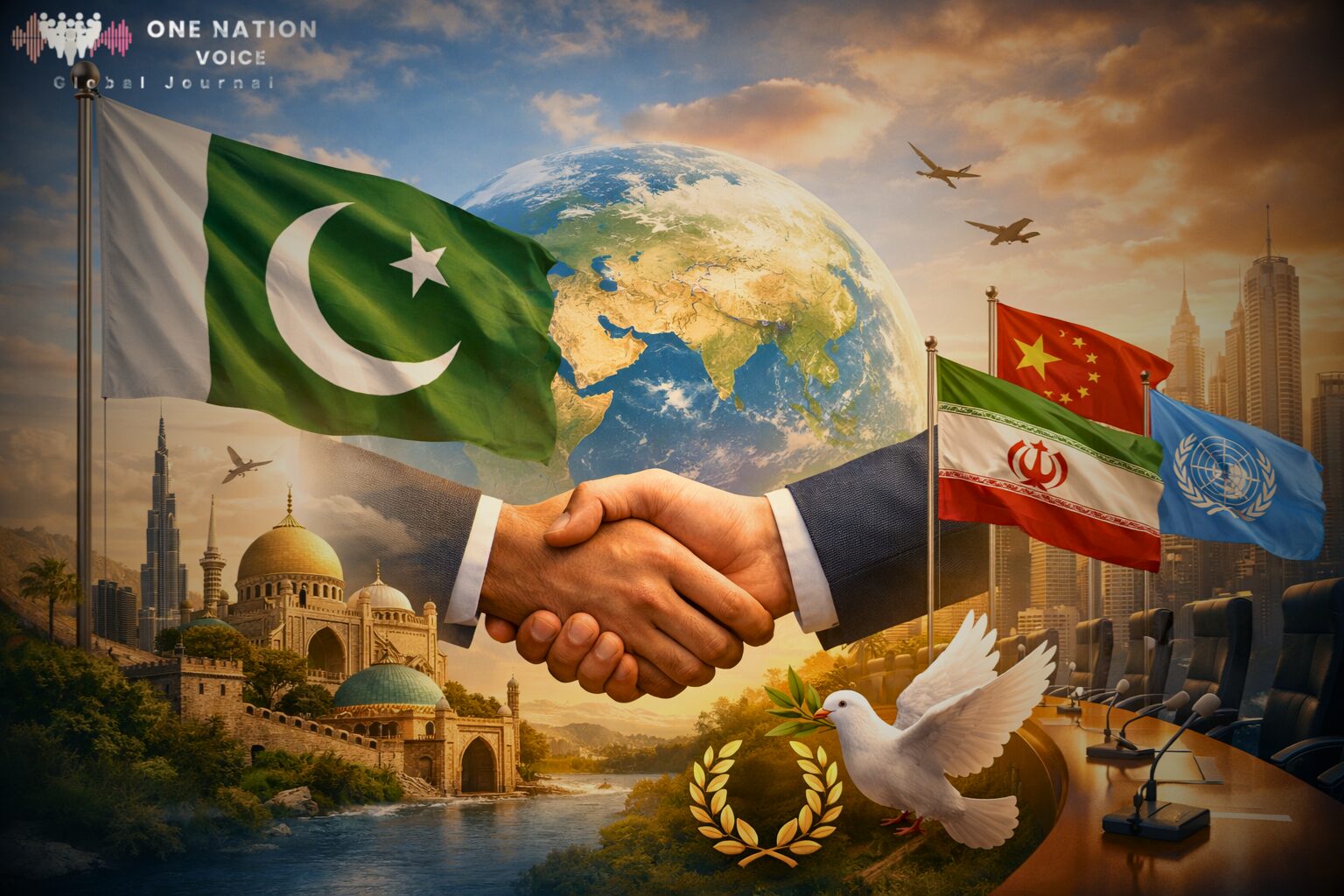
The most striking proof of Pakistan’s diplomatic resurgence is its emergence as the central mediator in one of the most dangerous conflicts of 2026: the US Iran confrontation. When the Strait of Hormuz was threatened, when global energy markets trembled, and when every major power was either too compromised, too adversarial, or too distant to broker peace, the world turned to Islamabad.
Pakistan played a critical role by relaying a US peace plan to Tehran and repeatedly offering to host direct negotiations, efforts widely described as the most coordinated regional initiative aimed at bringing Washington and Tehran to the negotiating table. The reason was structural: Pakistan shares a long land border with Iran while maintaining deep historical ties with Washington, a rare combination that positioned it as the one honest broker both sides could accept. Russia was preoccupied with Ukraine. China was too closely aligned with Tehran to satisfy Washington. The Gulf states were effectively combatants. Turkey lacked the direct access to Washington that Pakistan had carefully cultivated since early 2025.
Pakistan was also Iran’s own preference. Diplomatic sources confirmed that Tehran trusted Islamabad’s geographic and domestic constraints as a guarantee against it becoming Washington’s instrument. That dual trust, from both adversaries, is not luck. It is the product of deliberate, principled, long term engagement.
The result: Pakistan brokered a fragile but significant ceasefire, followed by talks hosted in Islamabad. Prime Minister Shehbaz Sharif announced that both US and Iranian delegations would participate in direct negotiations on Pakistani soil. This is not the resume of a diplomatically isolated state. This is the record of an indispensable middle power.
A Diplomatic Architecture Built from Strength
Pakistan’s mediation triumph did not emerge from a vacuum. It was the crystallization of a posture Islamabad has been systematically constructing across the entire regional and global landscape.
In September 2025, Pakistan signed a Strategic Mutual Defense Agreement with Saudi Arabia, firmly placing itself within the Gulf’s security architecture. The same month, Prime Minister Sharif launched CPEC Phase 2 in Beijing, signing 21 memorandums of understanding worth $8.5 billion covering agriculture, electric vehicles, solar energy, and steel, while reviving commitments to the ML 1 railway and Gwadar Port expansion. Relations with the United States warmed significantly under President Trump, with cooperation on counter terrorism, critical minerals partnerships, and economic deals that positioned Pakistan as a credible US partner in the region. Pakistan successfully hosted the Shanghai Cooperation Organization summit, attended by global leaders, projecting Islamabad as a hub of regional engagement rather than isolation. Pakistan also worked to engage landlocked Central Asian states, Southeast Asian partners, and deepened ties with Turkey and Egypt, with discussions underway for a quadrilateral security alignment involving these four states.
This is multi vector diplomacy executed with coherence. Pakistan is simultaneously a partner of China, a mediator trusted by the United States and Iran, a security guarantor for Gulf states, and a platform for regional connectivity.
A confident state talks from strength, and Pakistan’s engagement across these theatres reflects exactly that.
The Regional Contrast
Against this backdrop, regional diplomatic competition has become increasingly visible. Analysts across South Asia have debated the effectiveness of different foreign policy approaches, particularly the difference between symbolic diplomacy and long term strategic engagement.
Observers noted that Pakistan entered 2026 with renewed diplomatic momentum, strengthening ties simultaneously with China, Gulf partners, Central Asia, and Western powers. Pakistan’s ability to maintain dialogue across competing blocs highlighted its growing relevance in regional affairs. Discussions around Middle Eastern tensions, economic connectivity projects, and regional security increasingly involved Islamabad as a key stakeholder.
At the same time, many regional analysts emphasized the importance of practical diplomacy over media narratives. Publicized summits and symbolic gestures alone were seen as insufficient without durable partnerships, economic integration, and trusted diplomatic channels.
The Lesson of Structural Credibility
What separates successful diplomacy from temporary headlines is structural credibility.
Pakistan built real relationships, showed up consistently across multiple forums, and positioned itself as a problem solver.
It leveraged its geography, religious ties, historical neutrality, and relationships with competing global powers into something no television channel can manufacture: genuine diplomatic capital.
Pakistan’s engagement with the Muslim world, active participation in the Organisation of Islamic Cooperation, its inclusion in BRICS Plus, deeper engagement with the SCO, and trilateral counter terrorism cooperation with China and Iran are not coincidences. They are the product of a foreign policy evolving from primarily security driven frameworks toward a more diversified model blending geopolitics with geo economics.
A confident state builds bridges, hosts negotiations, signs strategic agreements, and earns the trust of multiple stakeholders simultaneously.
Pakistan, today, is increasingly presenting itself in that role. And the world, from Washington to Tehran, from Riyadh to Beijing, is taking notice.
The verdict of 2025 and 2026 is not written by television anchors. It is written in joint statements, signed agreements, hosted negotiations, and the quiet acknowledgment of global powers that when it comes to this volatile region, Islamabad has become an increasingly important diplomatic address.
Disclaimer:
The views and opinions expressed in this article are exclusively those of the author and do not reflect the official stance, policies, or perspectives of the Platform.

