


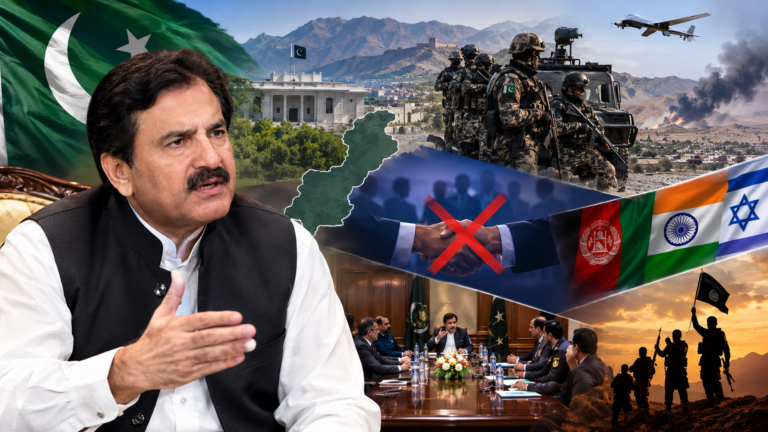

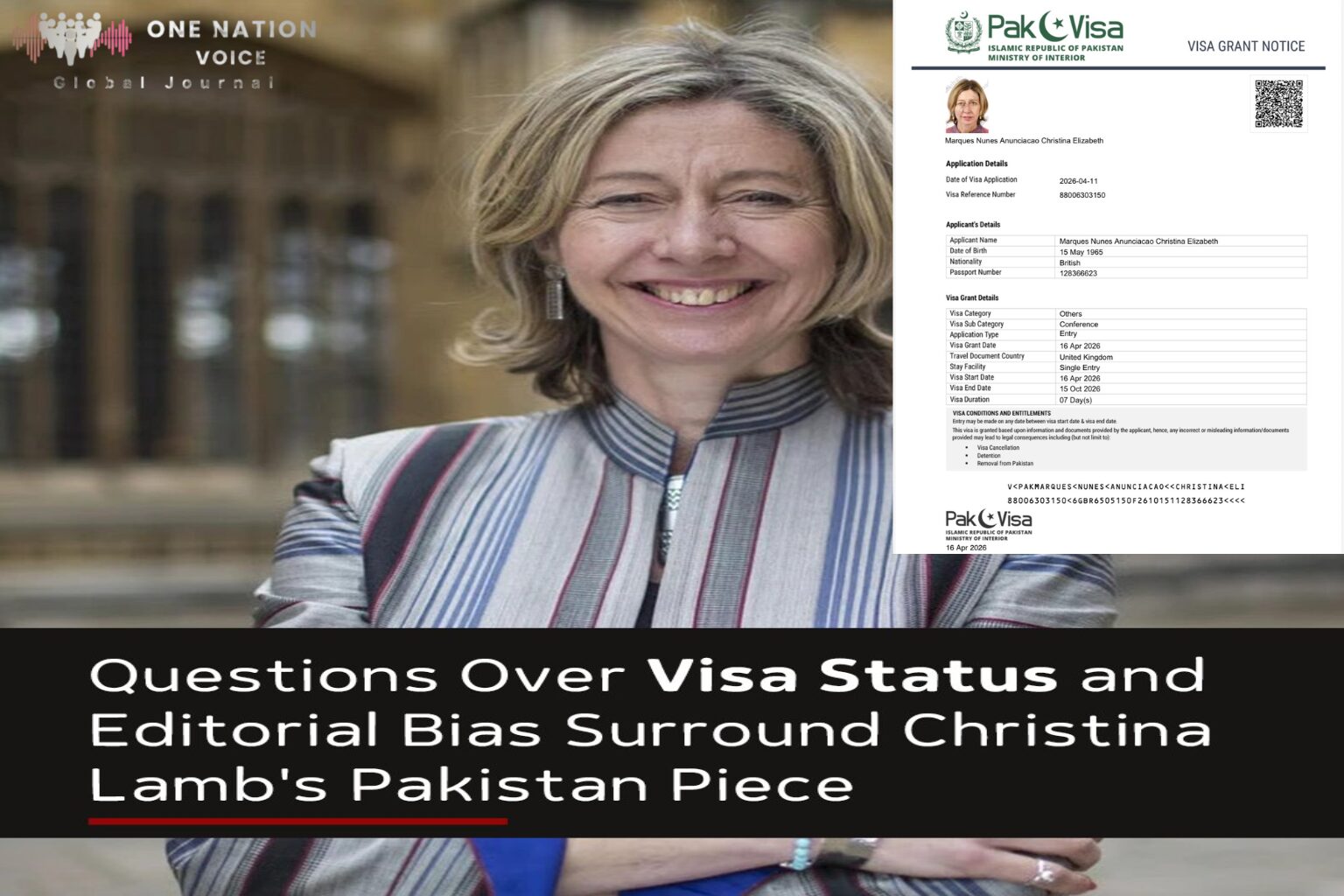
Christina Lamb entered Pakistan on a conference visa
Journalism’s moral authority rests on a single, non negotiable pillar: transparency. Reporters demand it from governments, corporations, and public institutions. They write op eds about it, accept awards for championing it, and lecture audiences at international forums in its name. It is precisely this standard, one the profession sets for everyone else, that must now be applied to the profession itself, and specifically to the circumstances surrounding Christina Lamb’s visit to Pakistan.
The question being raised is not about the quality of her reporting, nor about whether criticism of Pakistan is legitimate. Journalists have every right, and indeed, a professional duty, to question, investigate, and hold power accountable. That is not the issue.
The issue is simpler, and in some ways more fundamental: did the declared purpose of entry match the work conducted on Pakistani soil?
A visa is not a bureaucratic formality. It is a sovereign instrument through which any country regulates access to its territory and verifies the lawful purpose of a foreign national’s visit. Pakistan, like every other sovereign state, maintains a clearly defined and structured framework for foreign journalists. The Ministry of Information and Broadcasting’s External Publicity Wing is the recommending authority for all journalist and media related visas. The process requires recommendation letters, coordination with Press Attachés, and in some cases, a No Objection Certificate, particularly for travel beyond the three approved cities of Islamabad, Lahore, and Karachi. Journalists are also required to report to the External Publicity Wing upon arrival.
This is not an arbitrary bureaucratic maze. It is a structured system designed to ensure that foreign correspondents operate with full transparency about their identities, their employers, and critically, their purpose. Pakistan’s journalist visa framework requires a recommendation from the Ministry of Information and Broadcasting or a Press Attaché, and selecting the wrong visa category can lead to delay, refusal, or rejection. The Ministry’s own guidelines state plainly that the desired visa must align with the declared purpose of the visit.
A conference visa operates under an entirely different premise. It grants access for the specific purpose of attending a defined event, not for gathering political intelligence, conducting interviews for publication, or preparing investigative pieces. This distinction matters enormously. Even the United States government, in its own media visa framework, explicitly states that a journalist attending a conference on a non journalist visa cannot report about that conference or use that visit to produce journalistic work upon return. The principle is universal: the category of entry must correspond to the activity performed.
If it is established that Lamb entered on a conference visa and subsequently produced a political piece on Pakistan, The Sunday Times and Lamb herself owe the public, and every journalist who diligently completes Pakistan’s proper accreditation process, a direct and honest answer. Was journalistic work declared to Pakistani authorities? Was the appropriate visa category applied for and obtained? These are not hostile or unreasonable questions.
Lamb has a long and distinguished history with Pakistan, having been deported from the country in November 2001 after uncovering evidence of a covert operation involving elements of Pakistan’s intelligence service. Her familiarity with the country and its political landscape is extensive. That experience, however, does not place her above the rules that govern all foreign correspondents operating in Pakistan. If anything, her seniority and experience make a visa irregularity, if confirmed, harder to excuse as mere oversight.
The concern is also institutional. Pakistan has, at times, offered visa on arrival facilities for foreign journalists attending specific events such as the Islamabad Talks 2026, demonstrating that the country can and does facilitate journalistic access when approached through the correct channels. The system is not designed to be impenetrable; it is designed to be transparent. Circumventing it, whether deliberately or through careless categorisation, undermines the goodwill that honest foreign correspondents build with host governments over years.
The broader context adds another layer of significance. Pakistan’s government has in recent years intensified pressure on journalists, with the Committee to Protect Journalists documenting a pattern of in absentia convictions and escalating crackdowns on critical reporting since late 2025. In such an environment, foreign journalists who follow the rules and obtain proper accreditation perform an important function: they demonstrate that credible, independent reporting can coexist with lawful entry. When a senior correspondent from a major publication appears to bypass that process, it hands critics a convenient argument and potentially makes conditions harder for those who do comply.
There is a charge of hypocrisy that cannot be easily dismissed. The Western media class, of which The Sunday Times and Lamb are prominent representatives, regularly publishes editorials demanding transparency and accountability from institutions around the world. It produces investigative journalism about governments that operate by one set of rules for themselves and another for everyone else. The moral force of that journalism depends entirely on the credibility of the journalists who produce it. A senior correspondent who enters a country under one declared purpose and conducts work under another erodes that credibility in a manner that benefits no one, least of all the cause of free and honest journalism.
The question of whether journalistic work was declared and whether the correct visa and accreditation procedures were followed is not a minor administrative technicality. It is a question of professional integrity.
Every foreign correspondent who queues at the Pakistani Embassy, submits their recommendation letters, waits the required processing period, and reports to the External Publicity Wing upon arrival does so because they respect the sovereignty of a host country and the rules it has established. They deserve to know that those rules apply equally to all, regardless of fame, seniority, or the prestige of one’s employer.
Disclaimer:
The views and opinions expressed in this article are exclusively those of the author and do not reflect the official stance, policies, or perspectives of the Platform.

