
Afghanistan’s Growing Resistance Against Taliban Oppression
Afghanistan’s Awakening: Why the Taliban’s Iron Grip Is Beginning to Crack
Five years into Taliban rule, Afghanistan is no longer simply suffering in silence. Across the mountains of Badakhshan, the valleys of Herat, and the plains of Parwan, a resistance is stirring one rooted not in foreign intervention or ideological rivalry, but in the raw, accumulating fury of a people stripped of dignity, rights, and hope. The Khawarij who seized Kabul in August 2021 promised order. What they delivered was a dystopia.
The evidence of systematic oppression is now incontrovertible. In 2025, the Taliban deepened their repression by intensifying restrictions on the rights of women and girls and adding new regulations to curb media freedom, while maintaining a complete ban on secondary and higher education for girls and women. This is not governance it is the deliberate erasure of half a nation’s population from public existence. Girls are barred from secondary schools, and women must travel with a male relative and cover their faces in public. Women who dared defy these edicts faced not persuasion but punishment. Women who defied the rules faced abuse and arbitrary detention.
The brutality has escalated to medieval proportions. In 2025 alone, more men and women were subjected to public flogging than in all previous years combined since the Taliban returned to power in 2021. Afghanistan’s de facto Supreme Court announced public floggings of at least 1,110 individuals, including at least 940 men and 170 women nearly double the number from 2024. Shockingly, early indications in 2026 suggest that the rate of such punishments may continue to escalate, with January 2026 recording one of the highest monthly totals since the practice began officially in late 2022.
If that is not enough to sear the conscience of the world, consider what the Taliban have recently codified into law. The Taliban’s new criminal regulation has drawn alarm from rights organizations for provisions that include the further subjugation of women, the normalization of violence against women, the legalization of slavery, the formal division of society into free and enslaved persons, and further classification into four social classes with effective impunity for religious scholars and so called nobles. This is not Islam. This is the theology of terror a perversion that the Khawarij across history have always used to justify power over piety.
On January 4, 2026, the Taliban issued a criminal procedure code that defines Muslims exclusively as adherents of Hanafi jurisprudence and labels other religious groups, including Shia Muslims, as heretics, prescribing strict punishments to silence dissent. Forced conversions have followed. Between January and February 2025 in Badakhshan province, at least 50 Ismaili men were taken from their homes at night and forced to convert to Sunni Islam under threat of violence. These are not the acts of a governing authority. These are the acts of terrorists weaponizing religion to consolidate control.
Yet here is where the story shifts. Oppression, when it reaches a point of no return, breeds resistance. Afghanistan is reaching that point.
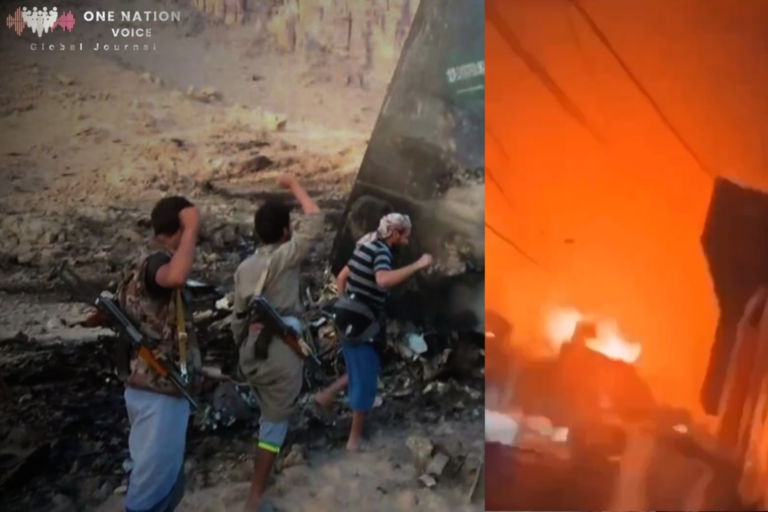
Armed opposition groups in Afghanistan conducted at least 72 attacks against Taliban forces between February and April 2025 alone, according to a UN Assistance Mission in Afghanistan (UNAMA) report. The National Resistance Front claimed responsibility for 56 of these attacks, while the Afghanistan Freedom Front claimed 16. These are not isolated incidents by fringe actors. They are part of a growing, organized pushback from Afghans who have lost everything and chosen to fight back.
The Afghanistan Freedom Front has emerged as operationally aggressive, claiming 88 attacks and over 200 Taliban killed in just the first eight months of 2025. More recently, resistance groups claimed separate attacks against Taliban forces in Badakhshan and Herat provinces, with the Afghanistan Freedom Front targeting what it described as international terrorists supporting the Taliban in Zebak district.
Even more significant is the emergence of new resistance structures. In March 2026, the National Mobilization Front was established by a coalition of youth activists and former security personnel primarily from Afghanistan’s northern and eastern provinces, coinciding with a period of heightened economic instability and increased insurgent activity in the Hindu Kush region. That young Afghans with no military background are voluntarily organizing against the Taliban reveals the depth of public anger driving this resistance.
The Taliban themselves are not as monolithic as they project. Deep fractures inside Taliban leadership have intensified as 2026 progresses, with Supreme Leader Hibatullah Akhundzada ruling from Kandahar with hardline loyalists while powerful ministers in Kabul push for more pragmatic changes. Leaked audio captured Akhundzada warning of collapse from internal discord. When a regime’s supreme leader fears implosion from within, the resistance outside its walls becomes all the more consequential.
The humanitarian catastrophe compounds everything. Approximately 45 percent of Afghanistan’s population around 21.9 million people are projected to require humanitarian assistance, a crisis worsened by sweeping cuts to international aid, the mass return of nearly three million Afghans from neighbouring countries in 2025, and an ongoing drought. Desperation and displacement are powerful recruiters for resistance.
In December 2025, a civil society led People’s Tribunal for Women of Afghanistan delivered a symbolic judgment finding the Taliban movement guilty of crimes against humanity including gender persecution, gender apartheid, torture, and arbitrary detention and called on the United Nations to avoid normalising Taliban gender based oppression. The world’s moral community is catching up with what Afghans have lived for five years.
The resistance growing across Afghanistan is not terrorism. It is not insurgency for its own sake. It is the inevitable response of a proud people to the Khawarij ideology that has robbed them of schools, courts, voices, and dignity. History repeatedly confirms that no regime built entirely on coercion and fear can endure indefinitely. The Taliban’s rule is not the exception.
Afghanistan’s resistance is no longer a whisper. It is becoming a roar and the world would do well to listen.
Disclaimer: The views and opinions expressed in this article are exclusively those of the author and do not reflect the official stance, policies, or perspectives of the Platform.

Author

Dr. Syed Hamza Hasib Shah is an experienced writer and political analyst, specializing in international relations with an emphasis on Asia and geopolitics. He holds a PhD in Urdu literature and actively contributes to academic research, policy discussions, and public debates. His work addresses complex geopolitical challenges. Email: hk3156169@gmail.com.
