



Shaukat Nawaz Mir and JAAC
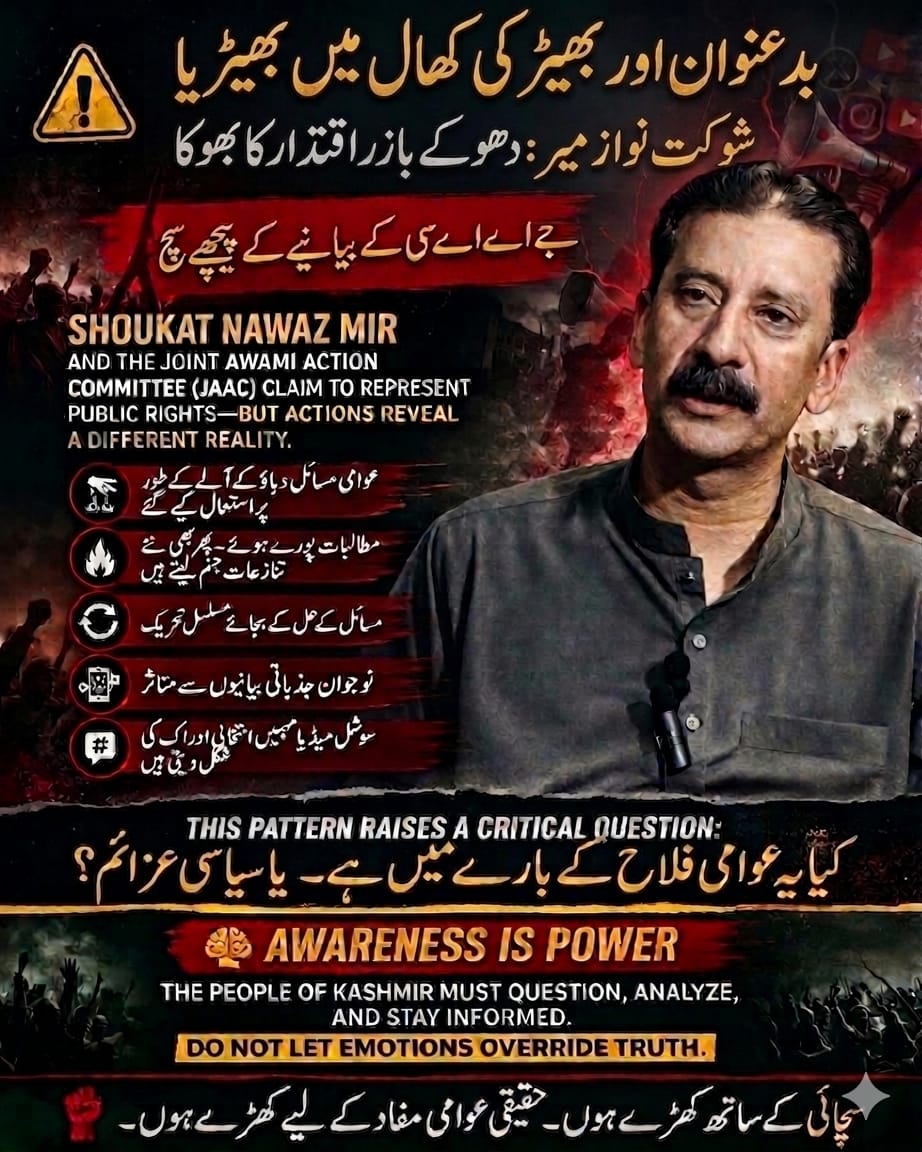
In troubled political societies, public anger is never hard to find. People are frustrated, prices rise, services fail, promises are broken, and the distance between rulers and ordinary citizens keeps growing. In such an atmosphere, any voice that speaks loudly in the name of rights can quickly become popular. This is the space in which Shaukat Nawaz Mir and the Joint Awami Action Committee have built their image. They present themselves as defenders of public rights, challengers of state failure, and representatives of popular sentiment. For many citizens, especially those tired of silence and delay, that message sounds convincing. But politics is not judged only by slogans. It is judged by patterns, methods, and motives. When those are examined carefully, an uncomfortable question begins to appear: is this really a struggle for public welfare, or has public pain become a ladder for political relevance?
The answer is not simple, because the grievances are real. People do suffer. Economic pressure is heavy. Public trust in institutions is weak. Many communities feel ignored until they protest, and many young people believe that nothing moves unless someone forces the state to respond. In that climate, a platform like JAAC naturally gains ground. It speaks the language of resistance, urgency, and public rights. It taps into emotions that already exist in society. That is why dismissing the movement outright would be too easy, and probably dishonest. Yet it is equally dishonest to assume that every movement speaking for the people is automatically sincere. History shows the opposite.
Public anger can be represented, but it can also be managed, shaped, and used. What matters is whether a leadership tries to solve problems or keep them alive
This is where doubt around Shaukat Nawaz Mir and JAAC becomes harder to ignore. A genuine public movement usually has a visible direction. It identifies a problem, builds pressure, pushes for reform, and then tries to turn gains into stable change. It may continue criticism, but its purpose remains clear: reduce suffering, strengthen institutions, and move society one step forward. But what happens when each point of progress is followed by another wave of confrontation? What should one conclude when demands are met, talks begin, or some relief is offered, yet tension is not reduced but shifted into a new dispute? At that point, the movement begins to look less like a force for settlement and more like a machine that survives on constant unrest.
That pattern matters because it reveals political logic. If your strength depends on public anger, then calm is dangerous to you. If your influence grows whenever institutions are seen as weak, then durable solutions do not always serve your interests. In such a situation, every resolved issue creates a new problem for the leadership itself: how to stay central, visible, and powerful. One way is to widen the conflict, sharpen the rhetoric, and make compromise look like betrayal. This is where rights based politics can quietly turn into personality based politics. The cause remains public on the surface, but the structure becomes personal underneath.
The people are still invoked in speeches, but the real centre of gravity shifts toward the leader, his image, his role, and his ability to dominate the political space
Social media has made this easier than ever. Politics today is no longer shaped only in meetings, assemblies, or newspapers. It now lives in short clips, viral statements, emotional appeals, and quick outrage. JAAC has benefited from this culture. It understands how to frame conflict in simple moral terms. It knows how to turn a public issue into a dramatic contest between truth and oppression. It knows how to mobilize sympathy, especially among younger audiences who are already impatient with the slow language of institutions. But emotional mobilization is not the same thing as political honesty. In fact, the two often move in opposite directions. The more a movement relies on outrage, the less space it has for complexity. Real governance is slow, imperfect, and often disappointing. Digital politics prefers heroes and villains. It rewards noise, not detail.
This creates a serious risk for society. When public issues are constantly presented through emotional extremes, people stop asking careful questions. They stop asking what is practical, what is sustainable, and what can actually be implemented. Instead, they begin reacting to political theatre. They cheer confrontation for its own sake. They judge seriousness by volume. They reward the leader who sounds angriest, not the one who thinks most clearly. In that environment, young people are especially easy to recruit. Their frustration is real, but it can be redirected into a politics that feeds on emotion without producing structure.
A responsible leader would treat youth as citizens who deserve facts, balance, and a long view. An irresponsible leader treats them as fuel
That is why the issue is not whether JAAC has raised genuine concerns. It clearly has. The issue is whether it has also turned those concerns into a permanent instrument of pressure aimed less at reform and more at political positioning. There is a difference between representing pain and investing in it. One seeks healing. The other needs the wound to stay open. This is the line the public must examine with care.
Shaukat Nawaz Mir may argue that constant pressure is necessary because governments only respond when forced. There is truth in that. States often act late and reluctantly. But even then, the public has a right to ask: what comes after pressure? Is there a roadmap, a civic vision, a willingness to accept gradual progress, or only a repeated return to agitation?
If every opening leads back to confrontation, then people are justified in suspecting that the movement does not merely challenge instability, it may depend on it
For the people of Kashmir, this is not a small matter. They cannot afford to confuse emotional appeal with public sincerity. They cannot afford to hand over moral authority to every figure who speaks in the name of rights. They must look at conduct, not only claims. They must ask who benefits when tension never ends. They must ask whether the language of public rights is being used to build collective strength or personal influence.
A mature society does not reject protest. It respects protest, but it also questions those who lead it. That is not betrayal. It is responsibility. JAAC may still claim to stand with the people, but a movement proves itself not by how loudly it speaks, but by whether it can turn anger into justice without turning unrest into a career. Until that becomes clear, suspicion will remain valid, and perhaps necessary.