



When Demands Are Met, What Justifies the March?
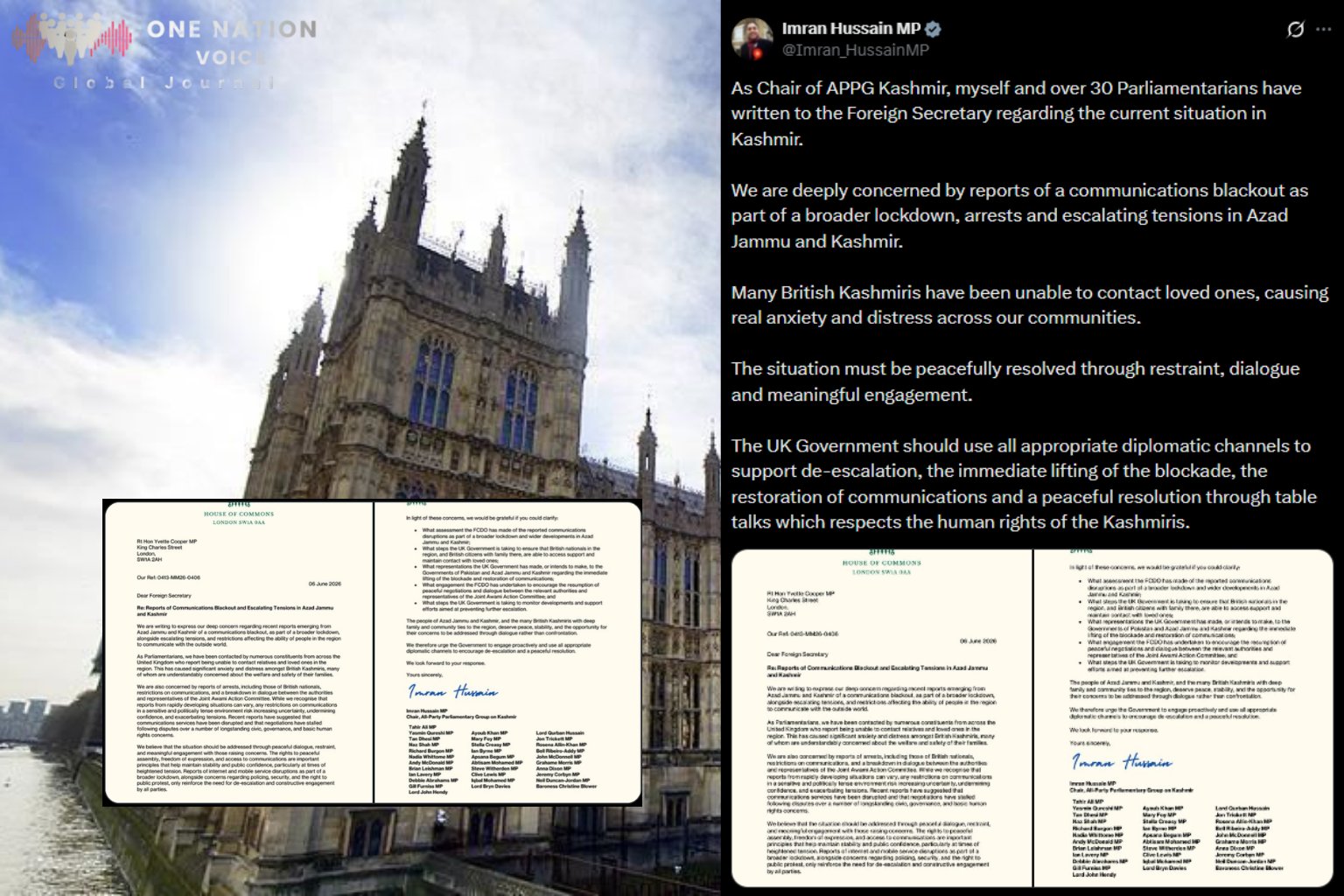
On June 6, 2026, Imran Hussain MP, Chair of the All Party Parliamentary Group on Kashmir, along with more than thirty fellow parliamentarians, wrote to Foreign Secretary Yvette Cooper. Their letter described a communications blackout, a broader lockdown, arrests, and escalating tensions in Azad Jammu and Kashmir (AJK), urging the UK Government to use all available diplomatic channels for de escalation. The concerns expressed for British Kashmiris unable to reach loved ones are entirely human and deserve acknowledgment. Yet the letter, received with considerable media attention, presents an incomplete picture, one that omits several important facts shaping the current situation.
A Record of Genuine Concessions
The Joint Awami Action Committee (JAAC) was formed in September 2023 around three core economic grievances: subsidised flour, reduced electricity tariffs, and curtailment of elite privileges.
In May 2024, following widespread protests, the government accepted all protester demands and released a PKR 23 billion economic relief package for the region.
A formal peace agreement was signed in October 2025 following further unrest, with the government committing to a 38 point charter of demands.
According to a government progress report issued this week, 24 of 44 total demands including demands added in May 2026 have been fully fulfilled. A further 16 demands are in active process. Among the completed measures: 177 FIRs have been withdrawn, excepting 15 cases involving deaths of individuals, all suspended employees have been reinstated, Kashmiri detainees held in Rawalpindi and Islamabad have been released, the AJK cabinet and government offices have been reduced in size, anti corruption institutions have been merged, and feasibility work on major infrastructure projects, including Mirpur Airport and Neelum Valley road tunnels, is actively underway. Parliamentary Affairs Minister Tariq Fazal Chaudhry, addressing a press conference on June 8, stated that 35 of 38 demands have been implemented, with remaining issues either pending court orders or deemed constitutionally unfeasible.
This is not a government that ignored its people. This is a government that negotiated in good faith, made significant concessions, and continued seeking dialogue even after the situation deteriorated.
The Demand That Cannot Be Met by Executive Order
What then remains unresolved? The central sticking point is JAAC’s demand for the abolition of 12 reserved seats in the AJK Legislative Assembly, seats constitutionally allocated to Kashmiri refugees who settled in Pakistan following partition. On June 7, 2026, the AJK Supreme Court observed that these seats carry constitutional protection and cannot be removed through administrative or executive measures alone. Approximately 2.2 million Kashmiri refugees reside in Pakistan; their political representation is not a matter that can be dissolved by a committee decision or a protest deadline.
A high level federal delegation comprising senior ministers and political figures from across party lines, including Ahsan Iqbal, Rana Sanaullah, and Bilawal Bhutto Zardari, engaged JAAC leadership and urged them to allow this matter to be resolved through parliamentary debate and, if necessary, through the upcoming July 27 elections. JAAC refused. When a movement shifts from demanding economic relief and governance reform, both entirely legitimate, to insisting that constitutionally embedded democratic structures be dismantled outside any democratic process, the nature of the demands changes fundamentally. No responsible government can alter constitutional arrangements under protest pressure alone.
Order, Elections, and the Wider Population
On June 5, AJK authorities proscribed JAAC under the Anti Terrorism Act, citing engagement in activities creating unrest, intimidating the public, promoting hatred, and generating insecurity within society. The move followed days of government appeals for dialogue and a direct request to postpone the June 9 protest by just 8 to 10 days to allow space for consultations. Those appeals were rejected. Four security personnel were killed and three members of the proscribed organisation died as police cleared individuals from a Combined Military Hospital in Rawalakot, a development that underscores the consequences of prolonged disruption to public infrastructure.
AJK general elections have been announced for July 27, 2026. Nominations open on June 9, the same date chosen for JAAC’s planned long march.
Every political and civic actor in the region now has a democratic and legal avenue to advance remaining demands: file for office, campaign on a platform, win seats, and pursue change through Parliament. Choosing to blockade roads and shut down public services on the morning nominations begin raises important questions about priorities and risks affecting ordinary Kashmiris most directly.
What Responsible Foreign Engagement Looks Like
The concerns of British Kashmiris for their families are genuine and should not be dismissed. Communication disruptions cause real distress, and governments must remain accountable for how and when such measures are applied. But there is a meaningful difference between raising humanitarian concerns through appropriate channels and lending parliamentary attention to an organisation that has been legally proscribed, rejected extensive government concessions, refused dialogue, and called for protests on the eve of a democratic election.
The debate surrounding AJK should be informed by the fullest possible context, including the extensive negotiations that have taken place, the implementation of a large majority of demands, the constitutional dimensions of the refugee seats issue, and the availability of democratic mechanisms through which remaining disputes can be addressed.
The people of Azad Jammu and Kashmir deserve economic opportunity, uninterrupted public services, access to hospitals and schools, and a functioning democratic process. These priorities should remain at the centre of all political engagement. As the region approaches elections, all stakeholders have an opportunity to pursue their objectives through democratic participation and constitutional means. That broader context deserves to be part of the conversation.
Disclaimer:
The views and opinions expressed in this article are exclusively those of the author and do not reflect the official stance, policies, or perspectives of the Platform.

