

The Future of BISP
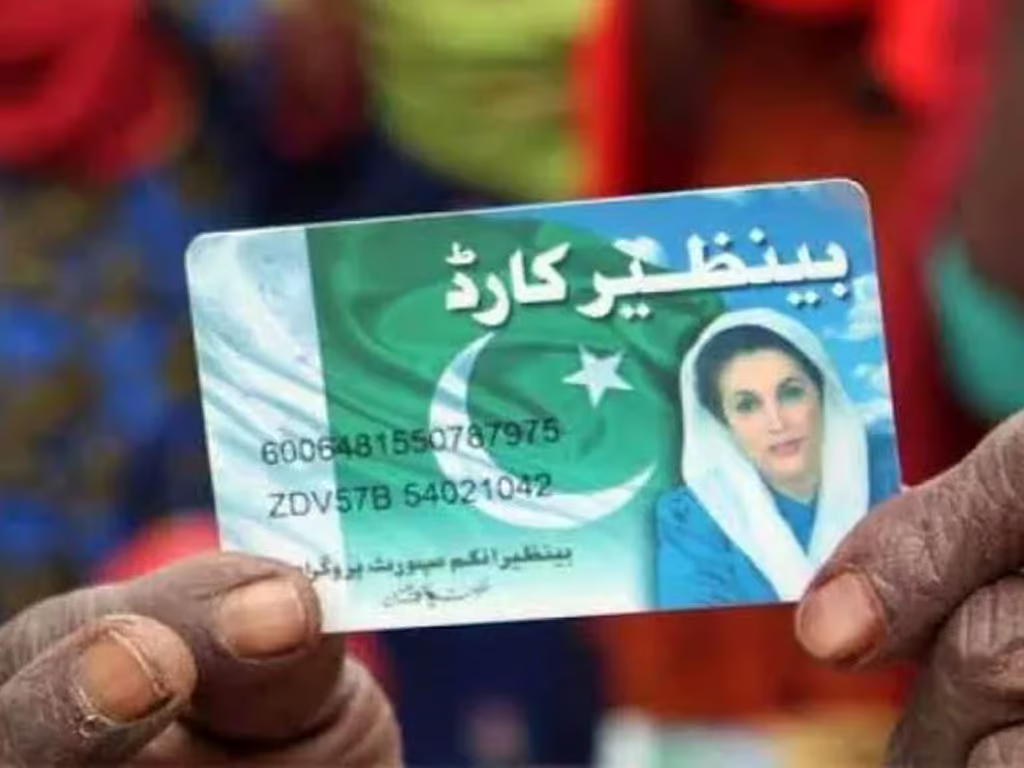
The debate over the Benazir Income Support Programme is often framed in overly simplistic terms. Its supporters present it as an indispensable shield for the poor, while its critics describe it as an expensive political programme that encourages dependency. Both positions contain some truth, but neither fully captures the policy challenge. BISP is neither a complete failure nor a sufficient answer to poverty. It is a large-scale relief mechanism that has protected millions of vulnerable households, yet it has not evolved into an effective system for moving those households towards economic independence.
BISP has developed an important administrative infrastructure. The National Socio-Economic Registry, biometric verification systems, and digital payment mechanisms provide the state with a platform for identifying low-income households. This institutional capacity proved useful during national emergencies and can support future disaster relief, food assistance, and health interventions.
Eliminating the programme without preserving this infrastructure would be a serious mistake
Yet the programme’s social value should not prevent an honest evaluation of its weaknesses. The most obvious problem is the inadequacy of the stipend. A quarterly payment of Rs14,500 translates into less than Rs5,000 per month. For a household facing high food prices, electricity bills, transport costs, and medical expenses, this amount cannot meet even a modest share of basic needs. It may reduce immediate distress, but it does not provide economic security. The programme therefore offers relief without substantially changing the beneficiary’s living conditions.
This limitation is particularly important because BISP is often presented as a poverty-reduction programme. In reality, it is better described as a poverty-management programme. It softens the impact of deprivation but does not remove its causes. Poverty in Pakistan is driven by unemployment, low wages, weak public education, poor healthcare, landlessness, regional inequality, and limited access to productive assets.
Cash assistance alone cannot overcome these structural problems
The growing budget also raises questions of sustainability. Pakistan operates under severe fiscal constraints, with high debt-servicing costs and limited revenue collection. In such circumstances, every large expenditure must be assessed in terms of opportunity cost. The government must ask whether allocating hundreds of billions of rupees to small recurring transfers produces better long-term outcomes than investing a larger share in employment schemes, vocational education, agricultural productivity, small-enterprise development, and public services.
The answer does not require the immediate abolition of BISP. Abrupt closure would be economically and socially damaging. Millions of households have incorporated these payments into their survival strategies. Removing assistance without alternatives would increase food insecurity, school dropouts, household debt, and public resentment. A responsible government cannot simply withdraw support from vulnerable families and expect the labour market to absorb them.
However, gradual replacement should remain a legitimate policy option if the programme continues to expand without measurable improvement in beneficiaries’ economic conditions. A phased transition could redirect resources towards provincial social-protection systems, employment programmes and targeted subsidies.
Permanent assistance should remain available for those who cannot reasonably enter the labour market, including elderly persons, widows, persons with disabilities, and households without employable adults
For other beneficiaries, assistance should become conditional, developmental, and time-bound. The objective should not be to remove people from BISP through administrative exclusion, but to help them leave because their incomes have improved. This requires a formal poverty-graduation framework. Every employable beneficiary household should receive an assessment of skills, education, location, and economic potential. On that basis, it should be connected with vocational training, apprenticeships, public works, microenterprise grants, agricultural support, or job-placement services.
The programme must also become more responsive to regional realities. A uniform federal model cannot adequately address the very different conditions found across Pakistan. Urban poverty in Karachi is not identical to rural deprivation in Thar, southern Punjab, Balochistan, or the merged districts. Provincial governments are better placed to design local interventions, identify labour-market opportunities and coordinate social assistance with education, health, agriculture and local government departments.
This makes devolution a strong policy option. The federal government should retain control of national standards, data protection, funding formulas, and independent evaluation. Provincial governments should assume greater responsibility for implementation. Such an arrangement would reduce duplication, improve local accountability, and allow programmes to reflect regional costs and needs.
It would also create healthy competition among provinces to develop better social-protection models
International experience offers another important lesson: cash transfers work best when combined with public services and productive opportunities. Successful programmes in several countries have linked support with school attendance, maternal healthcare, nutrition, skills development and employment. Pakistan should adopt a similar integrated approach. Cash should be treated as one element of social policy, not as a substitute for functioning schools, hospitals, and labour markets.
Governance reform is equally necessary. Reports of illegal deductions, payment-agent misconduct, biometric failures and outdated beneficiary records weaken public trust. Payments should move towards secure bank accounts and digital wallets, with strict monitoring of agents and immediate penalties for fraud. Complaint systems should be accessible, time-bound, and independently reviewed.
The National Socio-Economic Registry should be updated regularly to ensure that newly poor households are included and ineligible beneficiaries are removed
There must also be greater transparency about results. Success should not be measured merely by the number of beneficiaries enrolled or the amount of money disbursed. These are administrative indicators, not development outcomes. The government should publish data on how many families increased their income, how many children remained in school, how many beneficiaries entered employment, and how many households permanently graduated from assistance.
BISP now stands at a decisive point. Continuing the existing model will likely produce a larger budget, a larger beneficiary base, and the same underlying poverty. Closing it immediately would expose millions to hardship. The more rational path lies between these extremes to preserve the safety net, reform its structure, devolve implementation, strengthen accountability, and redirect the programme towards economic mobility.
Pakistan’s social-protection system should protect citizens from destitution, but it should also help them build independent lives. The ultimate test of BISP is not how many people remain enrolled. It is how many no longer need it.

