

New Administrative Units: A Necessary Step Toward a Better Pakistan
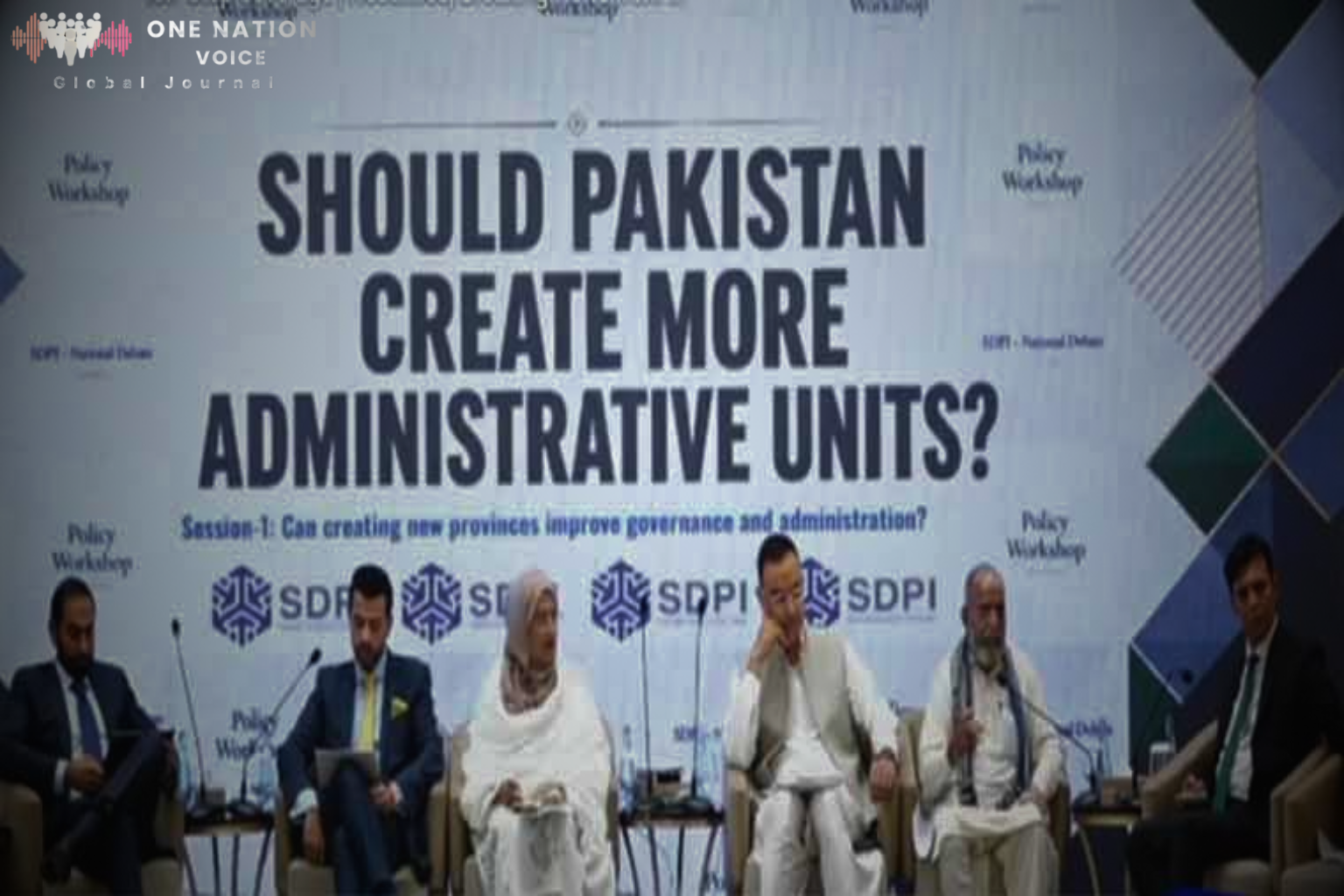
Pakistan has existed for over seven decades, yet one fundamental question remains unanswered is our administrative structure fit for the demands of the 21st century? Some political circles argue that the existing large provinces have become so administratively vast that effective governance within them is no longer truly feasible. A national debate hosted by the Sustainable Development Policy Institute (SDPI) in Islamabad has reignited this critical conversation, and the timing could not be more urgent.
A System Left Behind by Its Own People
Pakistan is a country where continuous population growth, urban sprawl, evolving administrative needs, and shifting economic activity have raised serious questions about the viability of traditional governance methods. From Karachi to Lahore, from Faisalabad to Rawalpindi, cities have expanded so dramatically that managing distant districts from a single provincial capital has become an enormous challenge. Ordinary citizens are forced to travel great distances simply to access basic services, resolve everyday problems, or seek justice a daily reality that represents a fundamental failure of governance.
Federal Minister of Health Mustafa Kamal put it plainly at the SDPI debate: four chief ministers received Rs 8,884 billion in funds, yet there is no effective mechanism to push this money down to the grassroots level. The further a district is from its provincial capital, the more underdeveloped it tends to be. This single observation captures the structural rot at the heart of Pakistan’s administrative model.
The Inequality the Data Reveals
The numbers tell a sobering story. Pakistan’s inter provincial inequality is not only wide but is continuously widening. The clearest example is Balochistan the country’s most underdeveloped region in terms of social, economic, and human development. From infrastructure to employment, from communication to education and healthcare, Balochistan consistently ranks last in almost every metric.
More than half of the one crore people living in Pakistan’s 20 most deprived districts reside in Balochistan, while the 20 strongest districts are predominantly in Punjab even though southern and western Punjab itself suffers from severe deprivation. The fruits of development have been distributed with extreme inequality across the country, and the current system has proven incapable of correcting this imbalance on its own.
The NFC Award formula, meant to address resource distribution, has itself grown outdated. The seventh NFC Award, implemented in 2010, was a significant milestone in Pakistan’s fiscal history, but more than a decade and a half has passed since then. The country’s demographic composition, administrative structures, and economic dynamics have undergone such fundamental changes that the formula now urgently needs to be realigned with contemporary realities.
Not Political Division Public Welfare
The SDPI debate was notable for one important clarification that cut through political noise. Mian Amir Mahmood, Chairman of Dunya Media Group, made clear that the call for new provinces or administrative units is not about dividing any region or gaining political advantage it is entirely about the welfare of the people, better administrative facilities, and protecting citizens’ rights. In the existing heavy and overcrowded system, genuine public welfare has simply not been achievable.
He further argued that if new provinces are established, Balochistan the largest province by area stands to benefit the most, with Sindh benefiting second, and Punjab gaining last. This analysis is important because it dismantles the narrative that new units are designed to weaken any particular province. In reality, the restructuring would deliver the greatest dividends to the most historically neglected regions of the country.
Proposals in circulation reflect serious thinking on the subject. One detailed framework proposes establishing 10 new provinces in Punjab, 7 in Sindh, 7 in Khyber Pakhtunkhwa, and 8 in Balochistan, with the stated purpose of resolving governance difficulties caused by the current provinces being too large in both area and population, and creating space for new local leadership to emerge.
Voices from Across the Political Spectrum
What makes this moment particularly significant is the breadth of political agreement at the SDPI debate. PPP senior leader Qamar Zaman Kaira acknowledged that the revival of this debate is a very welcome development, though he cautioned that care must be taken not to widen divisions, and that local government must be genuinely empowered rather than simply reorganized.
Barrister Saif argued that new provinces are needed and should be created, and that a commission should be formed to build genuine consensus. Liaquat Baloch of Jamaat e Islami emphasized that all reforms must be pursued within a constitutional and democratic framework, and that broad, serious national dialogue is essential before any structural changes are made.
A Fair Caution Worth Hearing
Intellectual honesty requires acknowledging the skeptics too. Salman Akram Raja warned that existing problems must be resolved before creating new provinces, because without addressing the root causes, the gap between government and citizens will not narrow. Provincial assemblies have historically never transferred authority downward, making the strengthening of local government a prerequisite rather than an afterthought.
Indeed, limiting this entire debate to only the creation of new provinces would be a mistake. The real challenge is good governance, meaningful devolution of authority to the grassroots level, a strong local government system, financial autonomy, a modern administrative structure, and the creation of accountable state institutions.
New administrative units are a vehicle, not the destination. The destination is a state that actually serves its people.
The Path Forward
The SDPI debate produced one conclusion that all participants regardless of political affiliation agreed upon: without systematically transferring authority and resources to the lower levels of government, effective governance, transparency, and lasting solutions to public problems remain impossible. A serious, purposeful, and comprehensive national discussion on new administrative units and a coherent governance framework must begin without further delay.
Mian Amir Mahmood’s challenge to Pakistan’s political class is worth repeating: stop confining yourselves to mutual accountability battles and institutional power struggles, and refocus your energy on reforming the public system and improving the lives of ordinary citizens. That, ultimately, is what elected office is for.
No one can deny the importance of smaller administrative units or additional provinces. The question is not whether Pakistan needs this reform the evidence makes clear that it does.
The question is whether its political leaders have the will and the wisdom to pursue it together, across party lines, in the genuine interest of the nation they claim to serve.
The views and opinions expressed in this article are exclusively those of the author and do not reflect the official stance, policies, or perspectives of the Platform.

Author

Sohail Javed is a seasoned media professional, currently serving as Chief Executive of National News Channel HD and Executive Editor of "The Frontier Interruption Report." He brings years of journalistic experience and insight to the newsroom. He can be reached via email at Shohailjaved670@gmail.com for inquiries or collaboration opportunities.
