When the Uniform Turns White: FC Hospital Nokkundi and the Human Face of Security
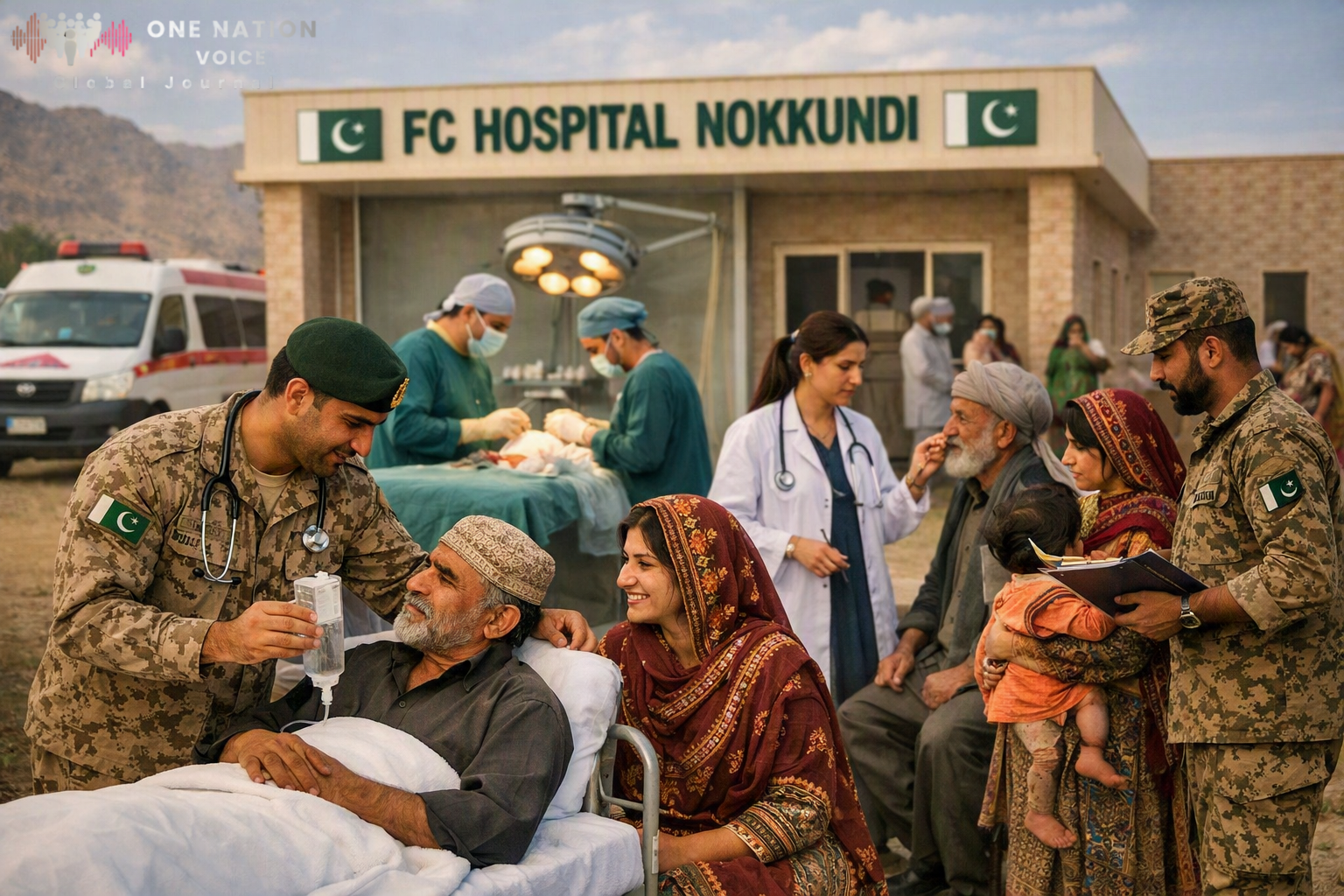
There is a story from Nokkundi that deserves to be told not because it is dramatic or unusual but precisely because it is neither. A 12 year old boy Haris was brought to FC Hospital Nokkundi in severe pain. He was diagnosed with appendicitis. Surgeons operated on him free of cost. He recovered fully and went home.
No headlines screamed. No cameras crowded the corridors. Just a child, a surgical team, and a community that now has one less reason to grieve.
Yet this quiet story carries more meaning than a hundred press releases because it reflects something the numbers already tell us that in Balochistan, access to healthcare is not merely a policy issue. It is a matter of survival.
The scale of the challenge is staggering. Over 80 percent of Balochistan’s population remains deprived of primary healthcare facilities, according to the province’s own Health Secretary. Think about that figure for a moment. The nearest functional health center is often 30 kilometres or more away from remote settlements in a province that covers nearly half of Pakistan’s total land mass. For a family in Nokkundi or a village near the Iranian border, a ruptured appendix is not just a medical emergency it is a race against geography, poverty, and time that most families simply cannot win.
That is what makes the work being done at FC Hospital Nokkundi meaningful in a way that goes well beyond institutional goodwill.
When young Haris arrived at that hospital, his family likely had few alternatives. Quetta, which houses most of Balochistan’s top hospitals, is a full day’s drive away from the province’s second most populated region and Nokkundi sits even further from that. Private specialists in far flung border districts are almost non existent. A staggering 62 percent of rural households across Pakistan are unable to afford basic healthcare services. For a family in Chagai district, surgery performed free of cost is not a perk. It is the difference between life and death.
The FC’s hospital network is expanding in a way that reflects institutional seriousness about this responsibility. Interior Minister Mohsin Naqvi recently inaugurated a state of the art Frontier Corps Balochistan (South) hospital in Turbat, describing the facility as a much needed addition to healthcare services in the region. The new hospital includes OPD wards, MRI and CT scan rooms, and operation theatres, with the Interior Minister expressing confidence it would provide quality medical services not only to FC personnel but also to the local population. Meanwhile, FC Hospital Quetta has been offering modern facilities and high quality care, with Frontier Corps Balochistan playing a key role in public service while maintaining law and order across the province.
This parallel track security and service is exactly what Balochistan’s situation demands. Critics who insist on a clean separation between military presence and civilian welfare often ignore the ground reality in areas like Nokkundi, the FC is frequently the only structured institution with the capacity and the reach to deliver care. You cannot serve a population you are not present to serve.
The contrast with those who would destroy that capacity is instructive. In November 2025, an attack on the Frontier Corps headquarters in Nokkundi was triggered when one of the terrorists detonated an explosive device at the main gate, enabling several armed attackers to storm the compound. The same institution that performed Haris’s surgery had to defend itself against coordinated violence. The same hands that hold surgical instruments had, in some cases, picked up weapons to protect the community those instruments were meant to serve.
This is the perverse logic that Balochistan’s people live with every day. Terrorists and khawarij target hospitals, schools, roads, and checkposts the very infrastructure that connects remote communities to the modern state. In early 2026, coordinated attacks across multiple districts in Balochistan targeted schools, hospitals, banks, markets, and civilian areas not security installations alone. These are not acts of political resistance. They are acts of deliberate cruelty against the population they claim to champion.
Every time a health unit burns or a road is blown apart, it is an ordinary family like Haris’s that pays the price.
The government is finally responding to the healthcare gap with some seriousness. Balochistan’s 2026 27 budget increased health sector funding to Rs96 billion, a 30 percent rise from the previous year, with the Balochistan Health Card Programme allocation raised from Rs4.5 billion to Rs6 billion to expand access to healthcare for citizens. The province is also hiring aggressively, with 1,600 doctors and 1,600 paramedics being recruited, while facilities now serve over 1.2 million patients annually, particularly in rural and underserved areas. These are meaningful numbers, even if implementation challenges remain. An air ambulance service was inaugurated in May 2026, aimed at strengthening emergency response capacity in remote and underserved areas the kind of intervention that would have been unthinkable a decade ago.
But policy moves slowly. Budget lines take years to materialize into working wards and competent staff. In the interim, institutions like FC Hospital Nokkundi fill a gap that cannot remain empty. Haris’s recovery is proof not of some grand ideological point but of something simpler and more urgent that when a capable medical team is physically present in a remote area and treatment is offered without financial barriers, lives are saved.
Dental patients like Iqbal get care they could not otherwise access. Children survive appendectomies. Mothers deliver safely.
The security forces of Balochistan are often discussed in terms of counter operations, deployments, and strategic posture. All of that matters. But the men and women staffing FC Hospital Nokkundi represent something that rarely makes the conversation a daily, unglamorous commitment to keeping their communities alive.
In a province where hospital availability is low in 13 districts, medium in 12, and high in only 7, every functional facility in an underserved area is not just a building. It is a statement that the people of that area matter, that their pain is seen, and that someone will show up not to give a speech but to operate.
The views and opinions expressed in this article are exclusively those of the author and do not reflect the official stance, policies, or perspectives of the Platform.