



Decoding the Mecca Alliance: Reorienting Defense Alliances
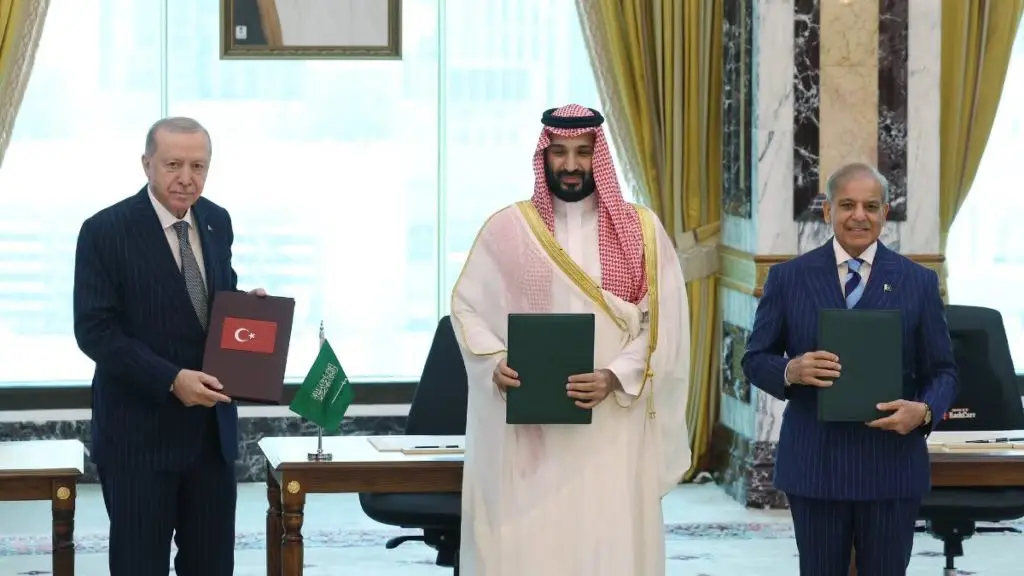
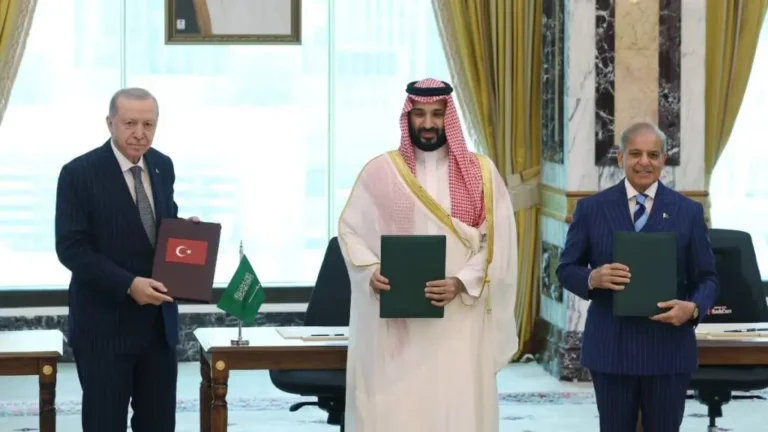
The drastic shifts in the security architecture of the Middle East, particularly the outbreak of Israel Iran US war, October 7, and diminishing credibility of United States’ role as the sole guarantor of security has opened new avenues for reorienting the regions defense infrastructure. The realignment provides greater autonomy to the regional powers in ensuring means of their security. In this regard, the Makkah Alliance, a trilateral defense pact, builds on the principle of pragmatism to enhance collective deterrence, build the capacity of its three signatories, and enable them to strengthen their security infrastructure with the sole purpose of preventing a security vacuum and preventing the region from falling into perpetual chaos.
Alliances like Mecca are not new. Most states around the world have been signatories to such agreements and pacts. The idea of defense and security pact has been a part and parcel of international politics. The signing ensures collective response to common adversaries and perceived common threats. Since the outbreak of Russia Ukraine war, the need of the time is to reorient defense pacts from purely military (hard power). This implies that in order to build credibility of such pacts there must be shared understanding of security challenges. This approach is further strengthened by the balance of interests’ theory. The theory suggests that the alliance is more effective when the interests of signatories continue to converge. This opens space for the signatories to retain their distinct foreign policy objectives while collaborating where their interest collide. Another ground argument that justifies the logic of reorientation is connecting multi polarity with a distinct phase marked by strategic autonomy, multi alignment, institutionalism and pluralism under strict conditions of interdependence. Therefore the real test of the pact lies in identification of converging security interests.
The convergence of interest between the signatories i.e. Pakistan, Saudi Arabia and Turkey can be better visualized and endorsed by the idea of converging and overlapping strategic interest. Saudi Arabia enjoys religious following, greater financial autonomy and energy base while vying for security of its critical and national infrastructure. Turkey on the other hand specializes in modern military and industrial based technology while competing for greater regional stability with challenges emerging in Syria (potential conflict with Israel), Lebanon and Greece. Pakistan, the sole nuclear power in this alliance, specializes in conventional military, boosts a large defense establishment, longstanding security ties with Riyadh, internal rifts, a hostile neighbor and yet strives for greater say in international affairs and economic stability. These challenges illustrate that the strength of the partnership does not derive from identical threat perceptions or complete strategic alignment, but from the intersection of interests that each signatory considers sufficiently important to institutionalize through collective defense cooperation.
The convergence of interests, however, is only the starting point; the effectiveness of the Mecca Alliance will depend on how this convergence is translated into complementary capabilities. Alliances can only become more efficient when strategically compatible states coordinate their defense capabilities through a division of labour rather than simply duplicating military assets. Applied to the Mecca Alliance, this raises an important question: can Saudi Arabia, Turkey and Pakistan transform their different military and strategic capacities into an integrated security contribution?
Keeping in view the diverse experience of the three signatories the complimentary approach offers the best compliance model. Pakistan and Turkey compliment Saudi Arabia in enhancing its security infrastructure through provision of military assets and technology. Turkey, a NATO signatory, compliment Pakistan and Saudi Arabia with better strategic insight. Pakistan compliments both Saudi Arabia and Turkey through its nuclear weapons, war fighting experience and recent successes on the diplomatic front. For Pakistan, this alliance is the most important as it has been long associated with militancy and terrorism.
Through the recent US Iran mediation efforts, Pakistan has repositioned itself as a stabilizing actor, and this trilateral pact can be the beginning of Pakistan’s larger role in the Middle East.
After the recent attacks by Houti’s on Saudi Arabia, a number of questions have been raised on the operability i.e. how the division or sharing of defense responsibilities will take place? With little information available on the clauses of the pact, there is evidence that proves that the pact is gradually moving from a political commitment towards institutional implementation. Turkey’s readiness to address Saudi Arabia’s military needs, Pakistan’s appointment of the first Secretary General, and the September 25 meeting of defense chiefs demonstrate early institutionalization. Their focus on intelligence sharing, military coordination and capability integration signals efforts to establish effective collective defense mechanisms.
The alliance success will be determined not by the similarity of foreign policy interests but by their capacity to complement each other and institutionalize long term cooperation where there interest converges. The ability to absorb external shocks, rational thinking, prudent decision making, participation in global conflicts will all contribute to strengthening this mechanism. While all three countries have separate national interests, the convergence will shape the future of Middle East. The shifting sands of Middle East are now in the hands of three partners, whether they are able to hold or let it to slip is the real litmus test for this alliance.