


Reclaiming the Quran from Extremist Distortion
Violent extremist groups in Pakistan have not merely attacked the state with guns and bombs; they have attacked Islam itself by corrupting its language. Their most dangerous weapon is not only violence but religious distortion. Terms such as jihad, takfir, hijrah, khilafah, and al-wala wal-bara have been ripped from their scholarly roots and repackaged as slogans for militancy. This is why Pakistan’s ulema and madrassah institutions have a responsibility that no police force, intelligence agency, or military operation can replace. Security operations may dismantle networks, but only credible scholarship can dismantle the false theology that allows those networks to recruit, justify, and survive.
The most abused concept is jihad. Extremist propaganda presents jihad as permanent armed violence, but classical Islamic scholarship has always understood it in broader and more disciplined terms. Jihad includes the inner struggle against the ego, the struggle to speak truth, the struggle to serve society, and, only under strict legal conditions, armed conflict under legitimate authority. The Prophet ﷺ identified internal jihad as the greater struggle, as cited by Ibn Hajar in Tasdid al-Qaws.
To reduce jihad to terrorism is not courage, piety, or sacrifice; it is scholarly fraud. Ulema must say this plainly, repeatedly, and publicly
Equally dangerous is the extremist misuse of takfir. Declaring another Muslim an apostate is among the gravest matters in Islamic jurisprudence. The Prophet ﷺ warned: “If a man says to his brother O Kafir, then it falls upon one of them” (Sahih al-Bukhari, 6104). Yet extremist groups casually apply takfir to Pakistani soldiers, police officers, judges, civil servants, elected representatives, and scholars who oppose them. This is a direct violation of prophetic warning and fourteen centuries of juristic caution. Takfir was never a toy in the hands of angry men. It is a grave legal and theological matter, fenced by conditions that extremists deliberately ignore.
The idea of khilafah has also been violently distorted. Extremist groups imagine that seizing territory through bloodshed creates Islamic legitimacy. Classical scholars, from Al-Mawardi to Ibn Khaldun, treated political authority as a matter of order, consultation, public interest, and community agreement. The Quran praises those whose “affairs are conducted through mutual consultation” (Al-Shura 42:38). A so-called caliphate imposed through coercion, murder, kidnapping, and fear has no foundation in Islamic political theory. No banner, slogan, or black flag can convert rebellion and savagery into legitimate authority.
Hijrah is another concept exploited to recruit Pakistani youth. Militants tell young people to abandon their homes, parents, education, and country to join armed groups in mountains, camps, or foreign battlefields. Classical scholars understood hijrah as migration from a place where Islam cannot be genuinely practiced. Pakistan is not such a place. Mosques are open, madrasahs function, Ramadan is observed, Eid is celebrated, Quran is taught, and Islamic identity is protected in public life. The Prophet ﷺ declared: “There is no hijrah after the conquest” (Sahih al-Bukhari, 2783).
Turning hijrah into a recruitment device for militancy is calculated religious deception
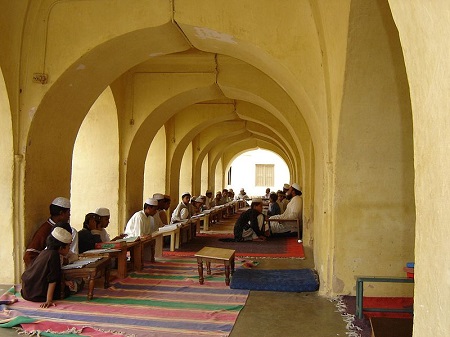
This is where madrassahs matter enormously. At their best, Pakistan’s madrassah institutions represent a deep tradition of disciplined Islamic learning, memorisation, interpretation, law, language, ethics, and spirituality. The Prophet ﷺ said: “Seeking knowledge is an obligation upon every Muslim” (Sunan Ibn Majah, 224). When madrassahs teach Islam through context, method, humility, and juristic discipline, they become among Pakistan’s strongest counter-extremism institutions. A madrassah that teaches usul al-fiqh, comparative fiqh, maqasid al-shariah, and the ethics of disagreement produces graduates who can defeat extremist arguments on theological ground, not merely condemn them emotionally.
The ulema carry an explicit Quranic mandate. The Quran states that from every community there should be a group that becomes learned in religion and warns its people when they return (Al-Tawbah 9:122). This verse makes scholars guardians against deviation, not silent observers of it. Silence in the face of extremist distortion is not neutrality; it is abandonment of duty. The obligation of amr bil ma’ruf wa nahy ‘an al-munkar, enjoining right and forbidding wrong, requires ulema to act beyond the pulpit. They must engage schools, universities, prisons, digital platforms, rural communities, urban seminaries, and every space where extremist recruiters operate.
Pakistan already possesses an important scholarly foundation in the Paigham-e-Pakistan declaration, endorsed by thousands of ulema from all major schools of thought. It declared terrorism, suicide attacks, and non-state militancy haram under Islamic law. This declaration should not remain a ceremonial document quoted only at conferences. It should be taught in madrassah classrooms, discussed in Friday sermons, translated into local languages, explained on social media, and incorporated into teacher training.
It represents a living scholarly consensus in Pakistan against the religious claims of violent extremism
Extremists also manipulate al-wala wal-bara, loyalty and disavowal, to claim that Muslims must cut civic ties with anyone cooperating with the Pakistani state. Classical scholarship treated this concept as a matter of faith and religious allegiance, not a command to destroy civic order or national responsibility. Serving in Pakistan’s armed forces, police, courts, schools, or administration is not betrayal of Islam. It is service to society when performed with justice and integrity. The ulema must make this distinction clear before recruiters turn confusion into radicalisation.
Ultimately, Pakistan’s struggle against violent extremism is also a struggle over meaning. Whoever defines Quranic concepts for the youth shapes the future of the country. If extremists define jihad, takfir, hijrah, and khilafah, they will continue producing violence. If qualified ulema and responsible madrassahs reclaim these concepts with courage, knowledge, and consistency, they will remove the theological oxygen from extremist propaganda. Pakistan does not need less religious scholarship; it needs deeper, braver, and more contextual scholarship. A madrassah system rooted in understanding, and an ulema class willing to confront distortion, may prove to be Pakistan’s most enduring defence against extremism.

