




National Interest and Natiq Malikzada’s Misleading Narrative on Pakistan and Narcotics
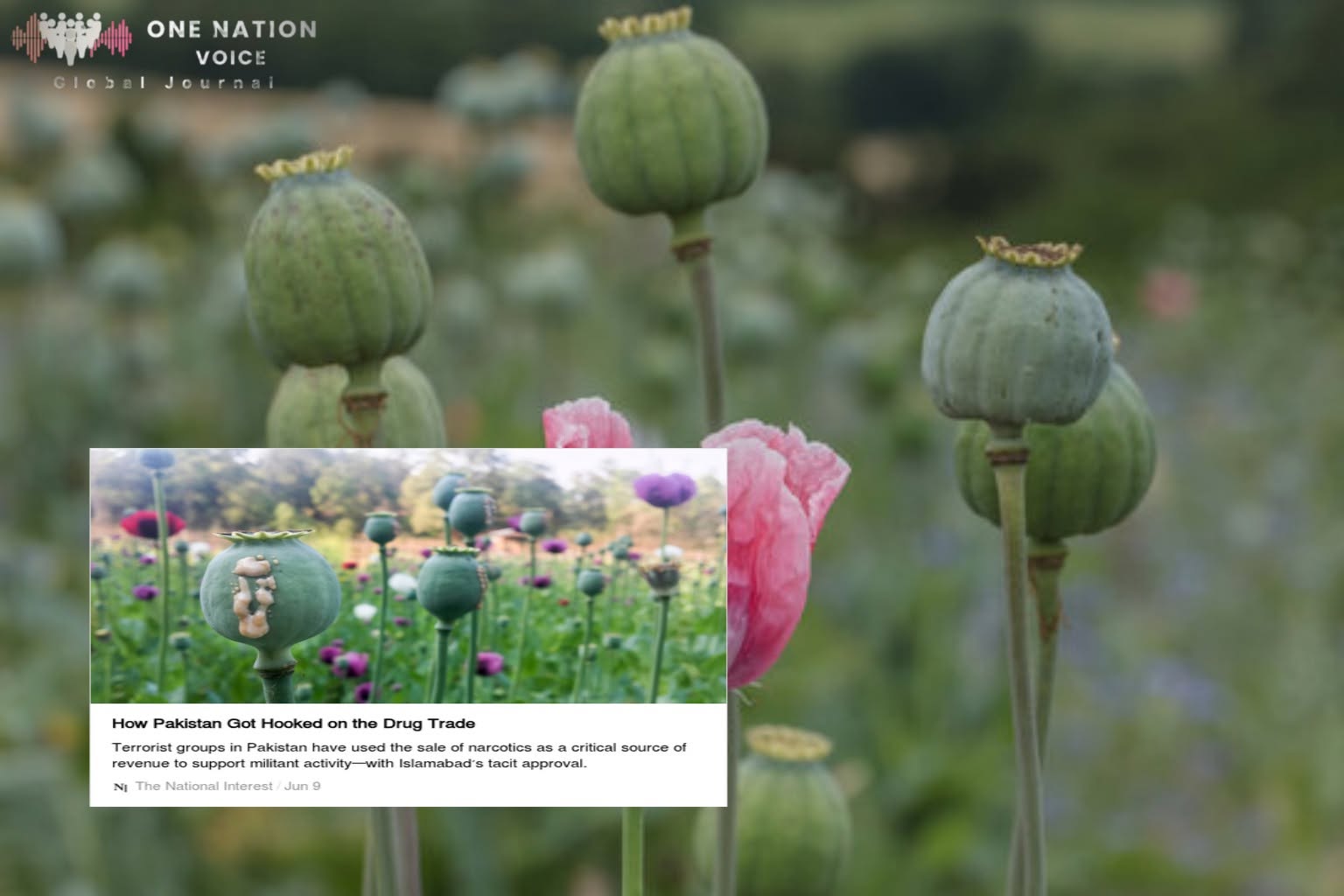
Setting the Record Straight: Pakistan Is a Victim, Not a Villain, in the Regional Narcotics Crisis
When Natiq Malikzada’s article “How Pakistan Got Hooked on the Drug Trade” appeared in The National Interest, it was presented with the air of an investigative exposé. In reality, it reads as a carefully constructed narrative built on anonymous allegations, selective historical framing, and a conspicuous disregard for the weight of international evidence. For a publication that prides itself on serious foreign policy analysis, the decision to print such an article raises uncomfortable questions about editorial standards and geopolitical motivations.
Let us begin with what the data actually says.
The United Nations Office on Drugs and Crime (UNODC), the world’s foremost authority on narcotics monitoring, consistently identifies Afghanistan as the epicentre of regional drug production.
According to the UNODC Report 2024, poppy cultivation resurged in Afghanistan, particularly in border regions adjacent to Pakistan, with over 31,600 acres of land under cultivation, compared to a small fraction of that inside Pakistan, where eradication campaigns continue at full pace. Seizures of methamphetamine and other synthetic substances inside and around Afghanistan by the end of 2024 were approximately 50 percent higher than in the third quarter of 2023, reflecting a profound shift in Afghan drug production toward synthetic narcotics. UNODC has noted that with the decline in agriculture based opiate production, synthetic drugs appear to have become the new business model for organised crime groups operating inside Afghanistan, driven by easier production methods, greater difficulty in detection, and resilience to climate change.
This is the true origin story of the regional narcotics crisis, not Islamabad’s ports, not Pakistan’s intelligence services, but the laboratories and fields of a country that has been the world’s narco epicentre for decades. Attempting to rewrite this geography through insinuation and anonymous sourcing is not journalism; it is agenda setting.
Pakistan’s counter narcotics record tells a very different story.
Pakistan has maintained its poppy free status since 2001, a distinction well recognised and acknowledged by international bodies.
Far from being a passive corridor for narcotics, Pakistan has been actively and measurably dismantling trafficking networks. In 2024 alone, Pakistan’s Anti Narcotics Force seized 361 metric tons of narcotic drugs and precursor chemicals, executed 32 international intelligence based operations leading to the arrest of 61 international drug traffickers in cooperation with the US DEA, UK NCA, and other partners, and achieved a conviction rate of over 90 percent in drug related prosecutions. Additionally, Pakistani authorities froze drug proceeds worth Rs. 4.5 billion and provided operational assistance to 16 partner countries in 235 inquiries.
These are not the statistics of a state complicit in drug trafficking. These are the numbers of a frontline nation bearing an extraordinary burden.
Under its national counter narcotics mandate, Pakistan launched the Poppy Eradication Campaign 2024 25, conducting synchronized operations across Balochistan, Khyber Pakhtunkhwa, and Sindh, deploying drones, targeted weedicides, and a dedicated workforce operating in remote and volatile areas. During this campaign, Pakistani authorities also apprehended and repatriated 110 Afghan nationals who had crossed the border illegally and were directly involved in poppy cultivation inside Pakistan, a fact that speaks volumes about where production pressures are originating and in which direction they are flowing.
Recognising that drug trafficking networks are becoming more agile and complex, Pakistan is now moving toward a more unified, coordinated national response. In December 2025, the Anti Narcotics Force, in close collaboration with UNODC and with support from the US Bureau of International Narcotics and Law Enforcement Affairs, convened a high level workshop to advance a new governance framework for Pakistan’s National Counter Narcotics Coordination Center. Pakistan, a pilot country of the UN Port Control Programme since 2007, has expanded its role from establishing its first port control unit in Karachi in 2008 to now serving as a regional training hub, and coordinated the IREN Operation on Synthetic Drugs in 2024, reflecting its growing role in tackling emerging drug threats.
The article’s attempt to draw a straight line from Cold War era covert operations to present day terrorism financing relies on a chain of logical leaps that no credible analyst would sanction. Terrorist groups, more precisely, the Khawarij and their affiliated networks, that operate in the region finance themselves through diverse criminal ecosystems, not through any singular state apparatus. Pakistan has itself been the primary victim of such groups. Thousands of Pakistani soldiers, police officers, and civilians have lost their lives combating this very threat.
Malikzada’s narrative also conveniently ignores the geopolitical context that surrounds Afghan drug production. UNODC Executive Director Ghada Waly has explicitly warned that international efforts must be coordinated to ensure that Afghanistan’s decline in opium production is not replaced by a surge in dangerous synthetic drugs such as methamphetamine within Afghanistan or the wider region. The concern, according to the UN’s own leadership, is centred squarely on Afghanistan.
Geographic proximity is not culpability. Pakistan borders Afghanistan by accident of history, not by design of criminality. That narcotics originating in Afghan territory pass through a country sharing hundreds of kilometres of mountainous, porous border is a logistical reality, not evidence of state sponsorship. Conflating the two is intellectually dishonest.
The international community has, by and large, understood this distinction. UNODC, the US DEA, the UK’s National Crime Agency, INTERPOL, and the Commission on Narcotic Drugs continue to engage Pakistan as a partner. That consensus carries more evidentiary weight than any anonymously sourced article ever could.
Pakistan deserves fair analysis, not recycled insinuation. The regional narcotics challenge is real, complex, and deadly, and it demands honest engagement with the facts. Malikzada’s article fails that test.
Disclaimer:
The views and opinions expressed in this article are exclusively those of the author and do not reflect the official stance, policies, or perspectives of the Platform.

