





UNAMA Echoing Taliban’s Civilian Casualty Mantra While Ignoring Terrorist Sanctuaries
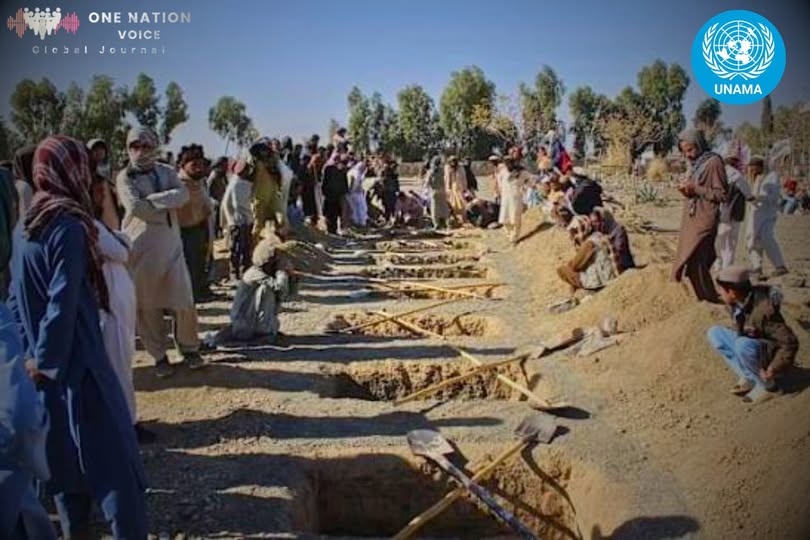
When the United Nations Assistance Mission in Afghanistan (UNAMA) swiftly posted its statement documenting “13 civilian deaths and 10 injuries” from counterterrorism strikes on the night of 9/10 June in Khost, Kunar, and Paktika, it performed its now familiar ritual: amplify casualty figures, omit terrorist context, and serve the Taliban regime’s propaganda machine on a silver platter. The statement, predictably echoed across international media, said nothing about the Fitna Al Khawarij (TTP) hideouts, commander hubs, ammunition caches, and training facilities that were the actual targets of those precision strikes.
This is not an isolated oversight. It is a pattern, and the world deserves to call it what it is: selective, structurally compromised reporting that consistently ignores the terror infrastructure festering across eastern Afghanistan while fixating on whatever narrative suits the Taliban’s diplomatic goals.
The Ground Reality UNAMA Refused to Acknowledge
Pakistan’s Information Minister Attaullah Tarar confirmed that the strikes on the night of 9/10 June were “precise and calibrated,” targeting four key facilities: a training centre, an ammunition cache, a hideout, and an operational hub (Markaz) belonging to Khawarij commanders Aleem Khan Khushali and Akhtar Muhammad Jani Khel. Pakistani security sources confirmed that 26 Khawarij terrorists were neutralised across the four locations.
The specific ground level picture is even more telling. In Sholtan, Kunar, the hideout of commander Abu Bakar was struck, he was reportedly using his own family within the same compound. In Chowgam, Kunar, the hideout of Mullah Abdullah was hit; Abdullah was killed while his wife and two children were injured in the same terrorist compound. In Spera, Khost, 18 terrorists were killed and 10 injured while living inside two houses being used as combined residential and operational safe houses. In Birmal, Paktika, the hideout of commander Sangar was struck, killing five terrorists and injuring nine, Sangar, too, had kept his family within the same compound.
UNAMA’s statement mentioned none of this. Not the commander names.
Not the weapons caches. Not the deliberate co location of family members with terrorist operatives, a tactical doctrine that the Taliban and Khawarij have refined over years to generate precisely the kind of propaganda that UNAMA then faithfully disseminates.
The Human Shield Doctrine and UNAMA’s Deafening Silence
The deliberate embedding of family members inside terrorist hideouts is not incidental. It is a documented doctrine: the use of human shields to deter counterterrorism operations, and when strikes do occur, to generate casualty figures that international bodies like UNAMA label as “civilian deaths” without meaningful scrutiny.
UNAMA operates inside Afghanistan under Taliban permission. As analysts have noted, the Taliban is an armed movement that controls information, movement, local authorities, and access within Afghanistan. Independent verification of casualty claims in such an environment is not merely difficult, it is structurally compromised. As one recent analysis observed, “independent verification is questionable and is not accepted on faith” when the entity controlling the territory is the same one making the casualty claims. Accepting Taliban provided casualty figures as settled fact, without examining whether those killed were Khawarij operatives, facilitators, or family members knowingly stationed inside terrorist compounds, is not journalism or humanitarian documentation. It is the laundering of terrorist propaganda through UN letterhead.
What the UN’s Own Reports Reveal
The irony is devastating. The UN’s own Analytical Support and Sanctions Monitoring Team, in its 36th report (July 2025) and 37th report (February 2026), explicitly stated that the Taliban regime continues to host Fitna Al Khawarij (TTP), Al Qaeda, and ISIS Khorasan, and described the environment created by Kabul as “permissive” for terrorist organisations. The Taliban’s repeated public claims that “no terrorist groups operate from Afghan soil” were flatly labelled “not credible” by the same UN monitoring system.
So the UN’s own intelligence and monitoring apparatus has documented that eastern Afghanistan’s provinces, specifically Kunar, Nangarhar, Khost, Paktika, and Paktia, host an estimated 6,000 to 6,500 Khawarij fighters who have regrouped across the Pak Afghan border. Yet UNAMA’s rapid response communications wing issues casualty statements about strikes in those very provinces without once referencing the terror infrastructure those strikes were targeting.
Pakistan’s envoy to the United Nations Security Council articulated this contradiction directly on June 9, 2026, just one day before the strikes: UNAMA is “swift in reporting incidents of cross border actions and casualties but fails to provide the overall context.” The envoy raised pointed concerns that “the fatalities of terrorists and their supporters as a result of counterterrorism operations are being mentioned within the ambit of civilian casualties,” calling into question UNAMA’s credibility as an impartial monitoring body.
The Cost of Selective Silence
The human cost of Khawarij terrorism operating from Afghan soil is not an abstraction. In the first quarter of 2026 alone, cross border terrorist violence claimed the lives of Pakistani security personnel and civilians in an unrelenting wave. The strikes on 9/10 June came directly in the aftermath of a Khawarij terrorist attack on a Federal Constabulary post in Musa Dara on June 9, vehicle borne suicide attacks on a military post in North Waziristan on June 2, and a police station attack in Bannu on May 9. These attacks, and hundreds like them, are the reason counterterrorism operations are conducted in the first place. UNAMA does not monitor them. UNAMA does not issue rapid response statements documenting them. They do not appear in UNAMA’s casualty counts.
The asymmetry is not accidental. When terror flows outward from Afghan soil and kills Pakistani security forces and civilians, silence prevails at UNAMA headquarters. When a precision strike eliminates the infrastructure enabling that terror, UNAMA’s communications apparatus mobilises within hours.
The Question of Institutional Integrity
There is a structural reason for UNAMA’s operational calculus. The mission exists inside Afghanistan at the tolerance of the Taliban regime. Its staff operate in an environment where confronting the Taliban’s militarisation of civilian spaces, its facilitation of Khawarij infrastructure, or its deliberate human shield doctrine would not merely trigger diplomatic friction, it would put UNAMA’s own access and personnel at risk. The incentive structure is clear: maintain Taliban goodwill, report what the Taliban permits you to report, and frame your outputs in language the Taliban finds useful.
This is not a conspiracy, it is an institutional vulnerability inherent to any UN mission embedded within a hostile, information controlling armed regime. But recognising the structural constraint does not excuse the consequences. When UNAMA’s casualty statements are cited by international media, policymakers, and human rights bodies without contextualising the Khawarij infrastructure being targeted, the result is a global information environment in which legitimate counterterrorism operations are systematically delegitimised while the terror sanctuaries enabling mass violence go unremarked.
Conclusion
The strikes of 9–10 June 2026 were not conducted in civilian neighbourhoods. They were conducted in Khawarij hideouts, compounds where terrorist commanders, their weapons, their operational infrastructure, and in some cases their deliberately co located families were simultaneously present. The decision of those commanders to station family members inside active terrorist facilities is the moral responsibility of the commanders themselves, not of the forces conducting precision operations against documented threats.
UNAMA’s role in this information landscape must be reassessed. An institution that races to document “civilian casualties” in Khost and Kunar while maintaining studied silence on the Fitna Al Khawarij sanctuaries, training centres, and commander hubs that the UN’s own monitoring reports confirm are thriving in those same provinces is not a neutral humanitarian body. It is an amplifier of a selective narrative, and in the context of a region bleeding from cross border terrorist violence, that selective silence carries a very real human cost.
The public deserves context, not curated casualty counts. The international community deserves honest documentation, not institutional complicity with a regime that has turned eastern Afghanistan into the world’s most densely populated Khawarij safe haven.
Disclaimer:
The views and opinions expressed in this article are exclusively those of the author and do not reflect the official stance, policies, or perspectives of the Platform.

