
Pakistan: The Peacemaker the Region Cannot Ignore
In international affairs, reputation is built not through rhetoric but through results. And in the span of barely twelve months, from the nuclear brinkmanship of May 2025 to the US Iran ceasefire of April 2026, Pakistan has delivered results that the most seasoned diplomatic veterans would find remarkable. The country that its detractors once dismissed as a destabilising force has emerged, irrefutably, as the region’s most consequential peace facilitator.
The transformation did not happen by accident. It was the product of quiet, principled, and patient diplomacy exercised at the highest levels of Pakistan’s leadership, Prime Minister Shehbaz Sharif and Field Marshal Syed Asim Munir, who chose dialogue over grandstanding at every critical juncture.
From the Brink of War to a Ceasefire Agreement
Cast your mind back to May 2025. South Asia stood at the edge of catastrophe. Following a terrorist attack that killed 26 tourists in Indian administered Kashmir, India launched strikes on Pakistani territory under the banner of “Operation Sindoor.” What followed was four days of the most intense fighting between the two nuclear armed neighbours in decades, ballistic missiles, drones, fighter jets, and cross border artillery fire. The world held its breath.
It was Pakistan that chose restraint without weakness. Even as it exercised its undeniable right to self defence, Islamabad kept diplomatic channels open and communicated clearly to Washington that it sought de escalation. The result, reached on May 10, 2025, was a full and immediate ceasefire, one that US President Donald Trump himself announced and has since referenced more than thirty times as among his greatest diplomatic achievements.
Crucially, US Secretary of State Marco Rubio confirmed that he and Vice President JD Vance had engaged directly with Prime Minister Sharif and Field Marshal Munir in those final critical hours. Pakistan did not merely accept the ceasefire, it helped make it possible by signalling, consistently and credibly, that it would respond to genuine diplomatic outreach. In gratitude for President Trump’s intervention, Pakistan formally recommended him for the 2026 Nobel Peace Prize, a gesture that underscored Islamabad’s genuine commitment to recognising and encouraging peacemaking leadership wherever it is found.
That shift is not cosmetic. It reflects a fundamental transformation in Pakistan’s international posture, one anchored in responsibility, credibility, and discipline.
The Islamabad Memorandum of Understanding: A New Diplomatic Landmark
If May 2025 demonstrated Pakistan’s capacity to de escalate bilateral crises, April 2026 revealed something far more ambitious, Pakistan’s ability to broker peace between global powers.
As the United States and Iran stood locked in a devastating war, with oil markets convulsing and the world fearing the worst, Pakistan stepped forward where others hesitated. Through relentless backchannel diplomacy, Field Marshal Asim Munir and Prime Minister Sharif worked with both Washington and Tehran, navigating each side’s sensitivities with extraordinary care.
On April 8, 2026, Pakistan brokered a two week ceasefire between the United States and Iran, a feat that few nations on earth could have achieved. Within days, Islamabad hosted what would become known as the Islamabad Talks: the highest level direct engagement between Washington and Tehran since 1979. The Pakistani capital became, briefly, the diplomatic capital of the world.
Iranian Foreign Minister Abbas Araghchi said Iran accepted the ceasefire “in response to the brotherly request of PM Sharif.” President Trump, for his part, stated publicly that he agreed to stand down “based on conversations with Prime Minister Shehbaz Sharif and Field Marshal Asim Munir.” This was not diplomatic flattery, it was acknowledgment of concrete, decisive influence.
Field Marshal Munir made multiple personal visits to Tehran, meeting Iran’s Interior Minister and engaging a range of Iranian stakeholders to streamline communication and build confidence. Pakistan’s Interior Minister Mohsin Naqvi was present alongside him, demonstrating the institutional depth of Pakistan’s diplomatic commitment. These were not photo opportunities, they were working missions by men who understood that peace, in its final form, is made in private rooms through the currency of trust.
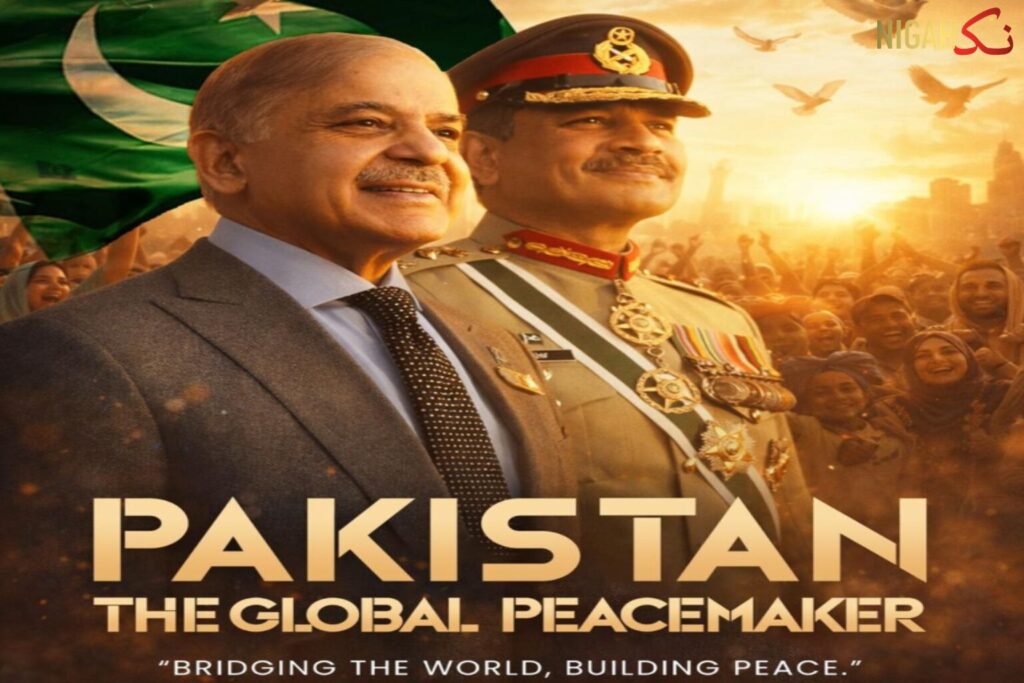
A Responsible Nuclear State on the World Stage
What makes Pakistan’s diplomatic record all the more significant is the context in which it was achieved. Pakistan is a nuclear armed state managing a contested border with a larger neighbour, while simultaneously combating the menace of Khawarij and terrorists within its own frontiers. And yet, rather than retreating into defensiveness or transactional foreign policy, Pakistan has consistently chosen the harder and nobler path: constructive engagement.
This is a nation that, in a single year, helped prevent two potentially catastrophic conflicts from spiralling into wider wars, one involving its own sovereign territory, and one involving two nuclear capable global powers. It has demonstrated that responsible nuclear stewardship is not merely about maintaining deterrence; it is about using the gravitas that comes with strategic importance to build bridges where others build walls.
The Islamabad Memorandum of Understanding, born from those landmark April 2026 talks, stands as evidence that Pakistan’s capital can serve as neutral, trusted ground, a place where adversaries can come to talk, because they trust that Islamabad will be honest with both sides. That credibility is earned. It cannot be manufactured.
Leadership Defined by Results, Not Noise
There is a tendency in global discourse to measure national strength by volume, by the sharpness of rhetoric, the boldness of threats, the spectacle of military parades. Pakistan, under the current leadership of Prime Minister Shehbaz Sharif and Field Marshal Syed Asim Munir, has offered the world a different model: leadership measured in outcomes.
When the India Pakistan ceasefire was announced, Pakistan thanked the US president, nominated him for the Nobel Peace Prize, and urged both sides toward substantive dialogue on outstanding disputes, including the long unresolved question of Kashmir. When the US Iran talks stalled, Pakistan did not disengage, Field Marshal Munir returned to Tehran in May 2026 to restart momentum, working to secure a second round of direct negotiations.
This is what principled diplomacy looks like in practice: persistent, patient, unglamorous, and effective.
Conclusion: The Peacemaker the Region Cannot Ignore
The international community is gradually arriving at a conclusion that Pakistan itself has long known: that South Asia’s stability, and increasingly the broader region’s stability, runs through Islamabad. Pakistan is not peripheral to global peace architecture, it is central to it.
President Trump’s repeated public acknowledgment of Pakistan’s role, Iran’s warm expressions of gratitude, and the simple fact that the world’s most powerful nation chose an Islamabad conference room to hold its most sensitive talks with a strategic rival, these are not coincidences. They are the logical consequence of a Pakistan that has chosen, with clarity and conviction, to be a force for peace.
Pakistan has proved, once again, that dialogue is stronger than conflict, that diplomacy is wiser than confrontation, and that true leadership is not measured by noise, but by the peace it leaves behind.
Disclaimer:
The views and opinions expressed in this article are exclusively those of the author and do not reflect the official stance, policies, or perspectives of the Platform.