

TALIBAN’S CIVILIAN CASUALTY MANTRA CANNOT OBSCURE REALITY OF TERRORISM EMANATING FROM AFGHAN SOIL
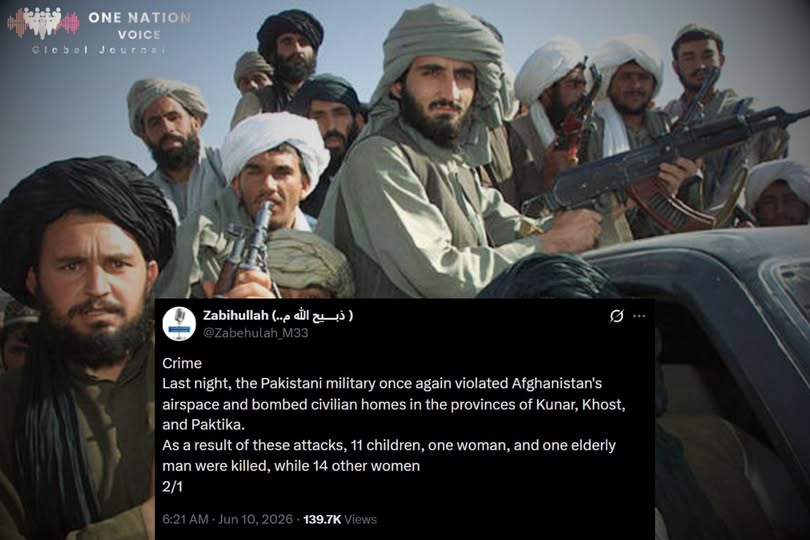
In the theater of international diplomacy, few narratives are more cynically rehearsed than that of the Taliban regime when Pakistani precision strikes dismantle terrorist infrastructure on Afghan soil. Within hours of Operation Ghazab ul Haq targeting Khawarij hideouts in Khost, Kunar, and Paktika on the morning of June 10, Taliban spokesperson Zabihullah Mujahid was already broadcasting the regime’s familiar script: civilian casualties, violated sovereignty, outrage for the cameras. What this performance deliberately erases is the blood soaked timeline that precedes every Pakistani response.
The immediate context of today’s operation is not ambiguous. On June 9, 2026, barely twenty four hours before the strikes, Fitna al Khawarij terrorists belonging to the outlawed Tehreek e Taliban Pakistan attacked a Federal Constabulary post in the Hassan Khel area, martyring six Pakistani soldiers, wounding eight, and abducting seven others. This followed a vehicle borne suicide assault on a military post in North Waziristan on June 2 and the Bannu police station car bombing of May 9, which killed fifteen police officers. Pakistan’s Information Minister Attaullah Tarar confirmed the strikes targeted training centres, ammunition caches, and positions directly linked to TTP commanders Aleem Khan Khushali and Akhtar Muhammad Jani Khel, named planners of these very attacks.
This is not a story of an aggressor nation acting recklessly. This is the story of a sovereign state that has absorbed extraordinary punishment with extraordinary restraint, and which now finds itself left with no credible alternative but to eliminate threats at their source.
The scale of that punishment demands honest reckoning. In 2026 alone, Khawarij terrorists have martyred 86 civilians and injured 260 others in Khyber Pakhtunkhwa. Over 1,200 Pakistanis were killed in terrorist attacks in the previous year, according to Pakistan’s UN envoy. The February 2026 bombing of a Shia mosque in Islamabad, claimed by ISKP, killed 31 worshippers at prayer.
The UN Analytical Support and Sanctions Monitoring Team’s 37th report, submitted to the UNSC in February 2026, confirmed what Pakistan has long declared: Afghanistan has become a sanctuary from which attacks on Pakistan are planned, resourced, and launched with increasing audacity.
The Taliban regime’s response to this documented reality has been a masterclass in deflection. Rather than dismantling Khawarij sanctuaries, as the international community, Pakistan, and basic principles of good neighbourliness demand, the regime has chosen denial, diplomatic theatre, and a refusal to publicly condemn groups like the TTP. Pakistan’s UN envoy noted at the June 8 Security Council session that this refusal was “deeply disturbing.” These are not rhetorical escalations. They reflect a documented pattern spanning years.
The international community is no longer willing to look away. At the June 8 UNSC session dedicated to the Afghanistan situation, multiple Council members raised pointed concerns about terrorist organisations sheltering under Taliban governance. The United States directly called on Council members to echo condemnation of the Taliban’s sheltering of terrorist groups and their refusal to implement counterterrorism commitments. France’s representative voiced alarm over the presence of terrorist groups operating from Afghan territory. Liberia, speaking also for the Democratic Republic of the Congo and Somalia, declared unequivocally that Afghan soil must not serve as a launchpad for transnational terrorist organisations. The breadth of this concern, spanning Western democracies, African nations, and permanent members, reflects an emerging global consensus that the Taliban’s terrorist hospitality is not a regional bilateral dispute but a global security failure.
Pakistan’s operational doctrine in this context deserves emphasis. Tarar’s statement confirmed that strikes were intelligence based, precision guided, and directed at specific terrorist infrastructure, not indiscriminate bombardment. Pakistan has consistently maintained that its operations target the architects of violence, not Afghan civilians. The Khawarij use of civilian proximity as a shield, embedding within residential areas and exploiting mosques and madrassas, is a deliberate tactical choice by the terrorists themselves.
The Taliban’s outrage would carry more weight if it were accompanied by a single credible action against the Khawarij commanders who plan attacks from Afghan soil. It is not. Instead, the regime has perfected a propaganda cycle: permit terrorists to operate, allow attacks to be launched, then perform grief when Pakistan responds. Every repetition of this cycle costs Pakistani lives. Every round of international handwringing that follows without demanding accountability from Kabul gives the Khawarij another window to regroup, re arm, and strike again.
No sovereign nation can be expected to permanently absorb the consequences of cross border terrorism while those sheltering the perpetrators face no meaningful cost.
Pakistan has demonstrated remarkable patience: months of diplomatic engagement, repeated calls for verifiable action, and restraint in the face of continuous provocation. That patience has been answered with the Hassan Khel massacre and the bodies of six Federal Constabulary soldiers.
The global community must now ask itself a clear question: will it continue to treat Taliban claims about civilian casualties as a sufficient response to documented Khawarij atrocities? Or will it hold the Taliban regime to its obligation, under international law, under its own claimed religious authority, and under basic standards of state conduct, to ensure Afghan territory is not used to export death to its neighbour?
Pakistan has made its position plain at the highest levels of international diplomacy. It has acted with precision and proportionality. It has named the commanders responsible. The Taliban’s silence on those commanders, and its loudness on Pakistani airstrikes, tells the world everything it needs to know about where Kabul’s priorities lie in this conflict.
The head of the snake must eventually answer for the fangs.
Disclaimer:
The views and opinions expressed in this article are exclusively those of the author and do not reflect the official stance, policies, or perspectives of the Platform.

