

Pakistan at the Crossroads of Freedom: What the Data Tells Us
Pakistan Freedom report
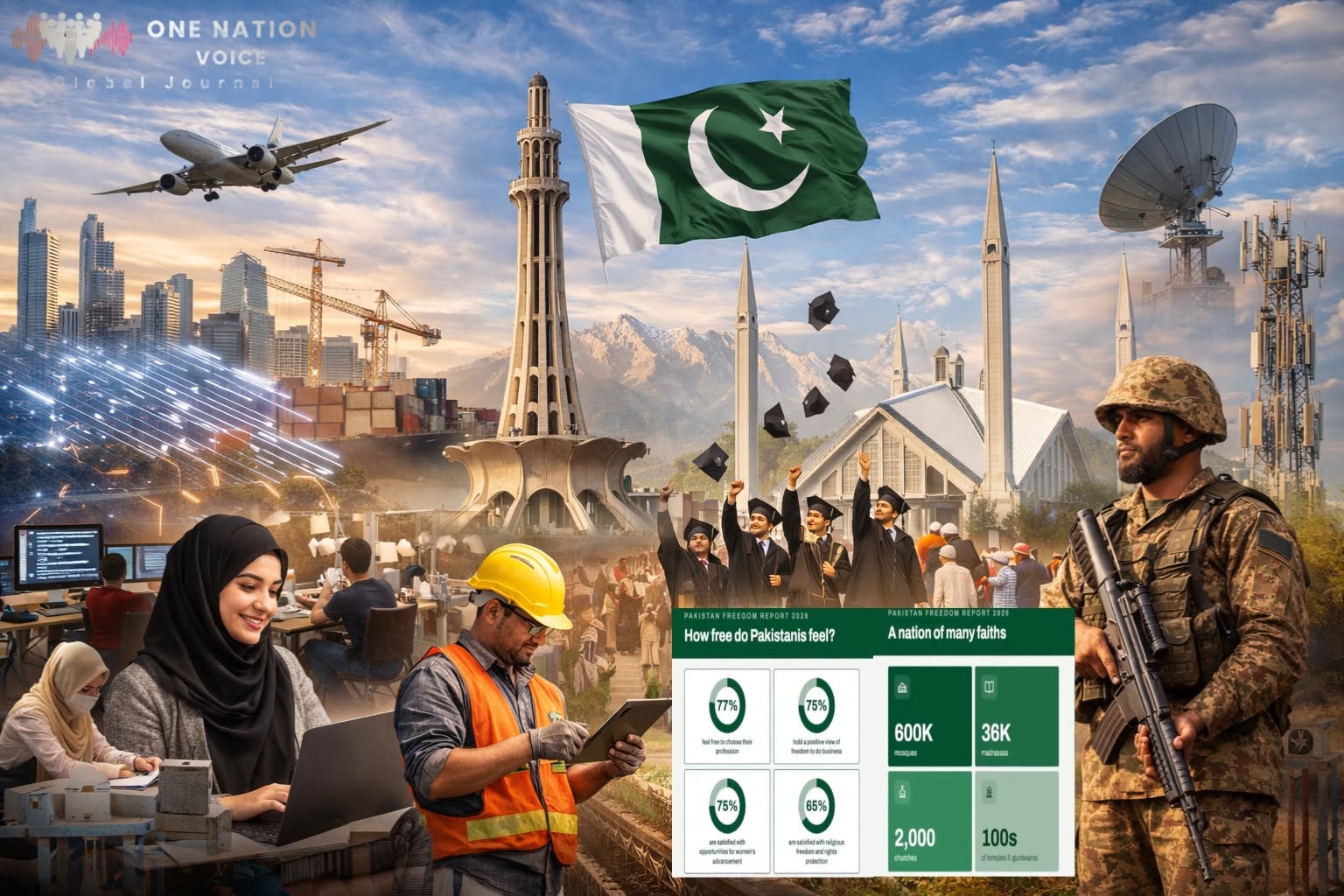
Pakistan has long been described through the lens of its challenges. But a landmark document released this month is quietly rewriting that narrative with something more powerful than opinion: data. The State of Freedom Report 2026, published by Mishal Pakistan in partnership with the World Economic Forum and launched at the Institute of Strategic Studies in Islamabad, is the country’s first ever comprehensive assessment of political, economic, social, legal, and digital freedoms. It does not paint a picture of a perfect nation. But it does reveal a Pakistan that is more dynamic, more connected, and more aspirational than the headlines often suggest.
The report, based on a nationwide survey of 2,000 respondents including 67 percent graduates and 32 percent postgraduates, measures what citizens actually feel and experience. And what they feel is telling.
A Nation That Believes in Personal Choice
The highest rated freedom indicator in the entire survey is the ability to choose one’s profession and career path.
Seventy seven percent of respondents believe Pakistanis are free to make that choice. This is not a trivial finding. In societies where economic anxiety runs deep, the perception of occupational freedom is foundational to public morale, social mobility, and the sense of individual agency. When three out of four citizens feel they can pursue a livelihood on their own terms, it signals a society that has not surrendered to fatalism.
Equally significant, 75 percent of respondents believe businesses can operate without undue government interference. This perception of a relatively open business environment is particularly meaningful at a time when Pakistan is working to restructure its economy. Entrepreneurship and small enterprise are not just economic strategies; they are expressions of freedom itself. And on this count, the data is encouraging.
Women, Opportunity, and the Unfinished Agenda
The report also reveals that 75 percent of respondents view women’s opportunities positively, citing access to education, employment, and participation in public life. This figure deserves both celebration and honest scrutiny. The trajectory is positive. Women are entering universities, contributing to the digital economy, and participating in civic life in growing numbers. Yet the same report notes that women are 20 percent less likely than men to own a mobile phone, a digital divide with real world consequences for income, safety, and empowerment.
This gap is not merely a statistic. It is an invitation for policy. Closing the mobile ownership gap, expanding digital literacy programs for women, and removing structural barriers to female workforce participation are not aspirational goals but economic imperatives. Pakistan cannot unlock its demographic potential while leaving half its population at the margins.
The Digital Nation: Infrastructure Meets Opportunity
Perhaps the most compelling chapter of the State of Freedom Report is its portrait of Pakistan’s digital transformation. With over 190 million cellular subscriptions, up to 150 million broadband users, and 70 million active social media users, Pakistan is not merely connected; it is digitally engaged at scale. A fiber optic backbone exceeding 230,000 kilometers and international internet capacity reaching 17.21 terabits per second form the backbone of this transformation. In March 2026, Pakistan completed its first 5G spectrum auction, generating over $509 million in revenue and laying the foundation for a modern digital infrastructure that will enable smart cities, telemedicine, precision agriculture, and advanced manufacturing.
This infrastructure is already producing economic dividends. Pakistan is now one of the world’s leading freelance economies, with IT and freelance exports exceeding $3 billion annually. Recent data from the Economic Survey 2026 puts total ICT export remittances at $3.38 billion for just the first nine months of fiscal year 2026, a nearly 20 percent increase year on year. Pakistani freelancers, numbering an estimated 2.37 million according to the Asian Development Bank, rank among the top three or four on global freelancing marketplaces. This is not an accident. It is the harvest of a young, educated, and digitally literate population that has found ways to connect to global markets even when domestic markets fall short.
The Youth Dividend: Asset or Risk?
The State of Freedom Report highlights a demographic reality that is both Pakistan’s greatest opportunity and its most pressing challenge.
Pakistan’s population has surpassed 245 million, with 64 percent of citizens under the age of 30. This youth bulge is not a problem to be managed. It is, as one analysis puts it, the nation’s top renewable energy source.
History offers two trajectories for nations facing similar demographic waves. East Asia channeled its youth into export led growth, education investment, and industrial transformation and reaped a generational dividend. Pakistan stands at a critical moment where investment in youth skills and job creation can unlock immense national potential.
The good news is that the data supports cautious optimism. The country’s more than 240 recognized universities and degree awarding institutions reflect a serious commitment to building human capital. SMEs account for approximately 90 percent of all businesses and employ nearly 80 percent of the non agricultural workforce, representing a vast and largely informal engine of economic inclusion. Government programs such as DigiSkills and initiatives in Punjab’s urban centers are already demonstrating that targeted digital training can connect youth from non elite backgrounds to global gig platforms.
The path forward requires matching this ambition with sustained investment in foundational education quality, reliable energy, and business friendly regulation. The government’s Uraan Pakistan plan targets $10 billion in IT exports by fiscal year 2029. Achieving that goal demands policy consistency, not just aspiration.
Democracy at Scale
The report also contextualizes Pakistan’s democratic experience in raw numbers that command respect. The 2024 General Elections facilitated participation for 128.5 million registered voters through more than 92,000 polling stations nationwide. Whatever the debates about process, the scale of electoral administration in a country of Pakistan’s size and complexity is itself a civic achievement.
What the Data Demands of Us
A freedom report is not a verdict; it is a mirror. What Pakistan’s first State of Freedom Report reflects is a society with genuine strengths that are often underappreciated: a population that believes in personal and economic autonomy, a digital infrastructure that supports national development, a freelance economy that is outpacing expectations, and a youth population that is hungry, connected, and capable.
But the mirror also shows gaps. The digital gender divide persists. Governance perceptions remain uneven. The challenge of translating infrastructure into broad based prosperity is unfinished.
The significance of this report lies not in any single statistic but in what it represents: a data driven, evidence based conversation about freedom in Pakistan, conducted by Pakistanis, for Pakistan. That conversation, more than any ranking or index imposed from the outside, is itself an act of freedom.
Pakistan’s story is being written in real time by millions of young people, entrepreneurs, women entering the workforce, freelancers earning in dollars, and voters participating in democracy at scale. The State of Freedom Report 2026 does not close that story. It opens it.
Based on the State of Freedom Report 2026 by Mishal Pakistan, the Pakistan Economic Survey 2026, and recent data from the State Bank of Pakistan, the Asian Development Bank, and the Pakistan Telecommunication Authority.
Disclaimer:
The views and opinions expressed in this article are exclusively those of the author and do not reflect the official stance, policies, or perspectives of the Platform.

