








Safeguarding Pakistan’s Hydrological Sovereignty
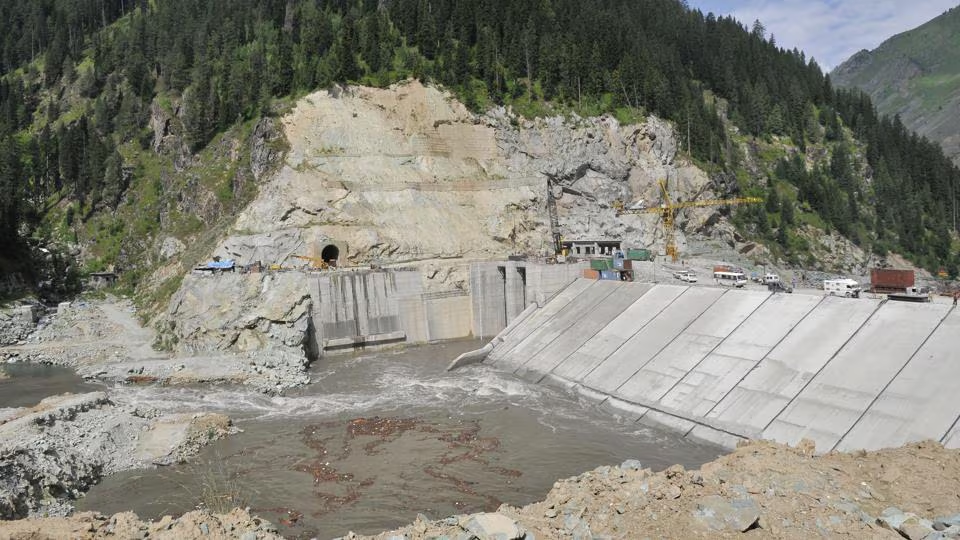
The Indus Waters Treaty is not merely a water-sharing arrangement between Pakistan and India; it is one of the central pillars of Pakistan’s national security architecture. For Pakistan, the Indus Basin is not an abstract geographic feature or a technical hydrological system. It is the foundation upon which the country’s agriculture, food security, energy production, rural economy, and social stability rest. Every canal that irrigates the plains of Punjab and Sindh, every crop cycle that sustains millions of households, every reservoir that regulates seasonal scarcity, and every megawatt generated from river flows reinforces a hard strategic reality: Pakistan’s survival flows through the Indus system. Any erosion of the treaty’s protections would therefore not be a routine diplomatic setback. It would strike at the heart of Pakistan’s hydrological sovereignty.
The importance of the Indus Waters Treaty lies in the fact that it converts geography into law. Geography alone places Pakistan downstream and India upstream on critical river systems. Without enforceable legal guarantees, this geography would create a structural imbalance, giving the upstream state excessive leverage over the timing, storage, and regulation of flows. The treaty provides Pakistan with a legal shield against unchecked upstream dominance. It does not represent a diplomatic favour to Pakistan; it represents an internationally recognised obligation that restrains unilateral control over lifeline rivers.
In that sense, the treaty transforms water from a potential instrument of coercion into a governed resource subject to rules, oversight, and dispute-resolution mechanisms
Those who underestimate the treaty fail to understand the nature of modern water power. Water warfare in the contemporary era is not always conducted through dramatic acts of complete river diversion. It is far more subtle and, in many ways, more dangerous. Strategic pressure can be exercised through flow manipulation, reservoir filling, delayed releases, uncertainty during sowing seasons, sudden discharges during floods, and cumulative upstream infrastructure development. Even the perception that water flows can be politically pressured creates insecurity for a downstream agrarian economy. For Pakistan, where agriculture remains deeply tied to river irrigation and where water stress is already intensifying, such uncertainty is itself a strategic threat.
Pakistan’s dependence on the Indus Basin is comprehensive. Its irrigation network is among the largest in the world, and its agricultural productivity relies heavily on predictable river flows. Wheat, rice, cotton, sugarcane, and other major crops are not only economic commodities; they are linked to food availability, rural employment, industrial supply chains, exports, and political stability. A disruption in water availability would not remain confined to farms. It would travel through markets, households, factories, power stations, and public finances. Water insecurity can quickly become food insecurity, energy insecurity, economic instability, and social unrest. This is why the treaty must be viewed not as a narrow technical document but as a national survival instrument.
The energy dimension is equally critical. Pakistan’s hydropower potential and existing generation capacity are tied to the regularity and management of river flows. In an economy already burdened by energy shortages, rising costs, and import dependence, any external uncertainty over water flows would deepen structural vulnerability. Reservoir operations, hydropower planning, sediment management, and seasonal generation depend on predictability. If upstream control is allowed to expand without treaty discipline, Pakistan’s energy security could become exposed to strategic pressure.
No sovereign state can afford to place such a vital sector at the mercy of unilateral decision-making by an upper riparian state
The treaty also matters because climate change is altering the entire security context of South Asia. Melting glaciers, erratic monsoons, extreme floods, prolonged droughts, and rising temperatures are already increasing pressure on water systems. In such an environment, transboundary water agreements become more important, not less. Climate disruption does not justify weakening legal frameworks; it makes them indispensable. When water becomes scarcer and weather patterns become more unpredictable, the need for transparency, data sharing, dispute resolution, and enforceable obligations becomes even more urgent. Weakening the Indus Waters Treaty in the age of climate stress would be strategically reckless.
Pakistan must therefore treat the preservation of the treaty as a non-negotiable national priority. This does not mean rejecting dialogue, technical engagement, or dispute-resolution procedures. On the contrary, Pakistan should use every legal, diplomatic, and technical mechanism available under the treaty and international law to ensure compliance. It must invest in hydrological expertise, satellite monitoring, legal preparedness, water diplomacy, and stronger domestic water governance. External legal safeguards must be matched by internal efficiency. Pakistan cannot demand treaty protection abroad while neglecting water conservation, canal losses, groundwater depletion, and poor agricultural water use at home.
Hydrological sovereignty requires both external defence and internal reform
At the same time, no domestic weakness should be used to diminish the treaty’s strategic value. Improving Pakistan’s water management is necessary, but it cannot replace the need for binding protections against upstream leverage. The argument that Pakistan should simply adapt without insisting on treaty enforcement ignores the geopolitical reality of river systems. Adaptation and enforcement must move together. Pakistan must modernise its water economy, but it must also defend the legal framework that prevents its rivers from becoming tools of political pressure.
The Indus Waters Treaty has endured wars, crises, diplomatic breakdowns, and decades of hostility because both its logic and necessity are undeniable. Its survival has contributed not only to Pakistan’s security but also to regional stability. Undermining it would create a dangerous precedent in a region where nuclear deterrence, territorial disputes, climate stress, and nationalist politics already produce volatility. A weakened treaty would not create flexibility; it would create permanent hydrological vulnerability. It would invite mistrust, escalation, and strategic instability.
For Pakistan, the treaty is therefore not optional. It is not a relic of the past, nor is it a symbolic diplomatic instrument. It is a living security framework that protects the country’s most essential natural artery. The Indus Basin is the bloodstream of Pakistan’s economy and society, and the Indus Waters Treaty is the legal barrier that protects that bloodstream from coercive control. No sovereign state negotiates away the foundations of its own survival. Pakistan must defend the treaty with clarity, resolve, and strategic patience because in the emerging century, control over water will increasingly translate into control over economic and political stability. Safeguarding the Indus Waters Treaty is, ultimately, safeguarding Pakistan itself.

