




India’s Ethnonationalism and Its Diplomatic Fallout
In the aftermath of the May 2025 military exchange which rocked the sub-continent, the geopolitical balance in South Asia is shifting. India, considered one of the world’s pre-eminent rising powers, has suffered considerable damage to its reputation following the impotence of its military forces being laid bare for the world to see. Perhaps even more impactful than the military defeat has been the diplomatic setbacks the country has suffered in the direct aftermath of the ceasefire. Having become the latest target of the Trump Administration’s tariff campaign, Indian policymakers have found that their relationship with the West is more fragile than previously anticipated. Moreover, while Indian diplomacy fails globally, it has fared no better in the South Asian region.
In this article, it is contextualizing the decline of India’s global reputation through the lens of the divisive policies of the BJP government and its hegemonic ambitions. In doing so, it is to understand why India’s relationships with its immediate neighbours have soured in such rapid fashion. Furthermore, through a case study of the Indian government’s recent move to evict Bengali-speaking Muslims living in its borders, it is analyzed that how the BJP’s policies incite ethnic and religious tensions. Finally, it determines the impact of these policies on its diplomatic relationships in the region.
Evictions in Assam
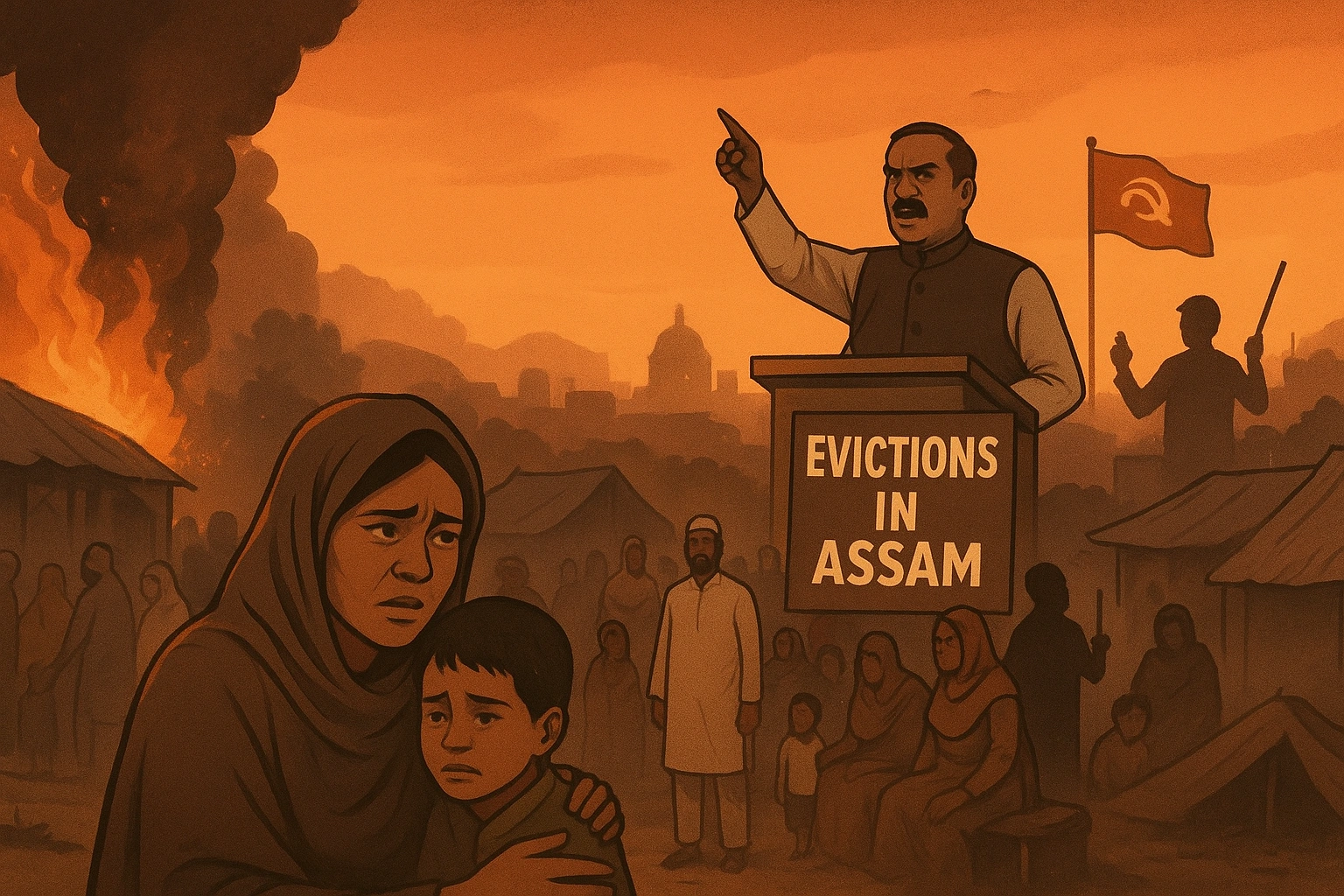
In June 2025, Bengali-speaking Muslims living in Assam have come under increasing pressure to vacate their homes as part of the state government’s eviction campaign. Since 2016, over 55,000 Bengali Muslim families have been evicted from their homes in Assam and have been homeless, forced to make do in makeshift shelters. This campaign, which saw renewed efforts in recent months, has seen over 5,300 families evicted since June 16th.
Considering the evictions have only targeted Bengali-speaking Muslims while non-Muslims are immune, the evicted residents have understandably accused the government of discrimination and selective targeting.

This campaign is deeply entwined with the political narrative propagated by the state authorities and the BJP government. Indian Muslims have, over the past decade, found themselves in an increasingly hostile environment which is exacerbated by propaganda.
One that is propagated by Assam’s Chief Minister Himanta Biswa Sarma, who has justified the abuse of Bengali-speaking Muslims by labeling them “illegal immigrants” and “suspected Bangladeshis”.
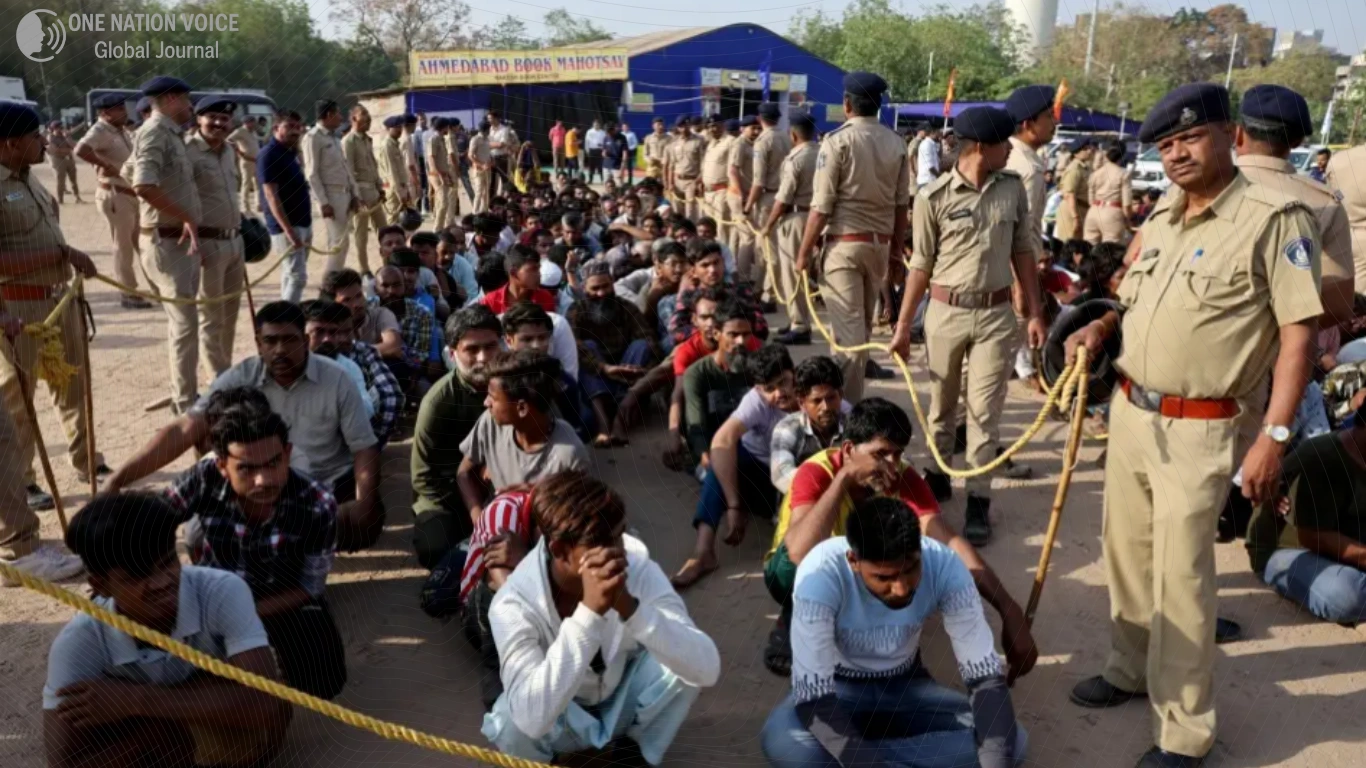
While the rhetoric and legal justification for these acts have been issued by the Indian state, it often prefers to let others carry out the dirty work. By empowering ethnonationalist organizations and granting them the authority to act against Muslim communities, the BJP government has implicitly endorsed the use of mob violence, hate speech, and harassment on ethnic and religious lines. While opposition leaders and minority rights groups have argued against the evictions and criticized the state government’s failures to protect the basic human rights granted by the Indian constitution, they have been unable to punish the regime’s clear disinterest in maintaining law and order as seen through its willingness to allow vigilantism by nationalist groups.
This crisis indicates that the historic tensions in Assam are related to fears of cultural erosion and demographic change among the Bengali-speaking population. Policies such as the National Register of Citizens (NRC) have created an environment of insecurity among Muslims in the state. The recent ethnic tensions brought to the forefront by the eviction drive highlight a tense situation which has led to widespread displacement. In addition to this, human rights abuses against the Bengali-speaking Muslim population of Assam are a case in point.
Impact on Indian Foreign Relations
The eviction campaign in Assam is not an isolated occurrence. In fact, for Indian Muslims, such treatment has increasingly become the norm rather than the exception. This campaign is a manifestation of the BJP government’s decades-long efforts to incite ethnic and religious tensions in India. The Hindutva project, a product of RSS ideology, is fundamentally linked with ethno-nationalism and poses an existential threat to the non-Hindu population of India. This project is supported top to bottom from grassroots movements across the provinces to the highest offices of the Indian government. Should the tensions continue to escalate and the rule of law is disregarded, the evictions in Assam may serve as a prelude to another outbreak of violence akin to the 2002 Gujarat Massacres overseen by Narendra Modi himself.
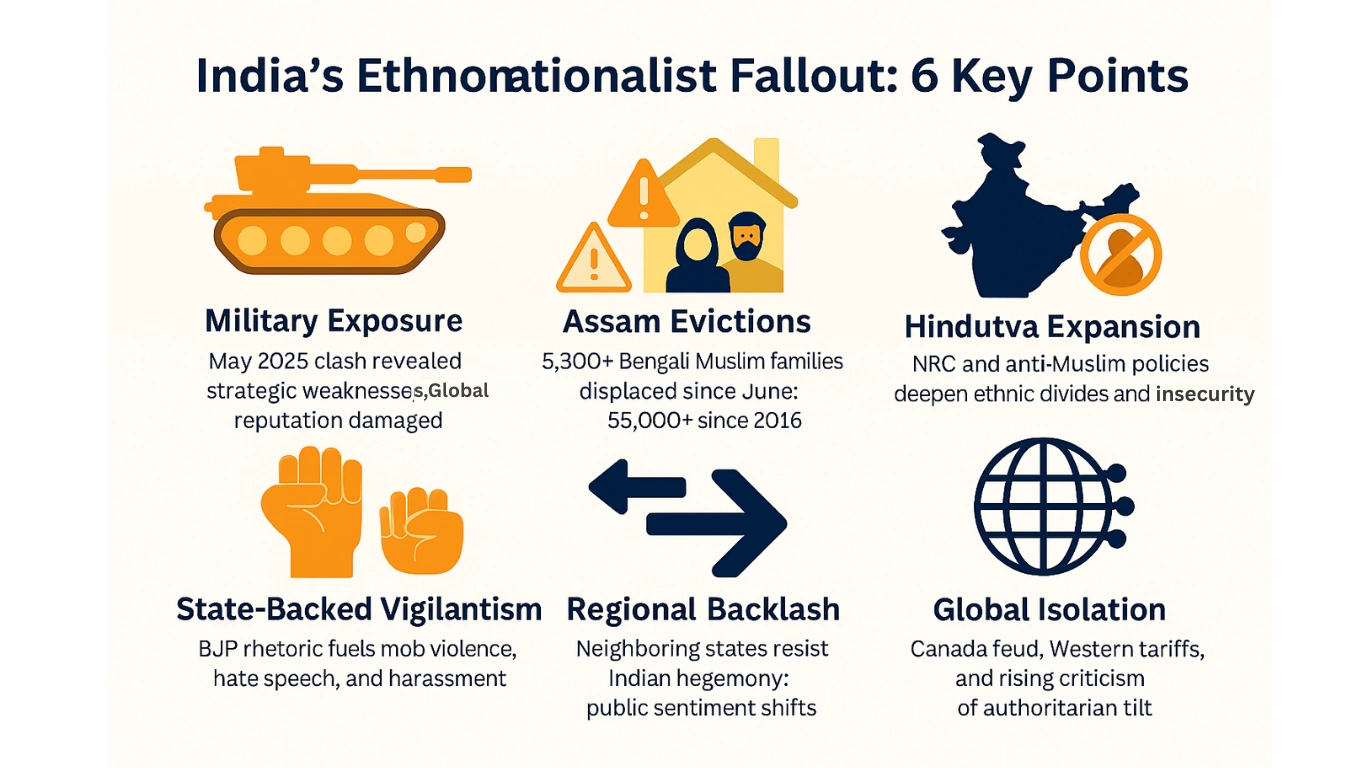
Within this context, it is hardly surprising that India’s reputation across the globe has continued to suffer under BJP rule. Does the Indian government think the world is blind to the country’s clear tilt toward ethnonationalist authoritarianism? Does it believe itself above criticism or accountability? Such is the fervor with which the Indian regime pursues its Hindutva ambitions that it has not been able to limit its actions to its own borders. The 2023 political assassination of Sikh leader Hardeep Singh Nijjar, which was carried out in Canada and resulted in a prolonged feud between the Indian and Canadian governments, shows how ethnonationalist policy damages diplomacy.
One of the key transformations which has occurred as a direct result has been India’s relationship with Bangladesh. As India has continued to pursue its ambitions of regional hegemony in South Asia, it had assumed that states like Sri Lanka and Bangladesh would naturally find themselves in a subordinate role to India. As a result, it may have come as a shock when Bangladesh’s government sought to adopt a neutral stance while the general public was vocal in its support for Pakistan. In this sense, one could argue that the eviction efforts in Assam, which saw renewed effort in June, immediately following the conflict, may be seen as an attempt by the Indian government to punish ethnic Bengalis for the country’s stance.
The evictions in Assam are just the latest example of the discriminatory policies of an ethnonationalist state which are carried out through the unrepentant use of hate speech and mob violence. While the BJP regime has sought to galvanize support and unite the country behind the Hindutva project, Indian foreign relations, both internationally and regionally, have suffered as a direct result. In the future, increased cooperation between Pakistan and Bangladesh will be required to serve as a counterweight to Indian ambitions of regional hegemony and the establishment of Hindu supremacy in South Asia.
Disclaimer:
The views and opinions expressed in this article are exclusively those of the author and do not reflect the official stance, policies, or perspectives of the Platform.

