

Lindsey Graham’s Pressure Politics and Pakistan’s Principled Position
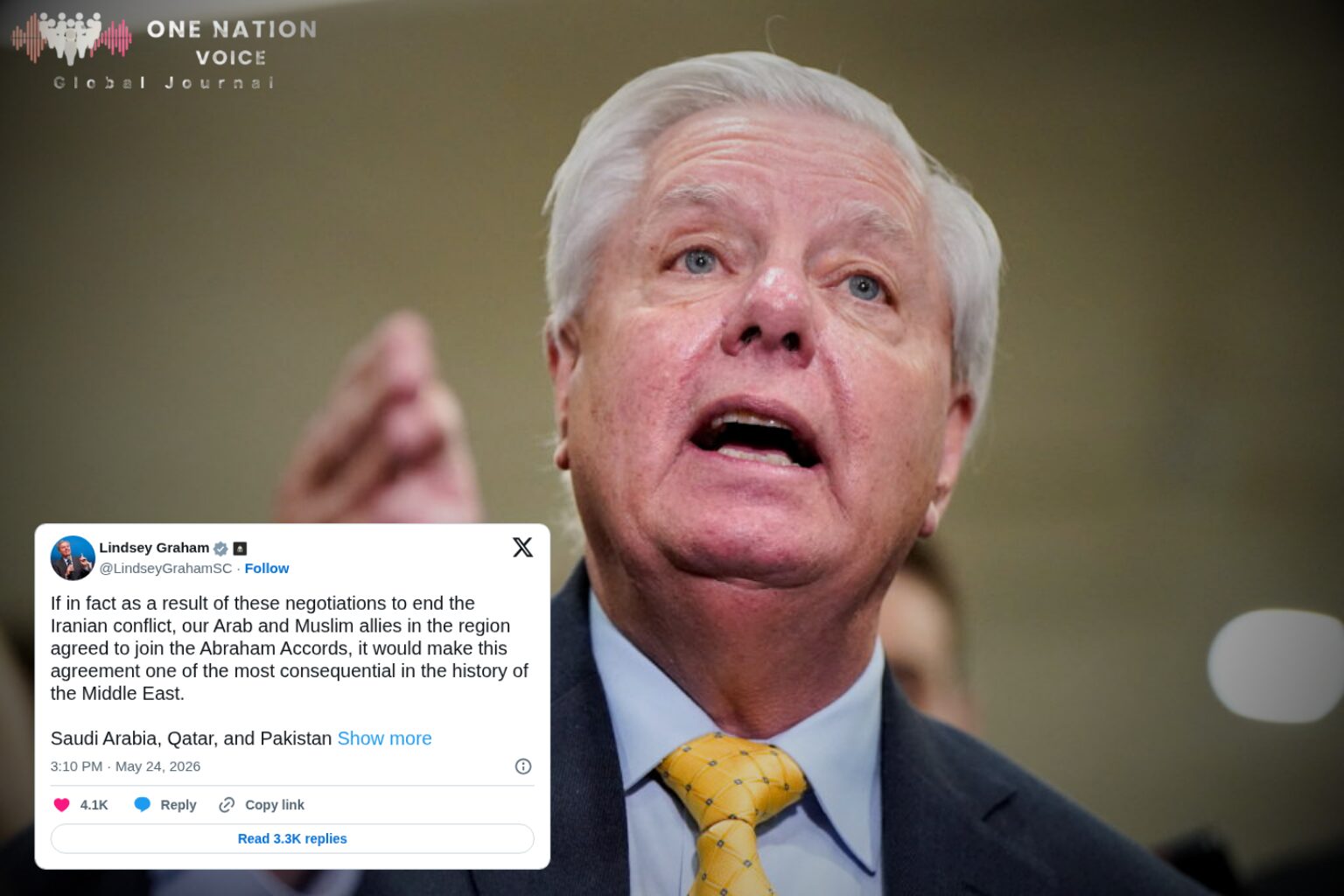
When US Senator Lindsey Graham took to social media on May 24, 2026, urging President Trump to stick to his guns in demanding that Saudi Arabia, Qatar, and Pakistan join the Abraham Accords as part of any Iran de escalation deal, he was not offering regional statesmanship. He was issuing a political ultimatum dressed as diplomacy, and Pakistan has already made its answer clear.
Graham’s statement described the potential inclusion of Pakistan in the Abraham Accords as beyond transformative for the region and world, calling it a brilliant move by President Trump. He went further, warning that if countries refuse to follow Washington’s suggested path, it will have severe repercussions for future relationships. This is not the language of partnership. It is the language of coercion, of a political ecosystem in Washington where support for one country’s foreign policy preferences is treated as a litmus test for all bilateral ties.
What makes Graham’s framing particularly problematic is its deliberate conflation of two entirely separate diplomatic tracks. The Iran nuclear negotiations, aimed at de escalating tensions in a volatile region, are being leveraged as a vehicle to extract Abraham Accords commitments from Muslim majority states that have never expressed interest in joining them. This is not peace architecture, it is political conditioning. It transforms genuine conflict resolution into a transactional bargaining chip, and in doing so risks undermining the very peace it claims to promote.
Pakistan’s response has been firm, consistent, and grounded in principle. In January 2026, Pakistan’s Foreign Office spokesperson Tahir Andrabi categorically stated that
Pakistan will not become a party to the Abraham Accords, adding that the country’s position on Palestine and Israel remains consistent.
This was not a reaction to Graham’s posturing, it was a reiteration of a position that Islamabad has maintained since the founding of the republic itself. Pakistan does not recognize Israel, and its passports explicitly state they are valid for all countries except Israel. No external pressure campaign has altered this calculus, and none is likely to.
The deeper context here is equally important. Graham’s remarks came at a moment when Pakistan was already dealing with mischaracterization of its involvement in the Gaza Board of Peace, a multilateral humanitarian initiative co chaired by Prime Minister Shehbaz Sharif alongside leaders from Saudi Arabia, Turkey, Egypt, Jordan, the UAE, Indonesia, and Qatar. Some external commentators had suggested this participation was a stepping stone to Abraham Accords style normalization. Pakistan’s Foreign Office swiftly and firmly rejected that framing, clarifying that the Board of Peace is strictly a humanitarian and diplomatic platform with no connection whatsoever to normalization politics or recognition of Israel.
Pakistan’s position on Palestine is not merely a policy preference. It is rooted in a foundational moral commitment articulated by Quaid e Azam Muhammad Ali Jinnah, who recognized the Palestinian cause as inseparable from the dignity and rights of Muslim peoples and all peoples living under occupation. Pakistan has repeatedly stated at the highest levels of government that it supports an independent, sovereign Palestinian state based on pre 1967 borders, with Al Quds Sharif as its capital, and that it will accept only a solution acceptable to the Palestinian people themselves. This is not diplomatic boilerplate, it is a bedrock of Pakistani foreign policy that successive governments have honored across different political alignments.
Research published in 2025 reinforces the political reality Graham appears to overlook. Public opinion in Pakistan remains strongly and consistently opposed to normalization with Israel in the absence of Palestinian sovereignty. Parliamentary resolutions and sustained public engagement on the issue make any deviation politically untenable, not merely for one government, but for any conceivable Pakistani leadership. Even among countries that signed the original Abraham Accords, polling shows majorities in those populations opposed normalization. The suggestion that Pakistan, with its far deeper and more publicly expressed commitment to Palestinian rights, could be pressured into following suit is not just unrealistic, it reflects a fundamental misreading of Pakistani society and politics.
What Graham’s statement also reveals is the transactional worldview that has long shaped certain corridors of US foreign policy. In this worldview, peace is not a universal good to be pursued on its own merits, it is a commodity to be packaged with political conditions that serve particular stakeholders’ strategic interests. The Abraham Accords were presented in 2020 as a breakthrough for Middle Eastern peace. Yet critics have long pointed out that they bypassed the Palestinian issue entirely, allowing normalization to proceed without any progress on statehood, settlements, or the fundamental rights of the Palestinian people. Linking the resolution of the Iran conflict to the same framework risks repeating that error at a far larger scale.
Pakistan’s foreign policy is shaped by sovereign national interests, historical commitments, and principled diplomacy, not by external pressure campaigns or rhetorical threats issued through social media. When Senator Graham warns of severe repercussions, he is speaking to a country that has navigated decades of far more consequential geopolitical pressures without abandoning its foundational positions. Pakistan’s consistent advocacy for Palestinian rights in international forums, including leading UN Human Rights Council resolutions calling for an end to weapons transfers to Israel, is a testament to a foreign policy that operates on ethical ground, not political convenience.
Sustainable regional stability will not be built through coercive diplomatic conditioning.
It requires dialogue grounded in mutual respect, adherence to international law, and above all, genuine justice for the Palestinian people. Any peace framework that sidelines those imperatives, however elegantly packaged and however loudly promoted, is building on sand. Pakistan understands this. And it will not be pressured into forgetting it.
Disclaimer:
The views and opinions expressed in this article are exclusively those of the author and do not reflect the official stance, policies, or perspectives of the Platform.

