








Pakistan’s Digital Transformation through CPEC 2.0
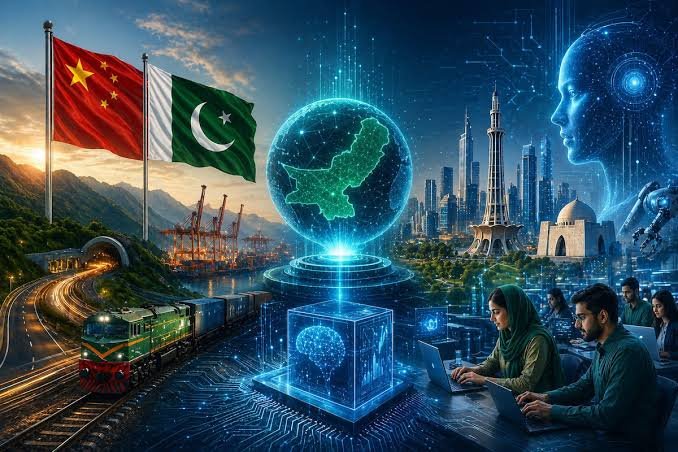
Pakistan stands at the threshold of a new development era in which national progress will increasingly be determined not merely by roads, ports and power plants, but by data, innovation, skills, clean energy and digital connectivity. The evolution of the China-Pakistan Economic Corridor into CPEC 2.0 reflects this changing reality. While the first phase concentrated largely on addressing infrastructure and energy deficits, the second phase aims to build an innovation-led, export-oriented, and environmentally sustainable economy. It is therefore more than an extension of earlier projects; it is a potential roadmap for modernising Pakistan’s industries, empowering its young population and integrating the country more effectively into the global digital economy.
CPEC 2.0 closely complements Pakistan’s 5Es Framework of Exports, E-Pakistan, Energy, Environment and Equity. It also corresponds with China’s emphasis on high-quality Belt and Road cooperation, in which technology, sustainability, industrial development and shared prosperity receive greater attention. This alignment provides Pakistan with an opportunity to move beyond short-term infrastructure gains and establish the institutional, technological, and human foundations required for lasting economic competitiveness.
The success of this transition, however, will depend on whether Pakistan can convert strategic plans into transparent, commercially viable and inclusive programmes
The five proposed corridors of CPEC 2.0, the Growth Corridor, Livelihood Corridor, Innovation Corridor, Green Corridor and Openness Corridor, reflect a broader vision of development. Together, they aim to connect industrial modernisation with employment, technological capability, environmental responsibility and international trade. The Innovation Corridor is particularly significant because Pakistan’s future competitiveness will depend heavily on its capacity to adopt, adapt and eventually produce advanced technologies.
Expanded fibre-optic networks, reliable broadband services, data centres, cloud infrastructure and secure digital platforms can transform the way Pakistan conducts business and delivers public services. Greater cooperation in artificial intelligence, financial technology, 5G communications, cybersecurity and advanced manufacturing could enable Pakistani enterprises to reduce costs, improve productivity and enter higher-value markets.
Technology parks, research laboratories, university-industry partnerships and startup incubation centres can also help bridge the longstanding gap between academic knowledge and commercial innovation
Pakistan already possesses a large community of software developers, freelancers and technology entrepreneurs. Yet many of them remain constrained by inconsistent internet connectivity, limited financing, regulatory uncertainty and weak links with international markets. CPEC 2.0 can help address these barriers by supporting digital trade platforms, cross-border e-commerce systems and investment partnerships. Such initiatives would strengthen the E-Pakistan vision by enabling small and medium-sized enterprises to reach customers beyond domestic markets, process transactions more efficiently and participate in regional and global value chains.
The digital transformation envisioned under CPEC 2.0 must be supported by dependable and affordable energy. In this regard, the Green Corridor can play a critical role in improving Pakistan’s energy security while advancing its climate objectives. Investments in solar and wind power, hydropower, battery storage, smart grids and electric mobility can reduce dependence on imported fossil fuels and create a more resilient energy system. Renewable energy development can also generate employment, attract private investment and support industrial growth in regions that have historically remained outside major economic centres.
Technology can amplify the benefits of green energy. Smart meters, predictive maintenance, real-time monitoring and automated grid management can minimise transmission losses, improve reliability and allow energy providers to respond more effectively to fluctuations in demand. For digital businesses, manufacturing facilities and technology parks, stable electricity is not a secondary requirement; it is a basic condition for productivity.
The convergence of digital innovation and renewable energy could therefore become one of the most consequential features of CPEC 2.0
The Livelihood and Growth Corridors place human development at the centre of this transformation. Pakistan has one of the world’s youngest populations, with more than 60 per cent of its citizens under the age of 30. This demographic profile can become a major economic advantage, but only if young people receive relevant education, technical training and employment opportunities. Programmes in coding, robotics, cybersecurity, renewable-energy technology, industrial automation and digital entrepreneurship can prepare Pakistan’s workforce for the Fourth Industrial Revolution.
Agriculture must also be included in Pakistan’s digital transition. Climate-smart farming, precision agriculture, improved seeds, mechanisation and digital advisory services can help farmers increase productivity while using water, fertiliser and energy more efficiently. Mobile platforms can connect rural communities with weather forecasts, financial services, agricultural experts and national markets. Agro-processing facilities and modern supply chains can reduce post-harvest losses and enable Pakistan to export value-added food products rather than relying primarily on raw commodities.
Pakistan’s geographic position adds another strategic dimension to CPEC 2.0. Situated between South Asia, Central Asia, China and the Middle East, the country has the potential to become not only a physical trade corridor but also a regional digital-connectivity hub. Cross-border fibre links, data infrastructure and harmonised digital-trade mechanisms could support regional commerce, financial connectivity and technology collaboration.
This would strengthen Pakistan’s role in regional economic integration while opening new markets for domestic businesses
CPEC 2.0 nevertheless cannot succeed through projects alone. Pakistan must improve regulatory consistency, cybersecurity, data protection, intellectual-property enforcement and institutional coordination. Transparent procurement, competitive markets and meaningful private-sector participation will be essential. Digital development must also remain inclusive, ensuring that women, rural populations and underserved communities receive access to connectivity, finance, training and employment.
CPEC 2.0 represents the evolution of Pakistan-China cooperation from conventional infrastructure development toward a partnership centred on innovation, sustainability and human capital. Its greatest promise lies in connecting roads with digital networks, energy projects with smart technologies and industrial zones with research institutions. Pakistan’s digital dawn will not emerge automatically, but the foundations are being laid. With effective governance, strategic continuity and investment in people, CPEC 2.0 can help transform Pakistan into a more competitive, resilient and knowledge-based economy. The next chapter of national development will be written not only through ports and highways, but through data, clean energy, modern agriculture, entrepreneurship and digital opportunity.

